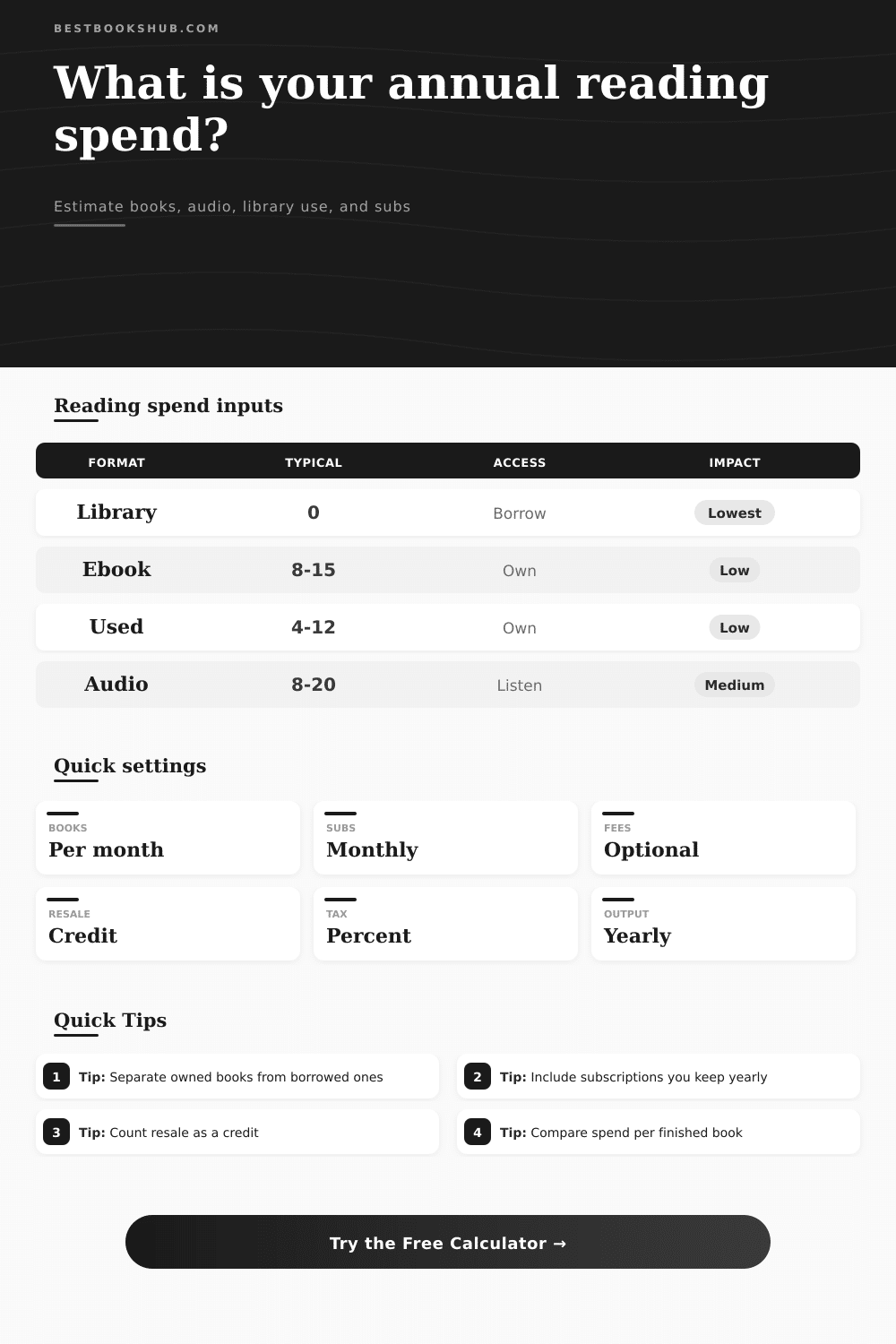
Annual Reading Spend Calculator
Estimate a full year of reading across print books, used books, ebooks, audiobooks, library borrowing, subscriptions, fees, taxes, and resale credits.
| Reader type | Books per month | Typical mix | Annual spend pattern |
|---|---|---|---|
| Library-first reader | 2 to 6 | Mostly borrowed, few owned | Low spend, sensitive to transit and small fees |
| Balanced personal reader | 3 to 8 | Print, ebooks, and some library | Moderate spend with clear monthly rhythm |
| Audiobook commuter | 2 to 5 | Audio credits plus ebooks | Subscription usage determines efficiency |
| Collector or gift buyer | 2 to 6 | New print and hardcover heavy | Higher spend, resale offsets can matter |
| Format | Best calculator input | What to include | Common mistake |
|---|---|---|---|
| New print | Quantity and average amount | Hardcovers, paperbacks, preorders, gifts | Leaving out tax and shipping |
| Used print | Quantity and average amount | Thrift finds, swaps with cash, used stores | Ignoring resale or trade-in credits |
| Ebooks | Monthly ebook count plus subscription | Direct purchases and paid reading apps | Counting subscription books as free |
| Audiobooks | Audio count plus monthly subscription | Credits, extra listens, membership fees | Not using unused credits in the result |
| Library | Borrowed count plus small monthly fees | Late fees, holds, parking, replacement cards | Comparing borrowed books to owned books directly |
| Scenario | Good target metric | Watch closely | Calculator signal |
|---|---|---|---|
| Trying to lower spend | Spend per finished book | Unused subscriptions | Monthly average rises faster than books finished |
| Reading more this year | Finished books and pages | Completion rate | Book count grows but finished count lags |
| Family reading plan | Per-reader annual spend | Shared reading benefit | Effective per-book value improves with sharing |
| Building a home library | Owned books added | Resale share | Gross spend stays high but net spend improves |
Those unopened books stacked up on your bedside table tell a story. They are about curiosity and intent. And it tells another one about your footprints… Financial ones that is too easily underestimated. Oh sure, the twenty bucks a month you believe you spend buying paperbacks. But then there’s the tax. There’s the shipping cost. There’s the subscription to audiobooks. There’s library fee. People are always surprised how much all of that adds up in a years time.
DISCLOSURE: This post may contain affiliate links, meaning when you click the links and make a purchase, I receive a commission. As an Amazon Associate I earn from qualifying purchases.
This calculator does that math for you. Take those random costs and put them in perspective. See true number clearly. Make it match your life.
See How Much You Spend on Books
There’s also this difference: Most readers decide their budgets based off what they purchase, not what they finish. Why does that matter? Because purchasing something create an ownership expense, whereas accessing it often doesn’t cost anything. Even if you read as much or more than someone else, your cash outflow will be dramatically lower if half your book come from the library.
By separating those two streams, the tool allow you to observe your actual spending… That is, the extra cost of adding to your own personal shelf, compared to merely getting stories into your eyeballs. And that’s where most people go off track. They take direct book purchases and assume that all books should be treated equally, regardless of whether borrowing incurs any extra cost. If you record both your direct book purchases AND your library usage, then net spend will represent how much real money has left your pocket.
Adding subscriptions complicates things even further, and this is where the math becomes important. A $12-per-month ebook or audio subscription sounds like a good deal, until you realize you’re actually spending twice as much per book because you’re using just one credit every two weeks. You can input both your subscription fees (separate from book prices) into the calculator, so it doesn’t accidently count unlimited library reads towards “free” books (when you’re actually still shelling out money for a streaming app you never use).
It will also show you whether your subscription is truly worthwhile, given its flat rate. If value metric indicates you’re spending a lot on each completed book, you may want to stop the recurring payment altogether and buy those titles à la carte instead.
One neglected offset in personal book budgeting is resale. New hardcover collectors will purchase at full price, including sales tax, then often hold onto them forever. If you adopt a ‘books are a revolving inventory’ mindset though, and resell gently-read versions, you’ll be able to get back a decent chunk of your original cost. You can use the tool to enter your trade-in credit percentage (which lowers your gross spend) and resale rate (ditto). Think of this as an investor mentality: focus less on the upfront purchase cost, more on the return you realize down the road. A small percentage of cash-back on sold books is just enough to drop the overall annual expense and allow you to buy better-quality editions.
Perhaps the most candid metric we have is completion rate. You can begin a lot of books each month, but if you’re not finishing them, then your effective reading volume isn’t as great than your purchasing history makes it seem. The calculator factors this into account by multiplying your total volume by your completion percentage. By doing this, it removes the illusion of productivity, one where you buy more than you read. Having a large number of unread novel is effectively wasting your cash. The combination of seeing both the amount spent and the amount finished provides a clearer sense of the efficiency of your reading habits. It may turn out that completing a smaller quantity of books is a better use of your funds then stockpiling half-finished novels.
On the page, it also breaks down the different types of readers in terms of how they like to read (minimalist vs. It also describes the different types of collectors and what they tend to spend money on. This shows that if you’re a minimalist reader (mostly using free apps and libraries), you’ll have far less to pay for annually than someone who’s a collector of first editions. It’s not right or wrong, it’s just reflective of where you are financially and in terms of your lifestyle. That way you can establish realistic expectations.
This isn’t meant as a way to limit the amount of books you enjoy! Rather, it’s meant as a reflection of what you do want, a budget-friendly approach to reading that lets every dollar go toward books you actually read (and thus finish). The numbers reflect your tastes. They’re a mirror to show where you’re overspending for convenience, or underspending because you could get those same books for “free” otherwise.
In the end, when the numbers are added up, you’ll see just how much you’re willing to pay to satisfy your curiosity. You would of also seen if your method can continue. This will make the next decision easier.