🏛️ AP Euro Test Score Calculator
Estimate your AP European History exam score from MCQ, SAQ, DBQ & LEQ results
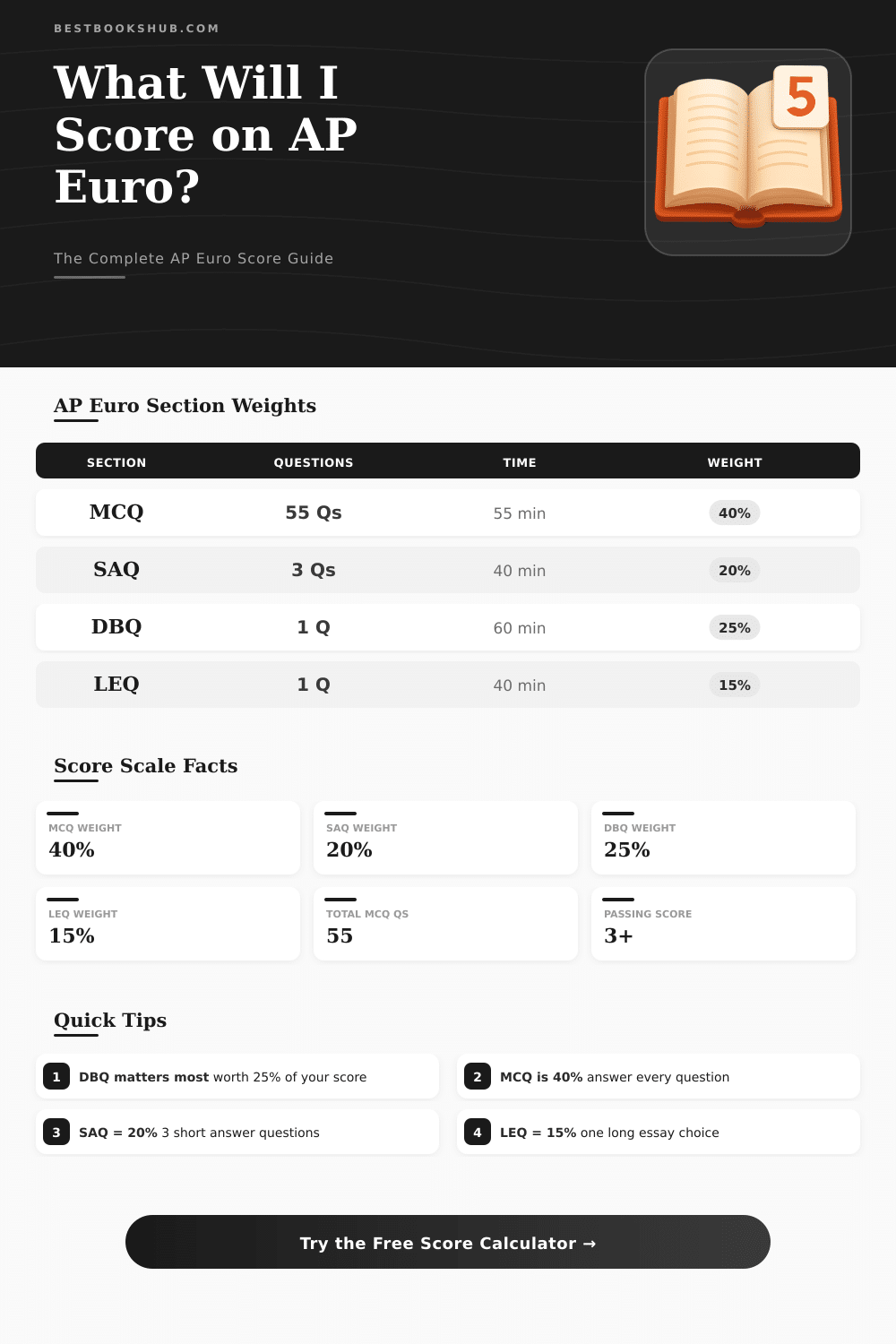
Multiple Choice Questions 40% of Score
Short Answer Questions (SAQ) 20% of Score
Document-Based Question (DBQ) 25% of Score
Long Essay Question (LEQ) 15% of Score
* This is an estimate based on typical College Board conversion curves. Actual scores may vary.
55 Questions
3 Questions
1 Essay
1 Essay
| Section | Questions | Time Allowed | Max Raw Points | Exam Weight |
|---|---|---|---|---|
| Multiple Choice (MCQ) | 55 questions | 55 minutes | 55 pts | 40% |
| Short Answer (SAQ 1) | 1 question | ~13 min each | 3 pts | ~6.7% |
| Short Answer (SAQ 2) | 1 question | ~13 min each | 3 pts | ~6.7% |
| Short Answer (SAQ 3) | 1 question | ~13 min each | 3 pts | ~6.7% |
| Document-Based (DBQ) | 1 essay | 60 minutes | 7 pts | 25% |
| Long Essay (LEQ) | 1 essay (choice) | 40 minutes | 6 pts | 15% |
| AP Score | Composite Range (Approx.) | Classification | Typical % of Students |
|---|---|---|---|
| 5 | 72 – 100 | Extremely Well Qualified | ~13% |
| 4 | 56 – 71 | Well Qualified | ~20% |
| 3 | 42 – 55 | Qualified | ~24% |
| 2 | 28 – 41 | Possibly Qualified | ~22% |
| 1 | 0 – 27 | No Recommendation | ~21% |
| DBQ Point | Category | Max Points | How to Earn |
|---|---|---|---|
| Thesis/Claim | Argumentation | 1 pt | Historically defensible claim with line of reasoning |
| Contextualization | Context | 1 pt | Describe broader context before/after/around topic |
| Evidence: Content | Document Use | 2 pts | Use 3 docs (1pt) or use 6 docs to support argument (2pt) |
| Evidence: Sourcing | Document Analysis | 1 pt | HAPP analysis on 3 documents |
| Analysis & Reasoning | Complexity | 2 pts | Demonstrate complex understanding (1 pt) + complexity (1 pt) |
| LEQ Point | Category | Max Points | How to Earn |
|---|---|---|---|
| Thesis/Claim | Argumentation | 1 pt | Historically defensible thesis with line of reasoning |
| Contextualization | Context | 1 pt | Describe broader historical context accurately |
| Evidence | Specific Evidence | 2 pts | Use relevant specific evidence; 2 pts to support argument |
| Analysis & Reasoning | HTS Application | 1 pt | Apply historical thinking skill (causation, comparison, etc.) |
| Complexity | Complex Understanding | 1 pt | Demonstrate nuanced argument across time/space |
DISCLOSURE: This post may contain affiliate links, meaning when you click the links and make a purchase, I receive a commission. As an Amazon Associate I earn from qualifying purchases.
The AP European History uses scores from 1 to 5 and here is the thing… Most universities give credit if you get 3 or more, although the rules differ between institutions. Even so, if a university is very picky, it likes to see 4 or 5.
Some schools unwillingly accept 3. Basically: 1 is very bad, 5 is stellar, and different parts of the exam have different weight for your final result.
AP European History Scores and How the Exam Works
The exam is made up of two main sections: multiple-choice and free-response. The multiple-choice questions cover 40% of your total score. The part with free answers does the remaining 60%, it includes short answers, DBQ and long essay.
Specifically, you encounter 55 multiple-choise questions with four options each, three short questions and two essays: one Long Essay Question and one Document-Based Question (DBQ).
A score calculator can help you get a clear picture about what you must win in every section. Those tools are very useful for test prep, especially when they base on prior exams released by the College Board; that is how they stay precise and reliable. Only remember, those calculators are only for info and do not guarantee a particular result.
Now we look at the actual numbers. According to the results of 2024, around 71.6% of the students managed to win 3 or more. Only about 13.7% of the test-takers received 5.
And here the surprise, almost half of the students that did the exam did not pass. The average score was around 2.95, which is a bit low regarding the passing line. Every year, the College Board issues the full list of how many 1s, 2s, 3s, 4s and 5s were won, together with the average score and the total number of test-takers.
The most difficult multiple-choice questions came from Unit 8 (Global Conflicts of the 20th Century) and Unit 9 (Cold War and Contemporary Europe). In those parts, only around 32% of the students managed to win almost all available points.
Even so, a score of 2 is not entirely bad. Study about students that received 2 in the AP European History showed that they commonly won better grades in university courses than students with the same high school GPA and same scores. That is an interesting fact.
For the Long Essay Question, it is helpful to choose the theme that you know best and organize your answer as an argument instead of only listing dates. If you use the rubric and improve your weak spots, that makes a big difference. You can find prior free-response questions directly at the College Board, and the Bluebook app lets you preview the digital AP exams and check your reports whenever youwant.