⚡ AP Physics Score Calculator
Estimate your AP Physics 1, 2, or C exam score from raw multiple-choice and FRQ points
📝 Exam Structure (auto-updates based on selection)
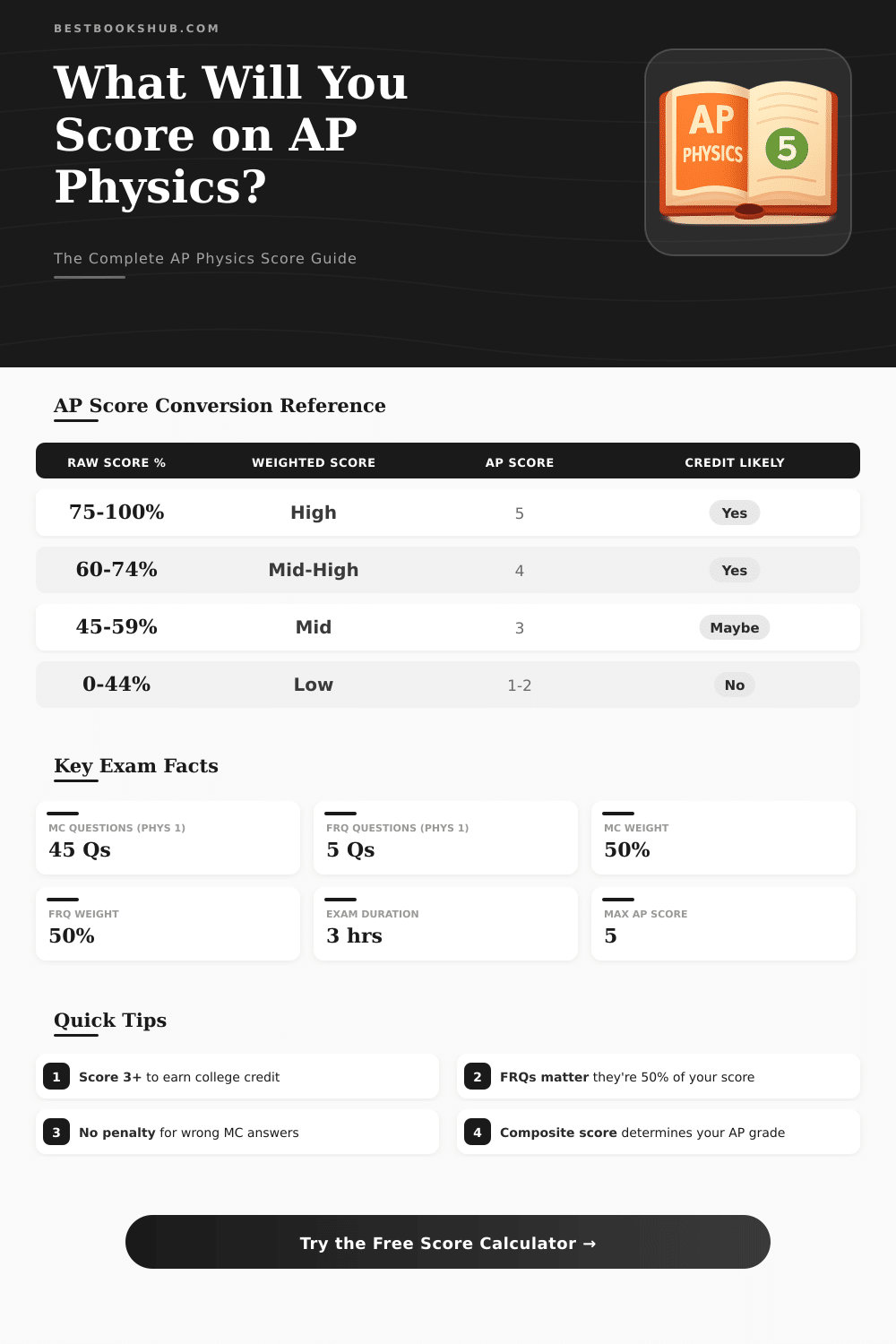
| Exam | MC Questions | FRQ Questions | FRQ Pts (approx) | Duration |
|---|---|---|---|---|
| AP Physics 1 | 45 | 5 | ~75 pts | 3 hrs 15 min |
| AP Physics 2 | 45 | 4 | ~75 pts | 3 hrs 15 min |
| AP Physics C: Mech | 35 | 3 | ~45 pts | 1 hr 30 min |
| AP Physics C: E&M | 35 | 3 | ~45 pts | 1 hr 30 min |
| AP Score | Meaning | Approx. Composite % | College Credit |
|---|---|---|---|
| 5 | Extremely Well Qualified | ~75–100% | Yes (most schools) |
| 4 | Well Qualified | ~60–74% | Yes (most schools) |
| 3 | Qualified | ~45–59% | Varies by school |
| 2 | Possibly Qualified | ~30–44% | Rarely |
| 1 | No Recommendation | 0–29% | No |
| Section | Your Raw Score | Multiplier | Weighted Points |
|---|---|---|---|
| Multiple Choice | MC Correct ÷ MC Total | × 50 | 0–50 pts |
| Free Response | FRQ Earned ÷ FRQ Total | × 50 | 0–50 pts |
| Composite Total | MC Weighted + FRQ Weighted | 0–100 pts | |
| AP Score | Phys 1 % Students | Phys 2 % Students | Phys C Mech % Students |
|---|---|---|---|
| 5 | ~7% | ~14% | ~33% |
| 4 | ~17% | ~21% | ~26% |
| 3 | ~23% | ~22% | ~20% |
| 2 | ~27% | ~22% | ~12% |
| 1 | ~26% | ~21% | ~9% |
Physics scores are really confusing things. Whether AP exam, school midterm or subject test… The numbers show an interesting picture.
DISCLOSURE: This post may contain affiliate links, meaning when you click the links and make a purchase, I receive a commission. As an Amazon Associate I earn from qualifying purchases.
Take AP Physics 1: you talk about it constantly, and if you see how the scores changed over the years, you understand why all say it is very hard
How Physics Test Scores Work
The official AP Physics 1 distribution shows the percentages of students who got 1s, 2s, 3s, 4s or 5s every year, together with the total number of test takers and mean scores. In 2024 the mean was 2.59. The year before?
2.55. In 2022 it dropped to 2.47, and 2.41 in 2021. So there was a little rise, but for years the average stayed under 3.
Here is the thing: the most common scores were not passing grades. In 2021 the 1 was the most common result. Since 2020 it shifted to 2.
AP Physics 1 does not give easy scores.
Then came 2025. The new format of AP Physics 1 entirely flipped the script. Suddenly 67.3% of the testtakers reached 3 or more, and the mean jumped to 3.12.
Specifically: 18% reached 5, around a quarter received 4, 23% had 3, and the other students split between 2s (around 14%) and 1s (20%). Questions about Kinematics from Unit 1 was the area where students did the best. Almost all units had equal results, although Unit 1 was a bit ahead, with Unit 7 (Torque and Rotational Motion) as second strongest.
Score calculators help students guess what they will get before the test day. This tool breaks down the results by section… Useful for prep to see where you stand.
College physics is an entirely different world. If you get 72 on a university physics exam and it curves to 79? That is normal.
Class averages decide everything. Get 50 when all have a mean of 40, and suddenly you do well. Some courses call 55% a passing score, put 70% as the B line and require 85% for A. In many college classes the median test score stays between 60 and 65, sometimes it falls to 58, which says a lot about how hard those exams can be.
The Physics SAT Subject Test has a mean of 664, a lot above the normal SAT average of around 500. More than 750 catches the attention of admissions offices at technical schools. The test has 70 multiple choice questions that check whether you really understand the basics.
The physics program of Oxford stresses the Physics Aptitude Test first, then backs it up in the interview. You need around 68 out of 100 for the shortlist, and only about half of the candidates get thatfar.