📚 ATOS Reading Level Calculator
Estimate the ATOS book level, AR points, and reading metrics for any book
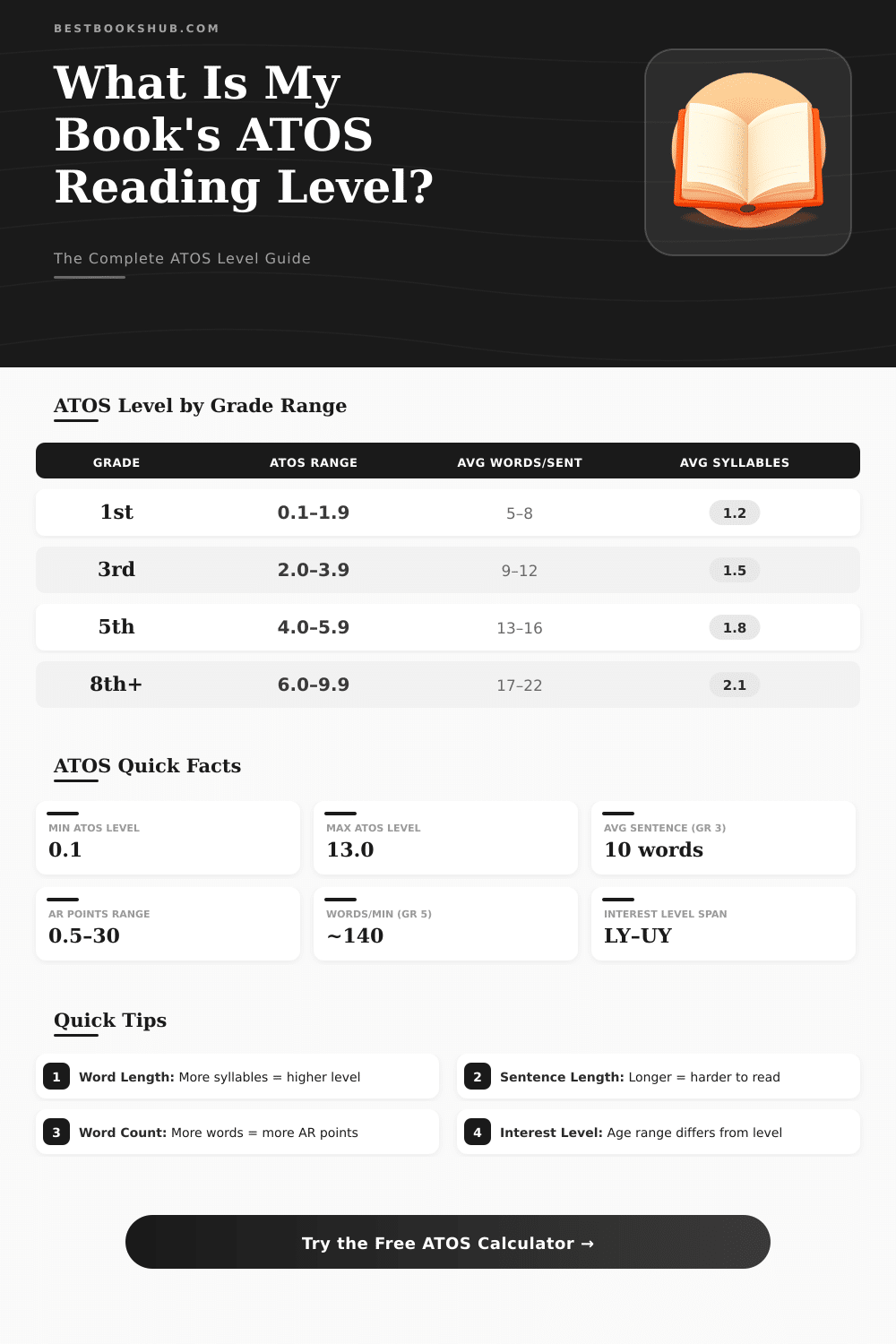
| Grade | ATOS Range | Avg Words/Sentence | Avg Syllables/Word | Typical Word Count | Interest Level |
|---|---|---|---|---|---|
| Kindergarten | 0.1 – 0.9 | 3 – 5 | 1.1 | 100 – 500 | LY |
| Grade 1 | 1.0 – 1.9 | 5 – 8 | 1.2 | 500 – 2,000 | LY |
| Grade 2 | 2.0 – 2.9 | 7 – 10 | 1.3 | 2,000 – 8,000 | LY |
| Grade 3 | 3.0 – 3.9 | 9 – 12 | 1.4 | 8,000 – 20,000 | MY |
| Grade 4 | 4.0 – 4.9 | 11 – 14 | 1.5 | 20,000 – 35,000 | MY |
| Grade 5 | 5.0 – 5.9 | 13 – 16 | 1.6 | 30,000 – 50,000 | MY |
| Grade 6 | 6.0 – 6.9 | 14 – 17 | 1.7 | 40,000 – 65,000 | MY |
| Grade 7 | 7.0 – 7.9 | 16 – 19 | 1.8 | 50,000 – 80,000 | MY/UY |
| Grade 8 | 8.0 – 8.9 | 17 – 21 | 1.9 | 60,000 – 90,000 | UY |
| Grade 9+ | 9.0 – 13.0 | 20 – 28 | 2.1+ | 80,000 – 120,000+ | UY |
| Word Count Range | Typical Pages | Estimated AR Points | Typical Genre | Read Time (min) |
|---|---|---|---|---|
| 100 – 500 | 4 – 16 | 0.5 | Picture Book | 2 – 5 |
| 500 – 2,000 | 16 – 64 | 0.5 – 1.0 | Early Reader | 5 – 15 |
| 2,000 – 8,000 | 32 – 96 | 1.0 – 2.0 | Easy Chapter | 15 – 45 |
| 8,000 – 20,000 | 80 – 160 | 2.0 – 4.0 | Chapter Book | 45 – 120 |
| 20,000 – 45,000 | 120 – 200 | 4.0 – 8.0 | Middle Grade | 120 – 270 |
| 45,000 – 80,000 | 200 – 320 | 8.0 – 15.0 | YA / Adult | 270 – 480 |
| 80,000 – 120,000 | 320 – 480 | 15.0 – 25.0 | Long Novel | 480 – 720 |
| 120,000+ | 480+ | 25.0 – 30.0+ | Epic / Classic | 720+ |
| Format | Avg Word Count | Avg Pages | Words/Page | ATOS Typical |
|---|---|---|---|---|
| Picture Book | 300 – 800 | 24 – 48 | 10 – 30 | 1.0 – 3.5 |
| Early Reader | 500 – 1,500 | 32 – 64 | 20 – 60 | 1.5 – 2.5 |
| Easy Chapter Book | 3,000 – 10,000 | 48 – 100 | 80 – 120 | 2.5 – 4.0 |
| Middle Grade | 20,000 – 55,000 | 150 – 250 | 150 – 200 | 4.0 – 6.5 |
| YA Novel | 50,000 – 80,000 | 250 – 350 | 200 – 250 | 4.5 – 7.5 |
| Adult Fiction | 70,000 – 100,000 | 280 – 400 | 220 – 280 | 6.0 – 9.0 |
| Graphic Novel | 2,000 – 8,000 | 100 – 200 | 20 – 60 | 2.0 – 4.5 |
| Nonfiction (Adult) | 60,000 – 90,000 | 240 – 360 | 220 – 260 | 7.0 – 12.0 |
For the most accurate ATOS estimate, count every syllable in your text sample. A simple rule: count vowel sounds per word. Words like "beautiful" = 3 syllables, "cat" = 1. Higher syllable counts push the ATOS level up significantly.
Average words per sentence is the single biggest driver of ATOS score. Books with short, punchy sentences (5–8 words) score lower. Books with complex, compound sentences (18+ words) score much higher, often by 2–3 full grade levels.
Can consider atos reading level as a way to tie readers to books, that genuinely match their present skills. That is the only point where usual human achievement at a certain age or stage finds itself. The mainstream idea stays to bind children (and adults) to stories and texts, that they genuinely manage to read without it entirely crushing them.
DISCLOSURE: This post may contain affiliate links, meaning when you click the links and make a purchase, I receive a commission. As an Amazon Associate I earn from qualifying purchases.
Various methods exist for guessing this, and each of them has its own unique way to point where the level of a book sits. Levels of Accelerated Reader appears as numbers; would say, 4.2. Lexile, on the other hand, uses more full whole figures, commonly in the 700s or even higher.
Find Books That Match Your Reading Level
There is also Guided Reading or Fountas and Pinnell, that use letters (for example R or T). Atos reading level is based on the ATOS formula for readability, that estimates, how hard a text really is. For instance, a book at 4.5 mark points, that a student at that level probably manages to read it alone.
Finding the right book gets eaiser, if one has the right tools. One good option is the Accelerated Reader Book Finder, it allows students, teachers, parents and librarians to search in English or in Spanish, filter by atos reading level, Lexile score, interest or even just title. Besides that, the Book Finder gives real help for finding classroom collections, creating planned lists of books and tracking titles at precise atos reading level.
One can also find charts about atos reading level, that explain how those different systems relate.
Access some free online tools for readability hear. They right away point out what grade level a text reaches and mark phrases, that maybe block understanding. Interesting spot here, automatic scales do not genuinely work for fiction.
One program could estimate a chapter at 6th grade, while another estimates it 11th or 12th. They all differently judge.
For younger children there is a simple trick, that surprisingly works. While a child reads, it raises a finger for every word, that it stumbles on or that it does not manage to say out loud. Two or three fingers for a book?
It then fits perfectly. If it reaches four or five, the book is probably too hard to reach.
Current research results stress, that children need firm, step-by-step teaching of reading. Sound awareness, phonics, knowledge about sound-letter-ties, together with practice using simple texts. Leveled texts do not aim to be easy to decode, which is worth recalling.
When one reaches around 4th grade atos reading level, the available books grow a lot. The most important change happens around 6th grade. Reality is, that atos reading level matters most, while one still learns the basics.
After that stage? Read slowly, be patient with different styles and simply move through the pages. Everyday readingpractice smooths everything over time.
In many books, that children like, one finds their atos reading level printed on the cover or back. School books commonly point the grade out. A fast reading test, that lasts three minutes, helps to quickly estimate a matching grade.
The Lexile Framework for Reading fits into library systems, allowing librarians and readers to search books by their level.