📚 Book length lab
Average book length calculator
Estimate a book's pages, word count, chapter count, manuscript pages, and reading time from genre, format, trim size, and draft structure.
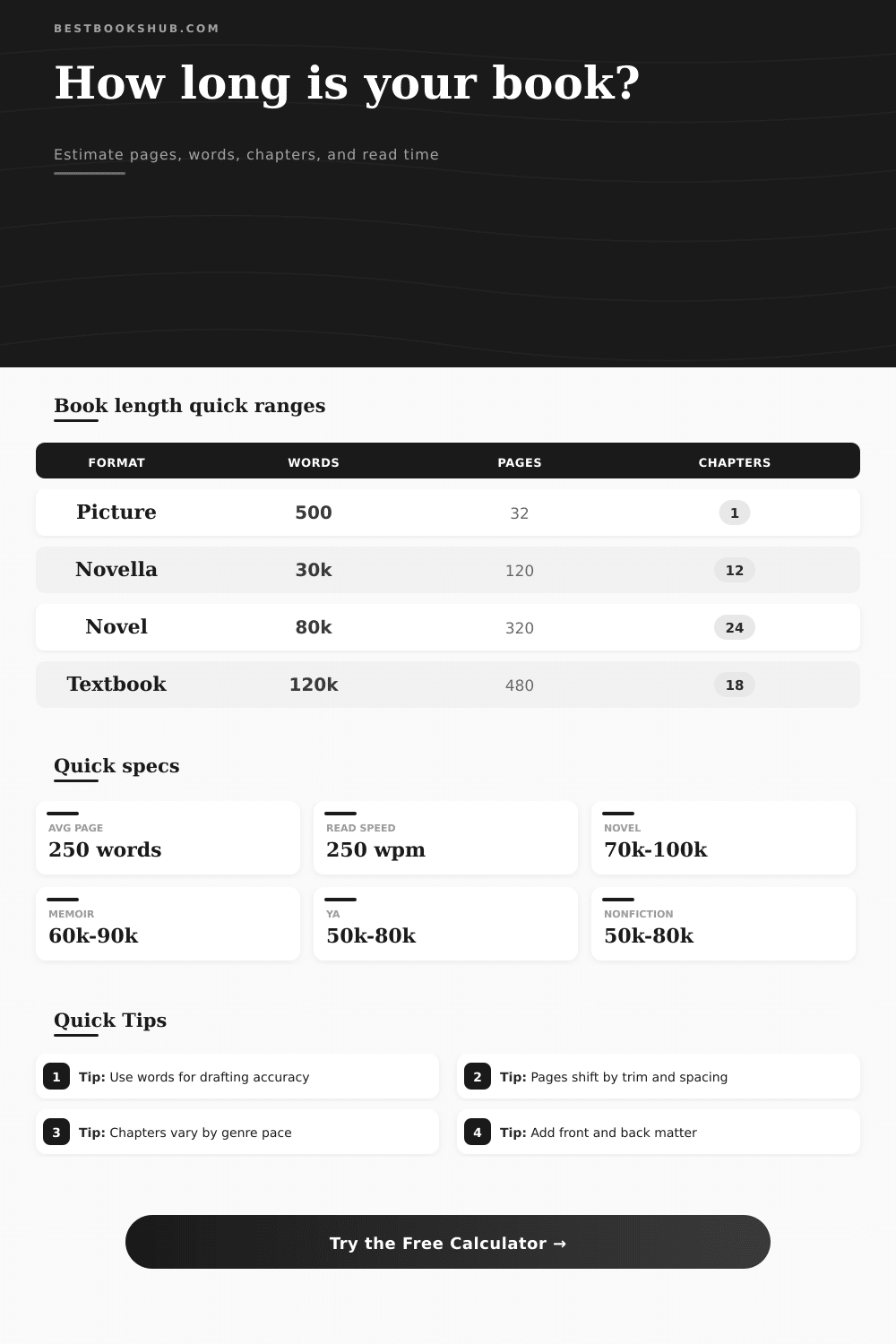
| Book category | Common word range | Typical published pages | Common chapter pattern |
|---|---|---|---|
| Picture book | 300 to 1,000 words | 24 to 40 pages | Single continuous story |
| Early reader / chapter book | 5,000 to 15,000 words | 48 to 96 pages | 8 to 12 short chapters |
| Middle grade fiction | 25,000 to 55,000 words | 120 to 220 pages | 12 to 24 chapters |
| Young adult novel | 50,000 to 80,000 words | 220 to 360 pages | 18 to 32 chapters |
| Adult literary novel | 70,000 to 100,000 words | 280 to 420 pages | 20 to 35 chapters |
| Fantasy / sci-fi novel | 90,000 to 130,000 words | 360 to 560 pages | 30 to 50 chapters |
| Memoir | 60,000 to 90,000 words | 240 to 380 pages | 18 to 30 chapters |
| Business nonfiction | 45,000 to 75,000 words | 180 to 300 pages | 8 to 16 chapters |
| Word count | Manuscript pages | Trade paperback pages | Large paperback pages |
|---|---|---|---|
| 30,000 words | 120 pages at 250 words | 120 plus front matter | 100 plus front matter |
| 50,000 words | 200 pages at 250 words | 200 plus front matter | 167 plus front matter |
| 70,000 words | 280 pages at 250 words | 280 plus front matter | 234 plus front matter |
| 90,000 words | 360 pages at 250 words | 360 plus front matter | 300 plus front matter |
| 120,000 words | 480 pages at 250 words | 480 plus front matter | 400 plus front matter |
| Format | Typical use | Words per page | Length effect |
|---|---|---|---|
| Mass-market paperback | Genre fiction and portable editions | About 220 words | More pages than trade |
| Digest paperback 5 x 8 in | Novellas, guides, compact nonfiction | About 235 words | Slightly more pages |
| Trade paperback 5.5 x 8.5 in | General fiction and memoir | About 250 words | Balanced estimate |
| Large paperback 6 x 9 in | Nonfiction, academic, workbooks | About 300 words | Fewer pages |
| Textbook 8 x 10 in | Instructional and reference books | About 350 words | Fewer text pages, more figures |
| Book length | Slow study 180 wpm | Average 250 wpm | Fast 300 wpm |
|---|---|---|---|
| 30,000 words | 2 hr 47 min | 2 hr 0 min | 1 hr 40 min |
| 60,000 words | 5 hr 33 min | 4 hr 0 min | 3 hr 20 min |
| 80,000 words | 7 hr 24 min | 5 hr 20 min | 4 hr 27 min |
| 100,000 words | 9 hr 16 min | 6 hr 40 min | 5 hr 33 min |
| 120,000 words | 11 hr 7 min | 8 hr 0 min | 6 hr 40 min |
DISCLOSURE: This post may contain affiliate links, meaning when you click the links and make a purchase, I receive a commission. As an Amazon Associate I earn from qualifying purchases.
With the average book length calculator, you can instanty convert your raw word count to estimated reading time, number of pages in a finished book, and the number of sheets of paper used by your manuscript. With this tool you’ll be able to make choices regarding genre expectations, font density, and trim size while eliminating guesswork. Before printing anything, you’ll know what it will look like on the page.
Pages comes and go, but the words remain the same. A novel that’s 80,000 words will always have those 80,000 words, no matter what size it is on a page. You can fit roughly the same amount of content into a bigger or a smaller book, depending on its physical size. That is why this tool offers options ranging from roomy trade hardcovers to smallish mass-market paperbacks. A smaller trim size squeezes fewer words onto each sheet, which makes book look thicker even though the content hasn’t changed. This often matters more to marketing than to the reader: people judge a book partly by its weight, which helps determine its size.
Why Book Length Matters for Writers
These calculations also takes into account genre conventions. Agents and publishers has expectations for weight if you’re writing epic fantasy: there’s world building to do, so they need space for it. What feels like a complete draft to you (say, 50k) will appear thin next to the hundred-plus thousand word counts of common speculative fiction. Genre presets on the calculator will adjust overall density and expected length of chapters.
For business nonfiction, things work differently; readers aren’t interested in endless anecdotes at the expense of actionable advice. A tight page count doesn’t mean it is incomplete; it shows efficiency. It is less a matter of reaching some magic number different than one of honoring your reader’s expectation for the rhythm.
New writers often overlook extra pages added by front matter. Dedications, acknowledgements, tables of contents, title pages, and even copyright notices all add up fast. These don’t add to your word count but they does increase your overall page count. Having an estimate for this will save you from being surprised when the last proof is 20 pages longer than what was estimated from your draft. This will also help if you’re self publishing since printing costs are based off sheet counts. A slight difference in front matter can push your book past a price threshold, which saves you money down the road.
For nonfiction writers, reading time estimates are another form of insight. For example, did you know that average person reads two hundred and fifty words per minute? This allows you to gauge whether your writing may be too dense. Do you have a chapter that takes forty-five minutes to read? The mental effort could of been too much for a casual commuter. Use this metric to break up longer sections. Insert summary boxes so skimmers can get the gist of what is being said without getting stuck.
Having something to work toward; even if just a rough estimate of what length your book will be; can keep you from wandering too far afield. From writing a memoir that covers decades to a picture book with only a few words per illustration, a goal helps keeps the story on track. But then when you plug those numbers into the calculator, you have a real reminder to ground your dreamy creativity in real-world terms. Seeing how much or little your text weigh against industry norms eases any worry over length and allows you to relax and write some more. After all, it’s less “Is this long enough?” and more “How am I going to make this page really count?”