📖 Book marketing copy
Blurb word count calculator
Plan back-cover blurbs, retail-page descriptions, query pitches, and ad teasers by word count, section balance, printed lines, and reading time.
| Placement | Typical target | Primary job | Best section emphasis |
|---|---|---|---|
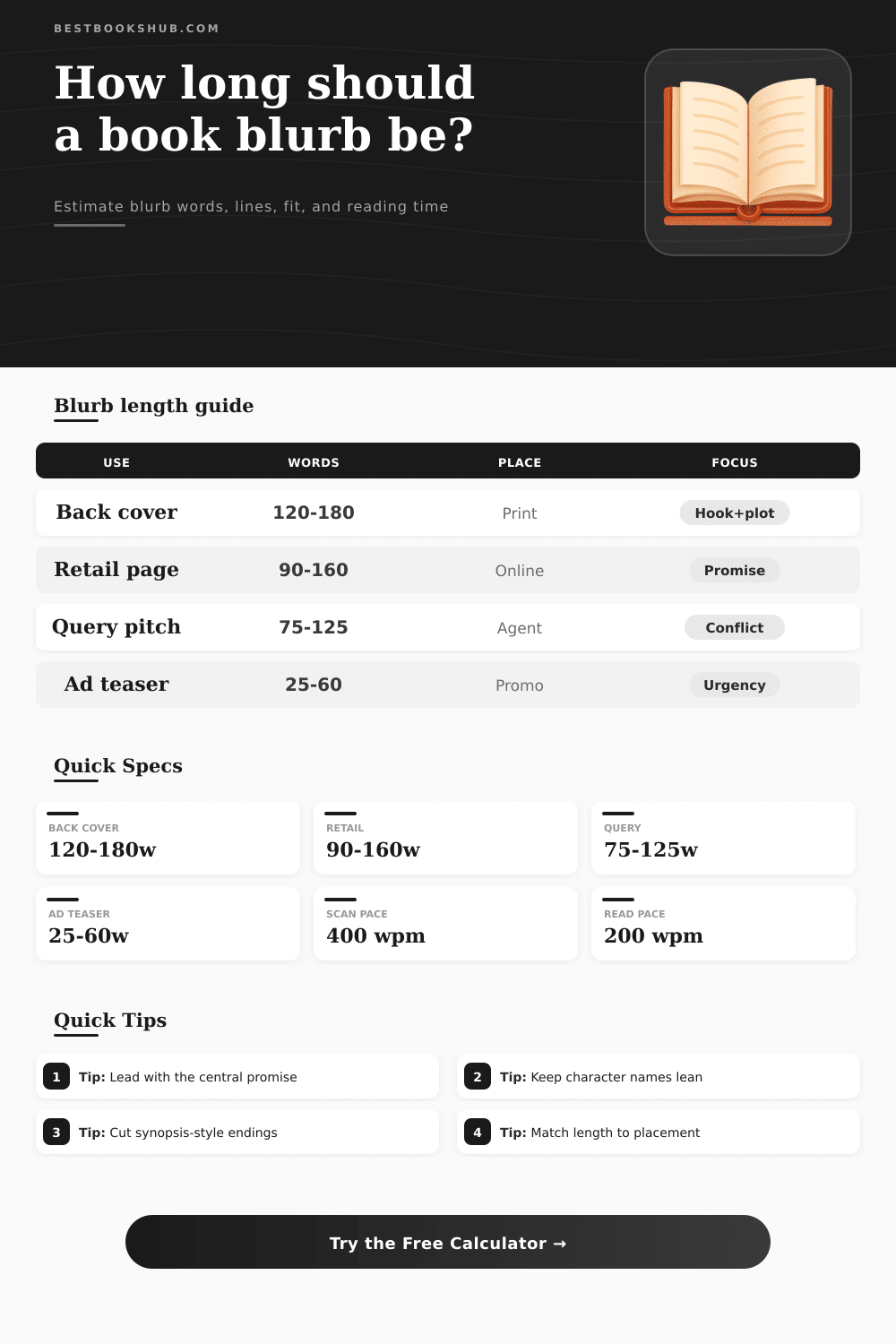
| Paperback back cover | 120-180 words | Sell the reading promise at print scale | Hook, setup, stakes |
| Hardcover jacket flap | 160-240 words | Allow a fuller setup and author context | Premise and proof |
| Online retailer description | 90-160 words | Convert a scanning browser | Promise and stakes |
| Query-letter pitch | 75-125 words | Show protagonist, conflict, and consequence | Conflict and decision point |
| Ad or newsletter teaser | 25-60 words | Earn a click quickly | Opening hook |
| Blurb section | Lean share | Standard share | What it should do |
|---|---|---|---|
| Opening hook | 18-25% | 16-22% | Signal genre, tone, or central trouble |
| Premise and setup | 28-38% | 32-42% | Explain who, where, and why now |
| Conflict or promise | 30-42% | 28-38% | Make the reader need the outcome |
| Proof or credentials | 0-12% | 5-15% | Add authority without crowding the pitch |
| Close or CTA | 6-12% | 6-10% | Land the mood and next action |
| Market | Length tendency | Tone cue | Risk to watch |
|---|---|---|---|
| Thriller or suspense | Shorter, punchier | Threat, clock, reversal | Too much backstory |
| Romance | Moderate | Character chemistry and obstacle | Generic trope stacking |
| Fantasy or science fiction | Slightly longer | World premise plus stakes | Worldbuilding overload |
| Memoir | Moderate to long | Transformation and voice | Chronology instead of arc |
| Business or self-help | Slightly longer | Problem, promise, proof | Too many claims at once |
| Format comparison | Line width | Fit cue | Calculator setting |
|---|---|---|---|
| Mass-market back cover | 35-45 chars | Very tight, compact paragraphs | Use 40 chars per line |
| Trade paperback back cover | 45-55 chars | Flexible with one short endorsement | Use 48 chars per line |
| Hardcover jacket flap | 55-70 chars | More room for a fuller premise | Use 62 chars per line |
| Retail product page | 60-75 chars | Screen width varies by device | Use 66 chars per line |
| Email or ad block | 35-55 chars | Short blocks improve skimming | Use 44 chars per line |
DISCLOSURE: This post may contain affiliate links, meaning when you click the links and make a purchase, I receive a commission. As an Amazon Associate I earn from qualifying purchases.
The back cover blurb you’re fond of might be a little long. A lot of times it’s just because there isn’t enough room for it on paperbacks (the actual real-world space) and the editor trim it down to make it work on design. More likely, though, you wrote what you wanted to say instead of what would fit inside box.
This tool will let you know whether you can actualy get your words into the box before submitting to an agent or designer. Instead of viewing it as a single mass of word, the tool breaks down your blurb into component parts. It allow you to enter word counts for closing call to action, the premise, the social proof, the hook, and the stakes. Why? Because all too many blurbs fail to focus adequately on conflict while taking too long to set up the story.
How to Write a Good Book Blurb
The calculator ask how many words you want in each area, separately. Want to know if your stakes are using half the space you allotted to the hook? Tweak ‘em till they look good to you. It’s just another way to keep yourself honest about your narrative structure.
It’s customizable. It has presets for common situations, such as a back cover, which typically maxes at about a hundred and eighty words. It also has presets for an online retailer page, which is a little bigger but has less patient reader. For any scenario, there are different word counts for different spots (so the interface take that into account).
It even considers how big font is, what kind of line length you’re using, and uses that to calculate approximately how many actual line your text would take up on paper. This visual feedback are handy if you want to get a sense of what everything would look like laid out.
The calculator also takes into account if you plan to submit this via a query letter, post it online, or put it in print. It shifts its range to match. This helps you stick to an effective beat when writing promotional copy.
Good copy has a certain rhythm. One of those things is that the hook must arrive right away. In the opening sentence, give us a sense of what sort of story we’re in. If it’s a thriller, show us the clock or the threat. Memoir: voice and transformation.
And the tool doesn’t do your writing for you, but makes you consider where the individual word goes. It makes you avoid the all-too-common sin of spewing backstory in paragraph one. Backstory is weighty, it slows momentum. Keep that part lean so you have space for book’s central promise.
The hard part about credentials and proof in a blurb is that you want some but not so much as to be distracting from the story, and not so little that you sound like an unknown author. You can set the word count for this section independently with this tool to ensure it’s in proportion to other copy. A line or two is often sufficient, sometimes three or four sentences. Ideally, you’ll establish authority while avoiding distraction.
If you find yourself within spitting distance of the top end of the word-count range where you’re placed, then it’s time to cut. Adjectives slow down readers; verbs propel them forward. Adjectives also uses more space than most people realize.
The other piece of context it provides is the estimated reading time. When I see a blurb that takes more than 30 seconds to read at my normal speed, I know I’ve already lost whoever’s skimming this book description. People just don’t have attention spans these days, particularly on digital storefronts. This lets you know exactly how long your copy will take people to read. How do you know what to cut if not for that? How do you know when to stop writing without sacrificing the point? It turns that vague sense of “this text is way too long” into a measurable number that you can control.
So what is a blurb? A blurb isn’t a summary. A blurb is a promise of a particular kind of experience. Don’t tell me who’s in it or what happens at the end. Just give me a reason for why I should pick up this one book more than all others.
When you’re inside those limits, the calculator keeps your words under control. Each sentence has to earn its spot on the page. After mastering those proportions, you’ll find yourself tightening your copy without even noticing. The limits becomes creative fuel. Filling empty spaces becomes unnecessary because you fill them well.
That change of perspective is far more valuable than any tool. It transforms a scary chore into something manageable through editing. Suddenly, that ideal back cover doesn’t seem so unattainable. You could of had it sooner.