📚 Book Binding Calculator
Calculate spine width, page count, and binding specifications for your book project
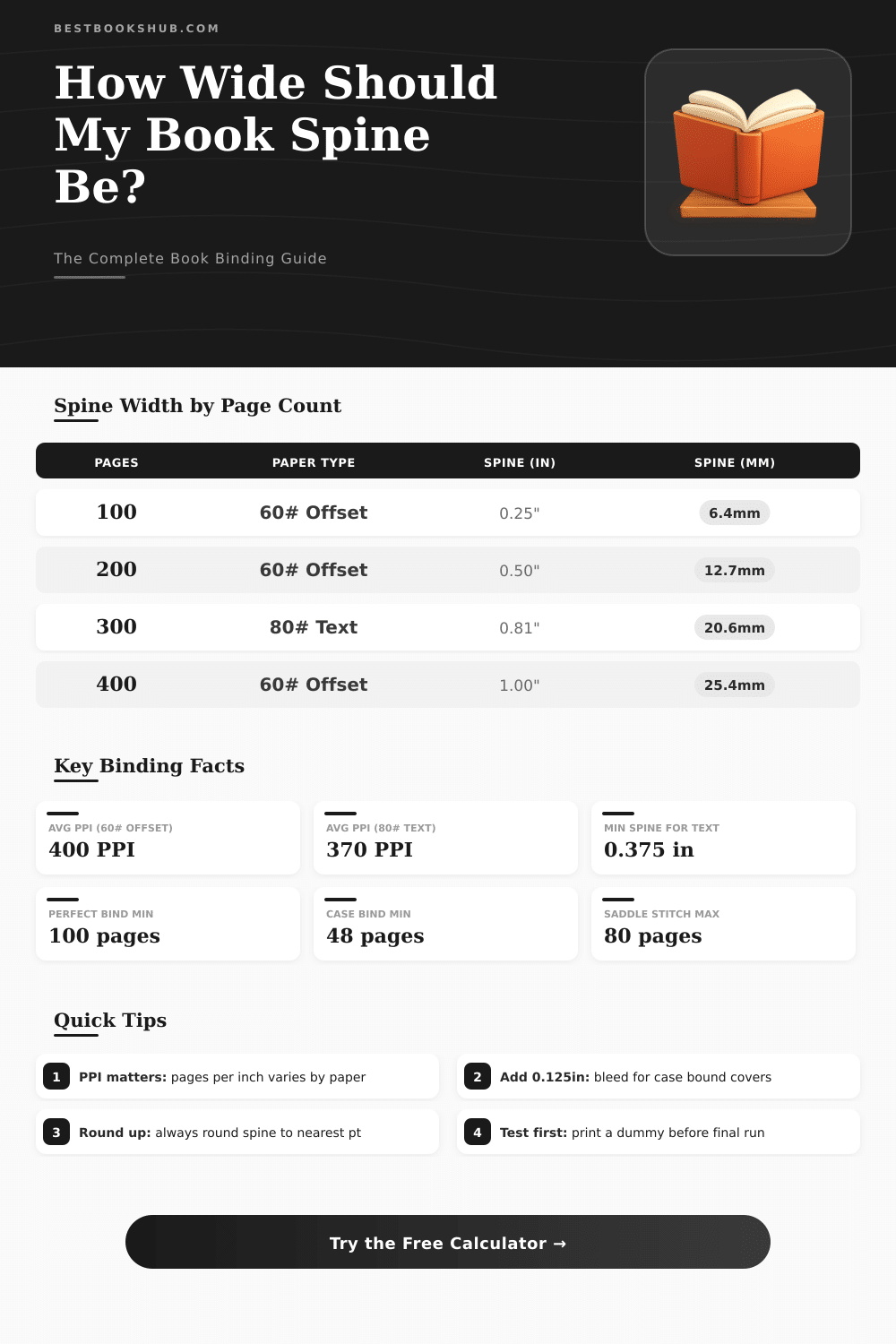
| Page Count | Spine Width (in) | Spine Width (mm) | Suitable Binding |
|---|---|---|---|
| 48 | 0.120 in | 3.1 mm | Saddle Stitch |
| 64 | 0.160 in | 4.1 mm | Saddle Stitch |
| 100 | 0.250 in | 6.4 mm | Perfect Bind |
| 150 | 0.375 in | 9.5 mm | Perfect Bind |
| 200 | 0.500 in | 12.7 mm | Perfect Bind |
| 250 | 0.625 in | 15.9 mm | Perfect Bind |
| 300 | 0.750 in | 19.1 mm | Perfect Bind / Case |
| 400 | 1.000 in | 25.4 mm | Perfect Bind / Case |
| 500 | 1.250 in | 31.8 mm | Case Bind |
| 600 | 1.500 in | 38.1 mm | Case Bind |
| Format | Size (in) | Size (mm) | Common Use |
|---|---|---|---|
| Pocket Paperback | 4.25 x 6.87 | 108 x 175 | Mass market fiction |
| Trade Paperback | 5.5 x 8.5 | 140 x 216 | Novels, non-fiction |
| US Standard Trade | 6 x 9 | 152 x 229 | Memoirs, guides |
| Large Format | 7 x 10 | 178 x 254 | Business, educational |
| Children's | 8 x 10 | 203 x 254 | Picture books |
| Coffee Table | 8.5 x 11 | 216 x 279 | Photo / art books |
| Textbook | 8.5 x 11 | 216 x 279 | Academic textbooks |
| A5 Format | 5.83 x 8.27 | 148 x 210 | EU standard paperback |
| Binding Type | Min Pages | Max Pages | Min Spine Width |
|---|---|---|---|
| Saddle Stitch | 8 | 80 | N/A |
| Perfect Bind | 100 | 800+ | 0.25 in (6.4mm) |
| Case Bind (Hardcover) | 48 | Unlimited | 0.375 in (9.5mm) |
| Spiral / Coil Bind | 8 | 500 | N/A |
| Lay-Flat / PUR | 100 | 600 | 0.25 in (6.4mm) |
| Case Bind + Board | 48 | Unlimited | 0.375 in (9.5mm) |
| Page Count | Paper | Spine (in) | Full Wrap Width (6x9 in) |
|---|---|---|---|
| 100 | 60# Offset | 0.250 in | 12.25 in |
| 200 | 60# Offset | 0.500 in | 12.50 in |
| 300 | 60# Offset | 0.750 in | 12.75 in |
| 400 | 60# Offset | 1.000 in | 13.00 in |
| 500 | 60# Offset | 1.250 in | 13.25 in |
| 200 | 80# Text | 0.588 in | 12.59 in |
| 300 | 80# Text | 0.882 in | 12.88 in |
Book binding is the way to make a book from sorted papers. You can do that by hand and simple tools or by modern automated processes in big publishers. When you bind a book, you join groups of pages, usually by thread or glue, although other options exist.
DISCLOSURE: This post may contain affiliate links, meaning when you click the links and make a purchase, I receive a commission. As an Amazon Associate I earn from qualifying purchases.
That art is an ancient craft but it is not very difficult. Even with little practice, you can reach genuinely impressive results. That is an excellent choice for fun projects or for quickly making nice gifts.
Easy Bookbinding for Beginners
Although book binding is an old trade passed through thousands of years, that does not mean it is only for professionals. No formal training is necessary to start making a book.
First, you can freely choose paper and materials that you like. Do not worry too much about the design or if the edges of the pages are smooth or rough. Those things do not matter before you start to work on methods like the Coptic binding or case binding.
If you make books of A5 size, you do not need to cut everything perfectly. Coptic binding is easy and does not require complex tools, except maybe an awl. For beginners, a good idea is first to practice by making blank books that you could call journals.
Singer sewing is a nice and traditional way where one thread of any colour is sewed through the folded pages at the spine. This safe method, that does not use glue, is usually used for books with only one section. Long stitch is also excellent for those who recently start.
The thread not only keeps the pages together, but also gives form to the spine of the book.
Perfect binding is commonly used in paperback books. The pages are made from letter-size paper, cut in half and gathered as a stack. To accomplish that, you use a binding press.
Other options are to clean the spine, apply PVA and several layers of mull, and later add a cover from binder board wrapped in cloth. The glue must be thick so it does not run. Too thin glue seeps between the pages and will cause splits very quickly.
Binding extends the lifetime of a book. Without binding, the pages can easily go missing. When you bind the pages, you ensure that the book will last for many years.
Library bound is the most rugged form used currently. Such books have a very hard outside with a slightly rough texture. For beginners, Amazon offers cheap kits, but the quality is sometimes bad.
Some simple tools suffice for practice, but weak thread or bad glue means that you will have to replace them quickly. Many copy shops also offer spiral binding quite cheap.