📦 carton weight lab
Book box shipping weight calculator
Estimate scale weight, dimensional weight, billable weight, carton count, packing allowance, and service-limit fit for mailing books, textbooks, comics, archives, or shop orders.
| Box size | Volume | Dim wt at 139 | Dim wt at 166 | Book shipping signal |
|---|---|---|---|---|
| 10 x 7 x 2 in | 140 in3 | 2 lb rounded | 1 lb rounded | Good for one thin hardcover or a comic mailer. |
| 12 x 9 x 4 in | 432 in3 | 4 lb rounded | 3 lb rounded | Often scale-weight driven with normal books. |
| 14 x 10 x 8 in | 1,120 in3 | 9 lb rounded | 7 lb rounded | Balanced carton for a small mixed stack. |
| 16 x 12 x 10 in | 1,920 in3 | 14 lb rounded | 12 lb rounded | Dim weight matters if the box is half empty. |
| 18 x 14 x 12 in | 3,024 in3 | 22 lb rounded | 19 lb rounded | Use only when the book load is dense enough. |
| Format | Typical size | Typical weight | Carton behavior | Packing note |
|---|---|---|---|---|
| Mass market paperback | 7 x 4.25 in | 0.35 to 0.55 lb | Many fit in a compact box | Keep stacks tight to prevent spine rub. |
| Trade paperback | 8 x 5.25 in | 0.5 to 1.0 lb | Good weight-to-volume ratio | Use flat pads against covers. |
| Hardcover novel | 9 x 6 in | 1.0 to 1.8 lb | Corners drive protection | Add wrap or corner pads for dust jackets. |
| Textbook | 11 x 8.5 in | 2.5 to 4.5 lb | Weight limit arrives early | Split cartons before they become hard to lift. |
| Comic or magazine | 10.25 x 6.75 in | 0.15 to 0.45 lb | Flat parcels can dim out | Use boards and keep bend room low. |
| Art book | 12 x 10 in | 3.0 to 6.0 lb | Both weight and size matter | Plan more void fill and edge protection. |
| Shipment type | Typical carton | Likely books | Expected scale weight | Limit check |
|---|---|---|---|---|
| Single book mailer | 10 x 7 x 2 in | 1 hardcover | 1.5 to 2.5 lb | Dim weight rarely dominates. |
| Small shop order | 12 x 9 x 4 in | 4 to 6 mixed books | 4 to 8 lb | Weigh after packing. |
| Book club carton | 14 x 10 x 8 in | 12 to 18 paperbacks | 10 to 18 lb | Compact and carrier friendly. |
| Classroom set | 16 x 12 x 10 in | 20 to 32 paperbacks | 18 to 32 lb | Use a lift-safe max target. |
| Textbook return | 14 x 10 x 8 in | 5 to 8 textbooks | 16 to 30 lb | Weight limit is the main risk. |
DISCLOSURE: This post may contain affiliate links, meaning when you click the links and make a purchase, I receive a commission. As an Amazon Associate I earn from qualifying purchases.
If you’ve ever shipped or moved a box of books, then chances are you know exactly how this goes: You find heavy duty box, cram it full of books, fold the flaps over, add a label, and call it a day. If it’s light enough to carry around, then surely it’ll be cheap to ship, right? Unfortunately, most people make this mistake.
Books don’t get weighed by shippers based off actual weight alone. Because carriers charge based on volume (the amount of space taken up by your package), they accounts for the empty air inside your boxes. They even assign a theoretical weight to that air and they charge you accordingly. This is called dimensional weight. One empty corner of your box turns that space into a loss for you and a profit for carrier.
How to Save Money When Shipping Books
Once you know how many book fit in each box and enter those dimensions into the calculator above, it does all the math so you don’t have to guess at numbers or rounding rules. The basic formula most carriers follow to translate cubic inches into pounds uses a divisor: a common standard is one hundred thirty-nine cubic inches per pound. So if you’re boxing up something twelve inches wide x eight inches tall x seven inches long (which would be 840 cubic inches), and even though the books inside might only weigh four pounds, the carrier will still charge you for seven pounds since that’s what it costs them to move that space. Unless your load bridges that gap with density, you’re literaly paying for empty air.
This isn’t true for paperbacks, though. Sure, they’re light, but they’re also bulky. Even at under one pound apiece, a trade paperback will take up a lot of space. Pack ten of them into a big box and don’t leave any space between them. The dimensional weight will dominate, even though it weigh less than a pound on the scale.
And then there’s textbooks. Textbooks are bricklike: heavy, dense objects made primarily of glue and paper. And many of them weighs two to three pounds. Fill a standard-sized carton with textbooks and you’ll reach the maximum allowable weight for a box well before you’ve filled all its volume. At this point, dimensional weight simply drops out of the discussion. Physical heft has become the limiting factor and no matter how empty the box appears, adding another book isnt possible.
But what does all this mean when added to original book weight? To help in that calculation, the tool lets you enter the empty weights of any packing materials or cardboard boxes you’re using. Don’t skip this section. Even a medium-size corrugated box will weigh nearly a pound by itself. Include some foam peanuts or crumpled up paper as void fill. Throw in some protective wrap for those dust jackets. You’ve just added a half pound to your total without realy thinking about it.
That doesn’t sound like much until you realize that carriers round up. Six point one pounds is a seven-pound package; six point zero one pounds is still a seven-pound package. They don’t care about precision near these thresholds; only if you cross them.
Sometimes you can save money by splitting big shipments into several smaller cartons, so long as the total weight does not exceeds the combined dimensional weight of the small packages. That’s where test scenarios come in handy. Run some of your items through various box sizes and calculate which one yields the lowest billable weight. You may be able to tightly pack an item into a bit bigger box with fewer books but get it all in the same shipment, saving on shipping labels and labor. Or maybe with light-weight books like comics, the dimensional weight will stay low while avoiding extra handling surcharges by using individual small mailers instead.
The last factor is how you pack them: if they’re loose and over-packed in a lot of void fill, it’ll add more real weight but won’t necessarily be any more protected. If everything’s tightly stacked with as little air between items as possible, then the cost will reflect weight of the actual books themselves, not all the wasted space around those books. Use flat pads to protect spines rather than bulky bubble wrap that expands your box dimensions. Bubble wrap and other large, bulky items increases the size of your box. This means you multiply the volume by another amount every time you add an inch to the width or length.
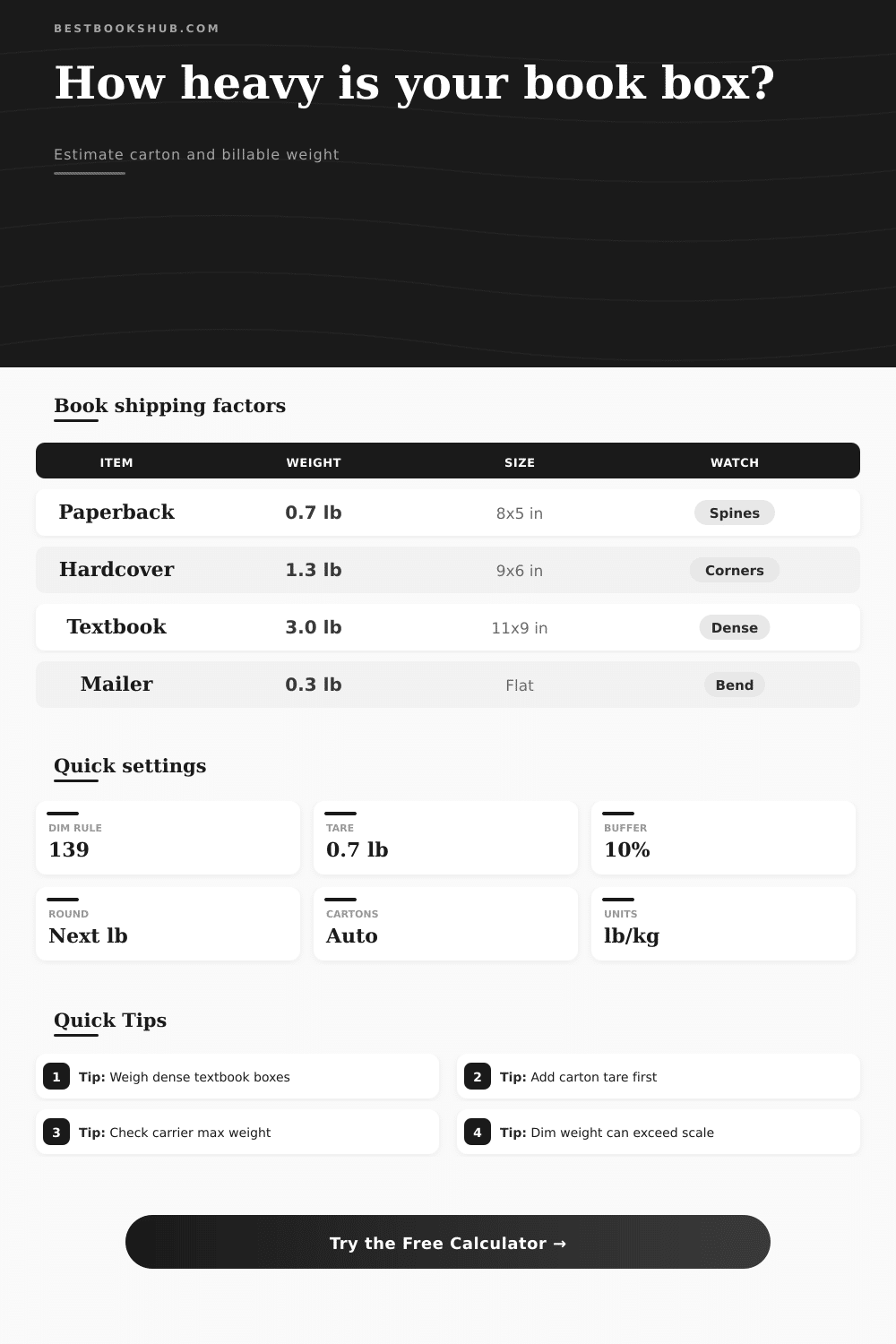
Without a scale at hand though, the tool’s reference table outlines typical weights for different kinds of books so you have some kind of baseline to go off of when you need it. A hardcover is roughly a pound and a third, which isn’t a terrible thing to know because knowing that can help you guesstimate correctly rather than wildly. It keeps you from making the classic misstep of guessing too much on space and not enough on density.
Remember, moving books around is a volume vs. It is a density puzzle. You want something that feels heavy in your hands. It also needs to be small regarding a carrier’s economic scale. Find where the physical weight meets the dimensional constraints so you aren’t paying for air, but just moving what needs to be moved. And that right there is how you get those pages to you safely and keep your margin intact.