📓 Reading money planner
Book Budget Planner Calculator
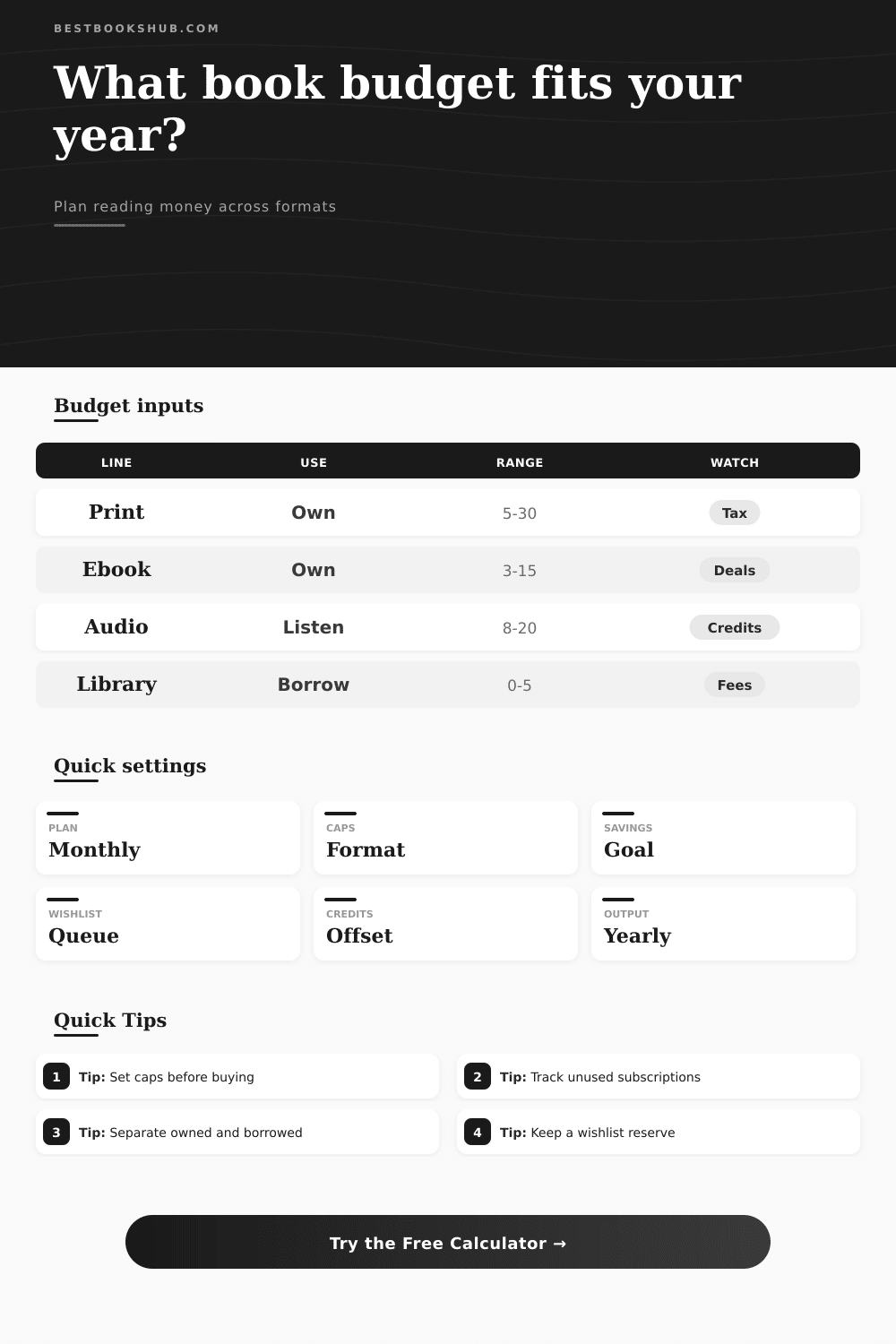
Plan a monthly and yearly book budget across new print, used print, ebooks, audiobooks, library borrowing, subscriptions, wishlist pressure, credits, and savings goals.
| Budget line | Monthly amount | Plan share | Planner signal |
|---|---|---|---|
| Direct book buying | 0 | 0% | Run the calculator. |
| Reader profile | Best cap style | Biggest swing item | Useful planner metric |
|---|---|---|---|
| Library-first reader | Small monthly cash cap | Holds, transit, and small fees | Borrow share versus owned share |
| Ebook deal reader | Wishlist reserve plus sale cap | Impulse purchases during promotions | Wishlist coverage after subscriptions |
| Audiobook commuter | Credit usage cap | Unused membership credits | Spend per finished listen |
| Collector | Monthly cap plus savings fund | Hardcovers, preorders, shipping | Shortfall before rare purchases |
| Family or shared household | Per-reader cap | Duplicate purchases and gifts | Annual spend per reader |
| Format | Input to track | Planning strength | Common leak |
|---|---|---|---|
| New print | Copies and average amount | Good for ownership goals | Tax, shipping, preorder stacking |
| Used print | Copies and average amount | Strong shelf-building value | Buying more because each book is cheap |
| Ebook | Purchases plus subscription | Flexible for sales and travel | Small impulse buys that avoid notice |
| Audiobook | Credits, extras, membership | Useful when credits are finished | Monthly membership without listening |
| Library | Borrows and monthly fees | Best for volume without ownership | Replacement fees or paid holds |
| Budget signal | What it means | First adjustment | When to keep it |
|---|---|---|---|
| Under cap with low coverage | The plan is lean but wishlist progress is slow | Add savings or reduce subscriptions | Good during no-buy periods |
| Over cap with high direct spend | Purchases outrun the monthly limit | Shift some titles to library or used | Acceptable for short preorder seasons |
| High cost per finished book | Buying and finishing are out of sync | Lower monthly quantity or improve completion | Fine for research or collectors |
| Subscription-heavy plan | Fixed charges drive the result | Audit credit usage each month | Keep if credits are fully used |
DISCLOSURE: This post may contain affiliate links, meaning when you click the links and make a purchase, I receive a commission. As an Amazon Associate I earn from qualifying purchases.
Ever find yourself purchasing an impulse buy of a hardcover, only to have stack of books on your nightstand overflow? That’s a form of literary anxiety. On one hand: books are wonderful! On the other: we also love having money left for other things. On the other: money is necessary for groceries/books/gas/other stuff you care about.
For most readers, this gap, the difference between what we’d like to purchase (i.e., everything in a particular genre) and what we can realistically afford. Is where our budget loses money without us noticing. Because book buying tends toward penny-wise, dollar-foolish (to borrow an idiom), it’s more important to track that spending then you might realize. That’s where the tool (above) steps in; allowing you to map out your real-life habits to a hard limit.
How to Budget Your Book Money
Usually people begins with an overly-optimistic guess at their monthly cap. Remember: different format = different cost. An ebook from a sale may run you less than five bucks; a new print release might cost you twenty shipped and taxed. Audiobooks are even messier: pay-per-title fees or a subscription base + credits. Unless you use those credits, your wasting that month’s subscription fee.
The tool breaks down the format streams so you can visualize which one gobbles up your budget first. And it distinguishes between borrowing vs. Owning… A distinction that completely changes the math.
Finally, library usage is the great equalizer of any reading plan. You might love your physical shelves, but switching out some purchases for library holds will also save you money for the books you really want to own. The tool’s reference table shows that a borrow-heavy month won’t cut down on your volume (or send you over budget).
Your finish rate connects to satisfaction. Buy 10 books and only finish two? That’s a skyrocketing cost-per-finished-read, one that most people don’t notice until they’re drowning in unread paperbacks. But what about those sneaky expenses, you know, the ones that never hit the bill but always end up in your shopping cart? There’s shipping for each order, which adds up fast. And then there’s tax (if it applies), which varies by location and sometimes by platform.
And finally, there’s the I-just-had-to-buy-that-other-book tax, i.e. These include limited edition covers and a three-for-two offer you just can’t pass up. Because this will happen, there’s a buffer category for all the unexpected spending in the planner. If you set aside 10% of your budget for surprise buys, you won’t need to trim another category down the line. A little bit of padding goes a long way, especially when preorder season strikes.
Audit your subscriptions honestly. A lot of us maintain ebook or audiobook services because we’ve been using them for years, even if we’re no longer getting our money’s worth. Every month, unused allowance amounts dissapears, and that’s money flushed down the drain with nothing to show for it. Plug your subscription fees into the calculator, and see what kind of fixed overhead you’ll be working around before you purchase a single book.
Often, reducing this baseline will free up far more than eliminating individual purchases can. Drop one service, and all of a sudden you’ve got the cash to spare on that art book you coveted months ago. But uncontrolled wishlists are dangerous things. They are endless queues of desire without an end in sight. The tool will ask you to guess the length and average cost of your wishlist.
It will then calculate how much of that you can realistically afford based on your current reading expenses. Odds are most readers’ wishlists runs into the hundreds of dollars. Watching that percentage fall can be sobering but can also focus priorities on what actualy gets purchased. It reframes thinking from acquiring stuff to selecting based off the plan.
The calculator’s presets are starting places for various kinds of lives. The Collector preset accounts for hardcover purchases and shipping spikes. The Student preset accounts for a heavy reliance on used copies and library items. But there is no ideal profile. There is only one that fits, based on your own tastes and income at this moment.
It’s all about being consistent. Run it once per month, make adjustments based on seasonality, and pay attention to where the cash flow ends up. Odds are you’ll realize you buy fewer books, but spend more on them, if you look at the figures with clear eyes. Does this mean you stop budgeting for reading? No. It means that you choose with intention. Every book on your shelf earns its spot by having a job.
Every single dollar you spend has a job. This makes finishing that book feel even better than purchasing it. Let the math do the work to help you make your next decision. Start with a reasonable cap. Clarity is power, and it turns anxiety into control.