📖 Book Chapter Title Generator
Generate compelling, genre-matched chapter titles for your book using proven title formulas
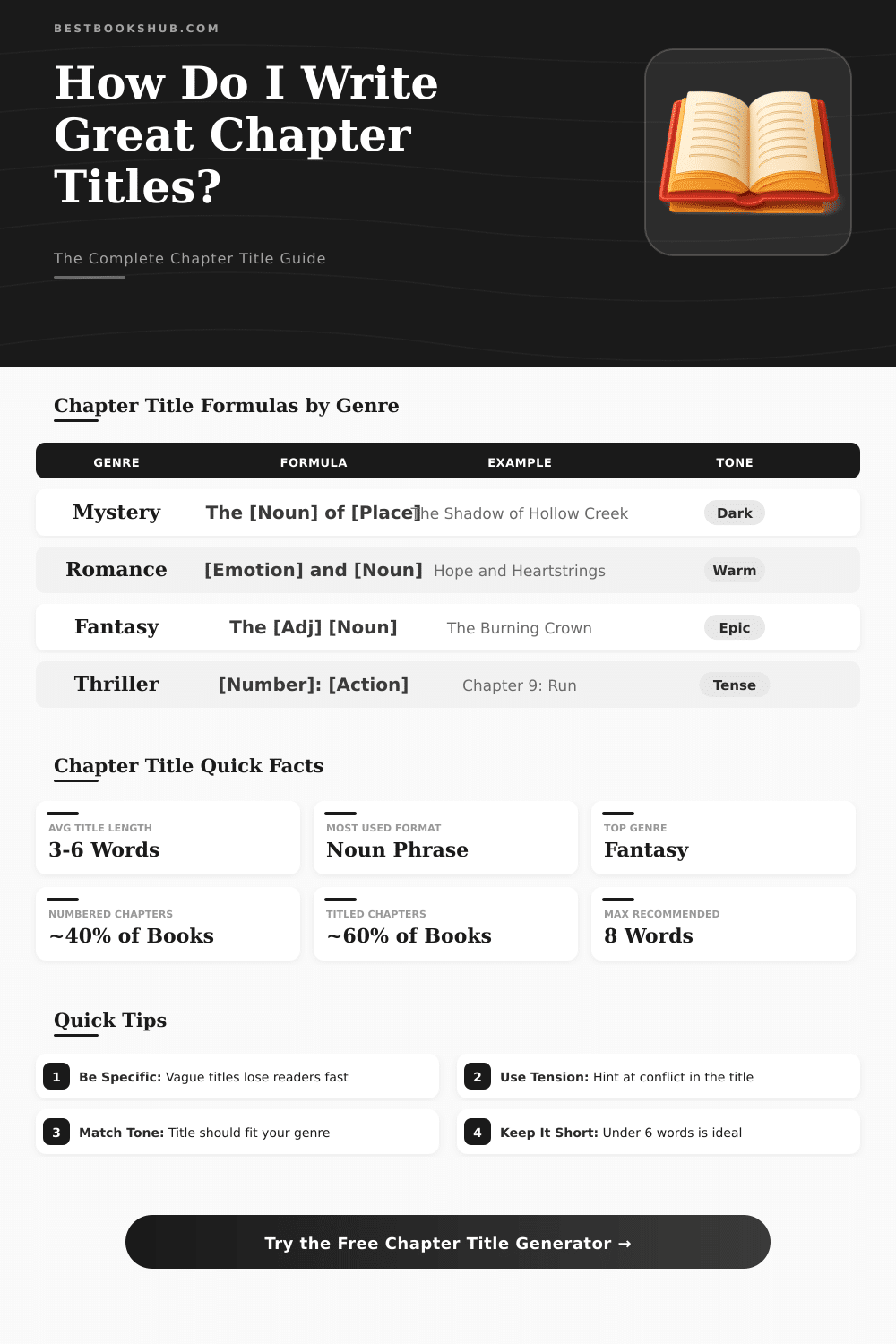
| Genre | Primary Formula | Secondary Formula | Example Title | Avg Words |
|---|---|---|---|---|
| Mystery | The [Noun] of [Place] | [Number]: [Noun] | The House on Maple Street | 4–6 |
| Romance | [Emotion] and [Noun] | [Adj] [Noun] | Storm and Silence | 3–4 |
| Fantasy | The [Adj] [Noun] | [Place Name] | The Burning Crown | 3–5 |
| Sci-Fi | [Code / Protocol Name] | [Noun]: [Subtitle] | Protocol Zero | 2–4 |
| Horror | The [Adj] [Noun] | [Single Noun] | The Hollow Place | 2–4 |
| Non-Fiction | [Action Verb] [Object] | The [Concept] Principle | Mastering the Method | 3–5 |
| Young Adult | [Gerund / Verb-ing] | [Emotion Noun] | Becoming Visible | 2–3 |
| Historical | The [Year/Era] [Noun] | [Place], [Year] | The Last Campaign | 3–5 |
| Literary | [Single Abstract Noun] | [Short Phrase] | Silence | 1–3 |
| Thriller | [Urgency Phrase] | [Time Noun] | Zero Hour | 2–3 |
| Book Type | Avg Chapter Count | Pages Per Chapter | Words Per Chapter | Title Style |
|---|---|---|---|---|
| Literary Novel | 12–20 | 15–30 | 3,000–5,000 | Titled |
| Commercial Fiction | 25–40 | 8–15 | 1,500–3,000 | Numbered or Titled |
| Fantasy / Sci-Fi | 30–50 | 10–20 | 2,000–4,000 | Titled |
| Romance | 20–35 | 10–18 | 1,800–3,500 | Titled or Mixed |
| Mystery / Thriller | 30–50 | 6–12 | 1,000–2,500 | Numbered |
| Non-Fiction | 8–15 | 20–40 | 3,500–7,000 | Descriptive Title |
| Young Adult | 20–30 | 12–20 | 1,500–3,000 | Titled |
| Memoir | 10–20 | 15–35 | 2,500–6,000 | Evocative Title |
| Word Type | Best For | Examples | Reader Impact |
|---|---|---|---|
| Abstract Noun | Literary, Romance | Silence, Hope, Ruin | Emotional depth |
| Concrete Noun | Mystery, Thriller | The Key, The Window, The Letter | Curiosity, tangibility |
| Proper Name | Any genre | Elena, Blackwood Hall | Personalization |
| Action Verb | Thriller, YA | Run, Fall, Burn, Rise | Urgency, momentum |
| Adjective + Noun | Fantasy, Horror | The Dark Path, Hollow Bone | Atmosphere, mood |
| Question | Mystery, Non-Fiction | Who Killed the Widow? | Reader engagement |
| Metaphor | Literary, Poetry | Paper Boats, Shattered Glass | Symbolic meaning |
| Place / Setting | Historical, Mystery | The Moors, Prague, Room 14 | Grounding, intrigue |
Libra Book Chapter Title generator is simply a program based on AI that creates original chapters for stories according to what you give to it. If you provide it with the right information, it will research your plot and later generate chapters that truly grab the attention of readers and push them to think. It takes elements from your outline, like the points of the plot, details about characters and settings, to produce a chapter that seems perfectly fitting in your story.
DISCLOSURE: This post may contain affiliate links, meaning when you click the links and make a purchase, I receive a commission. As an Amazon Associate I earn from qualifying purchases.
What makes those tools attractive is the ease of use. Writers have many options to experiment with their stories, which allows them to try various ways and adapt them according to need. One can enter details about the theme, the atmosphere, main narrative steps and general tone, to form the result.
How AI Chapter Generators Help Writers
For instance, one can request a “dystopian thriller around survival”, such input defines the whole mood and style for titles of chapters. One can also add a summary and title of book to give fast context. Here the spot: the AI itself can create that, if you want to skip that stage.
The clearer and more descriptive your entries are, the more precise the offers of the AI become.
Most many generators allow you to freely decide the lenght of every chapter. Usually there is an upper limit… Say, around 1000 words each chapter, to escape that it become too heavy.
One typical process is made up of adding chapters one by one, point the word count for each and write short descriptions. Because a page normally carries around 300 words, you have freedom to plan your whole structure. One can design a full set of content and create complete chapters in any length that one wants.
Some folks managed to create surprisingly good books of 100 pages from one precise input.
Rather than lay out a whole book in one go, many helpful methods help to work partially. Every chapter can be adapted, regenerated or polished separately. The standard mode is to first build a firm outline, later create chapters bit by bit, that escapes the technical limits on the amount of context that the AI can process at once.
Change the style, specify what goes in every part, everything that belongs too the process. When everything ends, one combines everything in one file and arranges it like a real book.
Those generators do not limit to fiction. They create chapters for digital books, training materials, study guides, technical documents and instructive books. One receives quick ideas for titles, subheads, key clauses, layout options and general flow.
Outlines for chapters, drafts for sections, summaries, lists of points and steps for actions can be done in any tone and audience that one intends. Some do not even require a subscription.
One main challenge that appears is that generated chapters sometimes feel like they shut one from the other. Read some together, and one could note that they seem like separate books that barely care about the rest. Tools like Sudowrite help to settle that by creating outlines, while they also allow you to well adapt every chapter withseparate details.
Because the tool can “see” information from other chapters and the bigger story, it cares that everything feels more united.