📚 Reading schedule planner
Book Club Chapter Split Calculator
Split a book across club meetings with chapter counts, page ranges, catch-up space, reading difficulty, discussion time, and a meeting-by-meeting schedule.
Load a common club format, then adjust chapters, pages, cadence, difficulty, and buffer to match your group.
DISCLOSURE: This post may contain affiliate links, meaning when you click the links and make a purchase, I receive a commission. As an Amazon Associate I earn from qualifying purchases.
The schedule table updates from your inputs. Catch-up meetings are placed near natural pauses without advancing chapter ranges.
| Meeting | Chapter range | Page range | Reading time | Discussion load | Split note |
|---|---|---|---|---|---|
| Run the calculator to generate a chapter split schedule. | |||||
| Book type | Common length | Suggested meetings | Pages per meeting | Planning note |
|---|---|---|---|---|
| Short contemporary novel | 220-300 pages | 3-5 | 45-85 | Usually works with weekly or biweekly meetings. |
| Standard literary fiction | 320-450 pages | 5-8 | 50-80 | Give extra time around midpoint reversals. |
| Dense nonfiction | 280-420 pages | 6-10 | 35-65 | Lower page counts leave room for notes. |
| Large fantasy or classic | 500-900 pages | 8-14 | 55-90 | Use catch-up meetings after long sections. |
| Cadence | Best for | Comfort range | Buffer advice | Watch point |
|---|---|---|---|---|
| Weekly | Short books and fast readers | 25-60 pages | Use 5-10% buffer | Busy weeks can cause drop-off. |
| Every 2 weeks | Most fiction clubs | 50-110 pages | Use 10% buffer | Keep section endings memorable. |
| Every 3 weeks | Dense books or large groups | 75-150 pages | Use 10-15% buffer | Recap earlier threads at each meeting. |
| Monthly | Casual clubs | 120-300 pages | Use 15-25% buffer | Large assignments need reminders. |
| Split style | Chapters | Pages | Discussion | Best use |
|---|---|---|---|---|
| Light social | 2-4 | 35-70 | 45-60 min | Casual fiction and mixed schedules. |
| Balanced club | 4-7 | 60-100 | 75-90 min | Monthly picks split across several meetings. |
| Close reading | 2-5 | 30-65 | 90-120 min | Classics, essays, or literary analysis. |
| Sprint finish | 8-14 | 120-220 | 60-90 min | Holiday deadlines and final wrap meetings. |
It’s happened to you, I’m sure: the moment in your book club when someone asks, “Who read up through Chapter Four?” and half the group stares at their feet. What’s wrong isn’t that people aren’t interested; it’s that they’re being unorganizedly. If you join a club to talk about ideas, you don’t want to start calculating everyone’s reading speed in real time. Even most well-meaning groups can fall apart. They can descend into awkward stammering or rush through things leaving no time left for any discussion.
Why? Because each page aren’t the same size. Three pages of dialogue won’t take as long to read than one full chapter of complex philosophical arguments, regardless of word count. This is where tool (above) comes in. It’ll help you plot out those variances before they catches up to you. Plug in your book’s pages and overall chapter count and you’ve got a sense of what kind of workload you’re facing.
How to Run a Better Book Club
The meat, however, is found in the other adjustments: Buffer Time & Difficulty Level. One page read differently than another. Complex sentence structures causes a high cognitive load. A standard novel has straightforward pacing. When you fail to account for this, your reading plan appears doable on paper but impossible in real life.
Your Buffer isn’t an admission that you can’t do it, it’s recognizing the fact that sometimes Life Happens. Deadlines loom at work, kids lose their stuff, people gets sick. Ten to fifteen percent will keep whole group moving forward when someone falls into a pothole. It doesn’t have to be precise.
Precision is less important than pacing: rigidly sticking to arbitrary page counts tends to kill good discussion by stripping out any necessary context. If you stop ten pages too early on a chapter that ends with some major reveal, how are readers supposed to know what to bring into the debate that night? To account for this, the calculator lets you set aside low-pressure catch-up meetings in which no new material is assigned. They act as schedule’s pressure valve, maintaining momentum and keeping everyone’s dignity intact. You can put one in after a particularly hefty section to let slower readers get caught up without being embarrassed at your next deep-dive session.
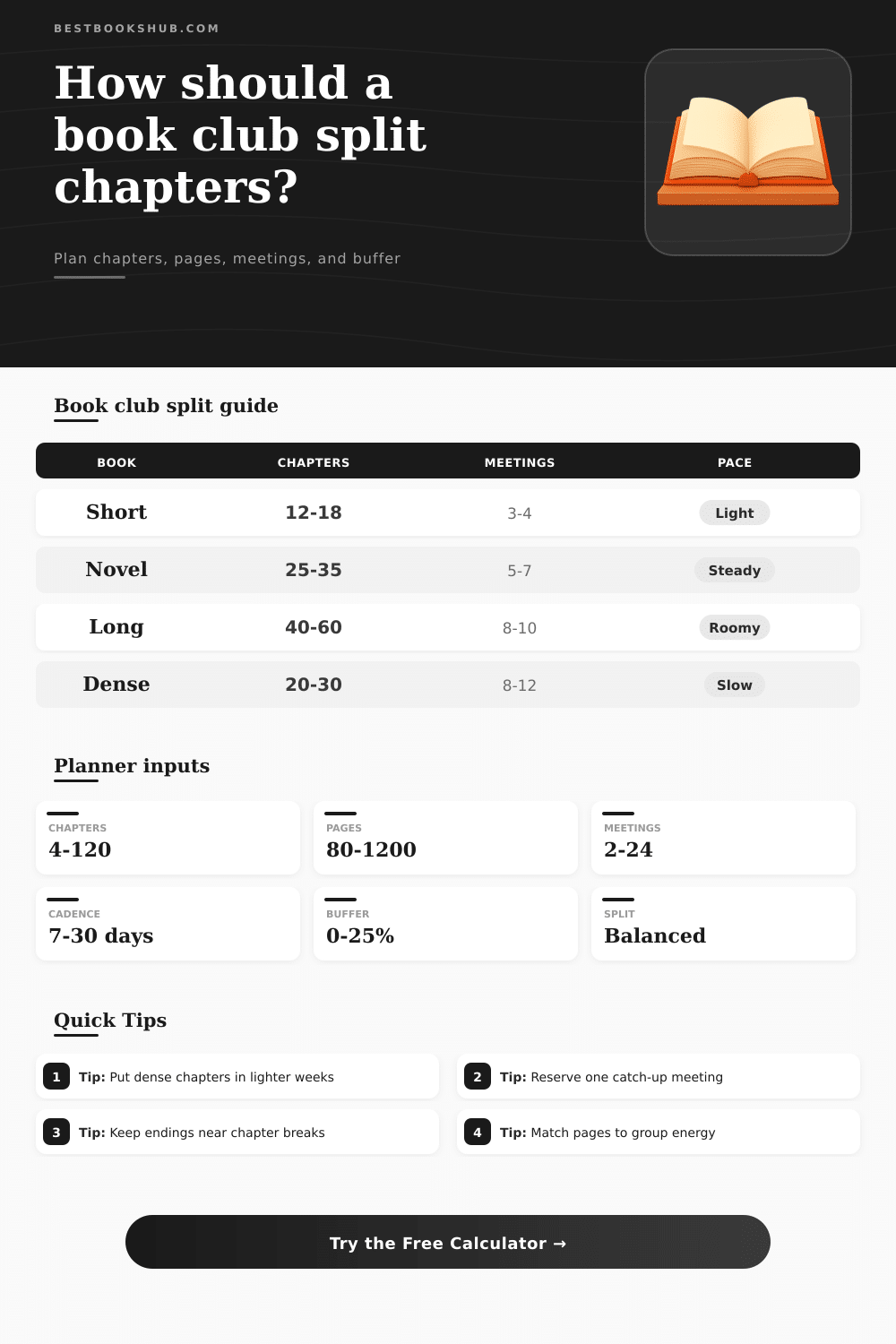
The remaining variables are all dictated by meeting cadence. If you’re meeting weekly, then your load need to be lighter, typically capped at about fifty pages per meeting for fast-paced fiction, but more difficult with epic fantasies and non-fiction books that dig deep into subject matter. For monthly groups, your assignment can get larger, sometimes as high as two-hundred-plus pages. There is also the issue of memory loss. Readers will have forgot what happened in the early chapters when they finally reach the climax. Bi-weekly tends to be ideal frequency for most groups, giving them ample opportunity to chew on heavy concepts while not yet losing track of story. These sweet-spots are outlined concisely in the reference table above.
One variable people don’t think of is discussion depth. You want to match number of pages with how much time you spend actualy talking about them. If you’re generally a gabby bunch that talks for an hour and a half, then you’ll have fewer pages to assign as it shouldn’t encroach on chit-chat time. For a group that needs to chat for 30 minutes, you’ll want to add more pages as they will help fill out the agenda. These two things balance each other, making sure neither feel rushed.
At its heart, a good book club isn’t about meeting a random number, it’s about enjoying a shared experience; that means it’s rooted in empathy far more then arithmetic. Think of the math as guidance, not gospel, and be flexible when needed. Feel free to skip the confusing prologue and cheer plot twists, even if you’re three pages off pace. It’s only when the mechanics become a beat that the true discussion comes out: the moment when reading becomes alive for everyone involved, it should of been more organic.