📚 Member pace planner
Book Club Members Pace Calculator
Estimate the daily reading pace your club needs, compare average and slowest-member progress, set check-in milestones, and see whether the group can finish before discussion day.
| Book length | 7 days | 14 days | 21 days |
|---|---|---|---|
| Short book, 180 pages | 26 pages per day | 13 pages per day | 9 pages per day |
| Standard novel, 320 pages | 46 pages per day | 23 pages per day | 16 pages per day |
| Long novel, 480 pages | 69 pages per day | 35 pages per day | 23 pages per day |
| Dense nonfiction, 360 pages | 52 pages per day | 26 pages per day | 18 pages per day |
| Progress signal | What it means | Pace response | Meeting adjustment |
|---|---|---|---|
| Average is near target | Most members are moving steadily. | Keep the current page goal. | Use normal full-book questions. |
| Slowest member far behind | A few readers may need a catch-up lane. | Send smaller daily targets. | Avoid early spoiler-heavy prompts. |
| Target finishers below goal | The club may not be ready for the ending. | Add check-ins or trim pages. | Plan section-based discussion. |
| Many members already done | The group can deepen discussion. | Optional notes or quotes work well. | Reserve time for themes and ending. |
| Check-in pattern | Best for | Milestone style | Host note |
|---|---|---|---|
| One midpoint check | Short books or relaxed clubs. | 50% page mark. | Ask for no-spoiler reactions. |
| Two check-ins | Most monthly discussions. | One-third and two-thirds. | Flag the next page target clearly. |
| Three check-ins | Long or dense books. | 25%, 50%, and 75%. | Use quick polls to reduce friction. |
| Weekly check-ins | Large clubs with varied schedules. | Even page targets. | Keep reminders short and specific. |
DISCLOSURE: This post may contain affiliate links, meaning when you click the links and make a purchase, I receive a commission. As an Amazon Associate I earn from qualifying purchases.
In that way, a book club chat group before meeting day are full of silent panic: here’s one person with some tired emoji comment and another talking about how they figured out the ending on page two-hundred. It is pressure-inducing. No one knows if you’re all keeping pace with each other. Can we realisticly read this together? You want to know so you don’t feel like you’re going to get lectured at during the meeting.
This is where the calculator come in. By taking your fuzzy intuition and turning it into concrete daily page targets, it let you plot out the uncertainty. How many more days? How many total pages? And where are they at their slowest? Most folks think about the middle (the “average” pace), but that’s what obscures reality.
How to Plan Your Book Club Reading Schedule
If you have an avid reader who’s making great time then you need one strategy. But if someone is barely at page 40 in a 300-pager, you’re gonna need another approach. Keeping track of the bottom ensure everyone stays together. Why? It makes you admit there is a bottleneck.
The other question: How many days do you want as a buffer? Books don’t always go as planned. There’s life. And then there’s the fact that books aren’t always as light than their covers make them look. You can include a certain percentage of days as a cushion in case things get tricky. This is good when you have a jam-packed week or if you’re reading something hard. Easy novels might be quick, but heavy non-fiction or a challenging classic might takes longer to read, because it demands more out of your brain.
Reading speed = retention + comprehension. If you don’t account for that, the plan may seem like it won’t fit even though raw page number looks feasible. The output of the math running are a picture of readiness, it reveals who’s probably going to make it, and who’s maybe not. And it allows you to adjust your discussion approach early in the game.
If the estimated finish rate is low, then redirect your conversation questions from the last few chapters and talk about themes everybody’s already experienced. That slight change prevents an awkward, exclusive conversation and acknowledges where everyone actualy is instead of pretending they are all at the same point.
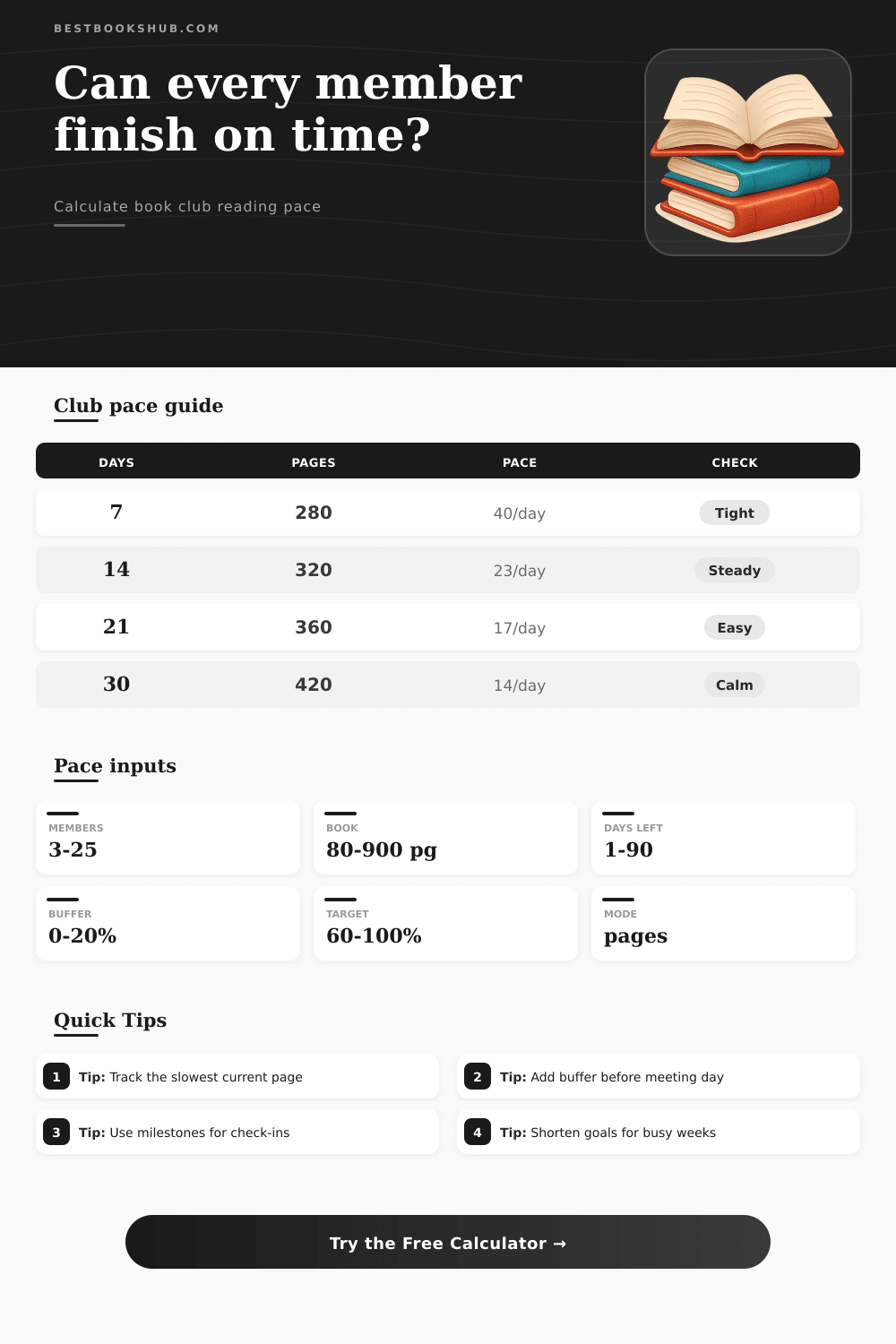
To put it simply, there’s a page of reference tables that breaks down typical scenarios so you can get a sense of what to expect right off the bat. For example, if you’re reading a short book during the week, you need to consume more pages per day than when you have a longer novel and plan to stretch it out over a month. These are good indicators to set an achievable goal straight from the beginning. That way you don’t realize halfway through that the rate at which you were going wasn’t sustainable.
Beyond the end goal, however, is the timing of the check-ins themselves. Too many or too few can go wrong here. I’ve found that a single mid-point check isn’t enough to pull lagging readers back into the fold; by then it’s too late. Instead, more low-friction check-ins at a higher frequency keep things moving while reducing the mental load on your members.
You can choose your desired frequency and from there, the tool will suggest the milestone-based target dates. Now when you contact them for an update, you’ll know exactly how far along they should be (e.g., “I’d love if you could get through 50 pages” rather than “How’s my book coming along?”). It makes things easier for both sides: readers have clear goals in the short term, not one massive mountain.
In the end, it’s not about whether the book is good or bad; it’s about the pace of your collective read: Does the group feel comfortabley? Judged? Supported? By removing some of the rough spots from planning, by using data… You can concentrate on what really counts: talking about books.
You don’t want to begin the conversation apologizing for yourself or anyone else. Creating a realistic buffer by anticipating the slowest reader and not stressing them out about catching up allows the pleasure of reading to remain pure. It’s less about getting it right than doing it. If you create a plan with enough room for reality, then every person can participate on their terms when they do sit down to discuss the book.
This is why book clubs sticks through the story and season. This is what bonds us all in those moments: we feel like we’re finished together.