📚 reread value lab
Book cost per reread calculator
Measure how a book's net ownership cost changes when you reread it, resell it, lend it out, borrow alternatives, or count reading time as part of the value.
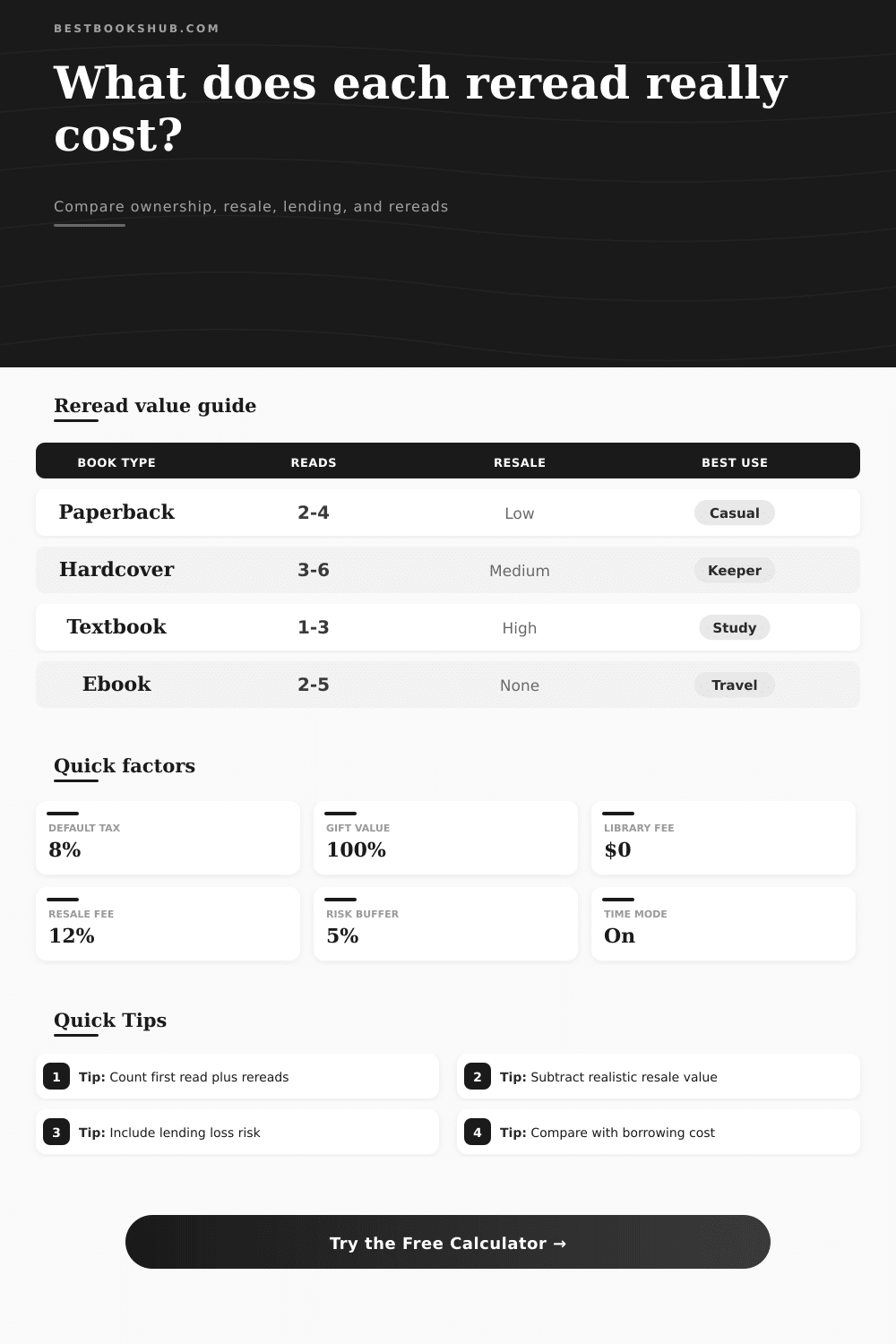
| Format | Typical purchase amount | Common resale value | Useful reread range | Calculation note |
|---|---|---|---|---|
| Paperback | $8 to $20 | 5% to 25% | 2 to 4 reads | Often low resale, but easy to lend and keep. |
| Hardcover | $18 to $35 | 15% to 45% | 3 to 6 reads | Higher upfront amount can be offset by resale. |
| Ebook | $3 to $16 | 0% | 2 to 5 reads | No resale in most storefronts, but no shelf cost. |
| Audiobook | $8 to $30 | 0% | 1 to 4 listens | Use listening hours as the time denominator. |
| Textbook | $40 to $220 | 20% to 70% | 1 to 3 cycles | Strong resale can dominate the final net amount. |
| Graphic novel | $10 to $35 | 10% to 40% | 2 to 7 reads | Shorter read time makes per-hour math jump quickly. |
| Collector edition | $35 to $150 | 30% to 100% | 2 to 8 reads | Resale and kept value should be estimated conservatively. |
| Library or borrowed | $0 to $5 | Not applicable | 1 to 3 reads | Fees, travel, or wait cost become the meaningful inputs. |
| Scenario | Starting amount | Rereads | Resale after fees | Approx cost per read |
|---|---|---|---|---|
| Mass-market paperback kept | $9.99 | 2 | $0.00 | $3.33 across 3 reads |
| Hardcover favorite kept | $28.00 | 5 | $0.00 | $4.67 across 6 reads |
| Hardcover resold at 35% | $28.00 | 1 | $8.62 after 12% fee | $9.69 across 2 reads |
| Ebook sale purchase | $4.99 | 3 | $0.00 | $1.25 across 4 reads |
| Textbook resold at 55% | $120.00 | 1 | $58.08 after 12% fee | $30.96 across 2 reads |
| Borrowed with travel fee | $2.00 | 0 | $0.00 | $2.00 across 1 read |
| Net copy amount | Borrow fee per read | Reads to match | Rereads after first read | Meaning in the calculator |
|---|---|---|---|---|
| $8 | $2 | 4 reads | 3 rereads | Ownership wins after the third reread. |
| $15 | $3 | 5 reads | 4 rereads | One reader needs several return visits. |
| $25 | $5 | 5 reads | 4 rereads | A favorite hardcover can reach parity. |
| $60 | $10 | 6 reads | 5 rereads | Works mainly for reference or study copies. |
| $100 | $15 | 7 reads | 6 rereads | Resale assumptions matter a lot. |
DISCLOSURE: This post may contain affiliate links, meaning when you click the links and make a purchase, I receive a commission. As an Amazon Associate I earn from qualifying purchases.
Once you’ve paid for a book, it’s easy to stop considering its cost. If you intend to keep that book, however, this would be a mistake. When it is sitting on your shelf, whether in digital or physical form, it stops being something bought and becomes something owned. It is an asset that loses value over time, a thing you return to repeatedly to create new experiences.
At what point do you expect to reread it? How does choosing between a subscription and a purchase relate to how many rereads you expects to do? Do you know yourself well enough to believe in the cost? If you choose how much of an owner you want to be, the calculator does the math for you. It also makes you face the unseen expenses most people overlook.
How Much Does a Book Really Cost?
If you’re in a small apartment, shelf space isn’t free. And even if you don’t earn money with your time, time is not without value. You run a slight risk that lending a book to a friend will result in loss or damage (reducing the copy’s total value). A hardcover book you love may end up being cheaper-per-read than a cheap paperback you’ll never open again.
If resale value matters, it can reduce net ownership cost. Because the tool removes your expected future returns, it shows you the actual net cost of ownership. Buy paperbacks: They’re less expensive up front (which doesn’t matter much if you think of your library as a consumption stream), but they won’t get you much when you sell them back.
Buy hardcovers: They’re more expensive up front, but they’ll sell for more when you do part with them. There’s a balance here that matters if you consider your library as a collection (i.e., you want to keep what you own). Say you purchase a $20 book, read it twice, then sell it back for ten bucks. You paid $10 in net cost. That is two reads at five bucks apiece.
Alternatively, say you never sell a $15 paperback book. This means you got one read out of it at a cost of seven dollars per read. If you plan to read it just once, go paperback. If you’re hoping to read it many times before parting ways, go hardcover. It depends on the format.
The ebook throws a wrench into all of that. It’s not limited by physical form. No more wearing down your books’ spines; on the other hand, no more selling them back when you’re done. The whole price of the book goes straight into the license fee, so the more rereads you can get out of it, the better. You need to get your money’s worth each time. This is so much more important with ebooks. That explains why my calculator adds a column that zeroes out resale expectations if you choose an electronic version.
But what about textbooks? That’s another beast entirely. Textbooks are pricey, heavily used for just one semester, and eventually get tossed aside. Your best recourse: resale. By selling off your book while it’s still relevant you can cut your actual cost-per-read down significantly. Wait too long and you’ll have to take a hit equal to the entire amount paid upfront.
The tool provides a detailed break-even calculation that illustrates the number of times a book must be shared or reread to justify ownership over borrowing. The single most subjective input is time value. For some readers, every hour they spend with a book represents immeasurable joy, beyond the scope of financial reckoning. For others, each hour has a price tag. Once you introduce that factor into the equation, it turns what might have been viewed as an expense into an investment. If you value an hour spent reading at $10, re-reading a favorite book three times yields a $30 personal return on investment. While this won’t appear on your bank statement, it’s a very real feeling of enrichment.
Keep it simple at first: Use reasonable buy-in numbers, and estimate the sale price conservatively. The book market has a bit of a forgiving nature (it’s not super-generous, though), and most folks tend to overvalue their used books. When in doubt, don’t count on reading your books again. Yes, we’d all love to re-read our favorite titles, but let’s face it: Life happens. Stick with the safe side; use a conservative number, and you’ll have some good data to work from.
Then there are the reference tables on the page which present the usual range of numbers per format. Treat these as guidelines, as a set of guard rails to bounce off when making your decisions, not hard-and-fast rules. Ultimately, the end number will depend on how quickly you read, what kind of fees (if any) you pay at your library, and what amount of clutter you can tolerate. It’s less about getting it right and more about seeing the tradeoffs: Maybe you’ll save both space and money by purchasing fewer books but rereading more.
Attention is a form of money, and reading is an act of spending. What does it cost you to reread something? If you track how much it costs to reread, you’ll know if your behavior matches your values. Your unclear preferences become real decisions. You’ll begin to view every book differently: not only its upfront cost but also the long period of enjoyment after you buy it. And that’s valuable beyond the cost of this tool.