📖 Reading day planner
Book length to reading days calculator
Convert pages, words, or chapters into realistic reading days using your remaining progress, weekday time, weekend time, pace, note-taking, rereads, and schedule buffer.
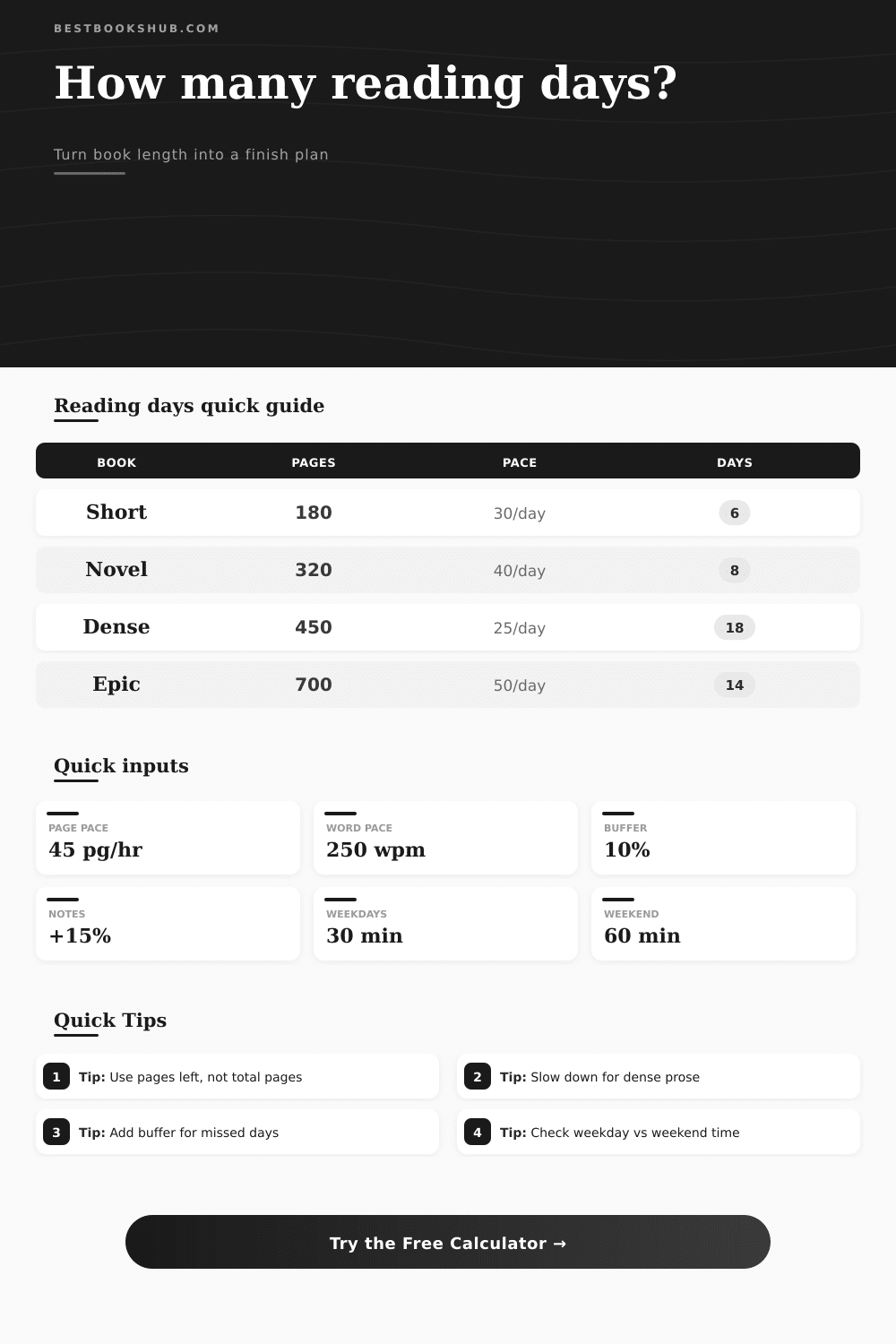
| Book length | 30 min/day | 45 min/day | 60 min/day | Best use |
|---|---|---|---|---|
| 180 pages, light prose | 8 to 10 days | 5 to 7 days | 4 to 5 days | Short novels, memoirs, novellas |
| 320 pages, standard prose | 15 to 17 days | 10 to 12 days | 8 to 9 days | Book clubs, typical adult fiction |
| 450 pages, dense prose | 30 to 34 days | 20 to 23 days | 15 to 17 days | Classics, literary nonfiction |
| 700 pages, epic length | 34 to 39 days | 23 to 26 days | 17 to 20 days | Fantasy, biography, large history |
| Reading speed | Page density | Pages per hour | 30 minute yield | Notes impact |
|---|---|---|---|---|
| 200 wpm | 250 words/page | 48 pages | 24 pages | Light notes: about 21 pages |
| 250 wpm | 250 words/page | 60 pages | 30 pages | Regular notes: about 26 pages |
| 250 wpm | 350 words/page | 43 pages | 21 pages | Study notes: about 17 pages |
| 300 wpm | 225 words/page | 80 pages | 40 pages | Review pass: about 36 pages |
| Schedule | Weekly minutes | At 45 pg/hr | 320 pages takes | Plan style |
|---|---|---|---|---|
| 20 min weekdays | 100 minutes | 75 pages/week | About 5 weeks | Gentle habit |
| 30 min weekdays | 150 minutes | 113 pages/week | About 3 weeks | Steady routine |
| 30 plus weekends | 270 minutes | 203 pages/week | About 2 weeks | Book club push |
| 60 min daily | 420 minutes | 315 pages/week | About 1 week | Focused finish |
DISCLOSURE: This post may contain affiliate links, meaning when you click the links and make a purchase, I receive a commission. As an Amazon Associate I earn from qualifying purchases.
You bought a heavy novel with good intentions. It spent three months on your nightstand as you scrolled through your phone in bed. Then one day, you finally sat down and discovered that it’s harder to finish then expected, because nobody told you just how long it would take.
“The difference between people who start books and people who finish them isn’t about willpower. It’s math, specifically bad math. Most of us think we’re reading 30 pages per evening. But we forget that some nights is tiring, some chapters are hard, and sometimes life gets in the way. A plan bridges this gap. It turns our vague goal (read more!) into a daily habit, one that fits our real lives instead of an idealized version of our free time.
Why a Reading Plan Works
When you enter your available minutes and remaining length into the calculator up top, it does all the tricky math for you. You will no longer has to guess whether you’ll make it under the wire on exam day (or book club).
The trickiest entry that many readers forget is text density. Even if two pages have roughly equal word counts, the one full of breezy commercial fiction will take far less time than the other, stuffed with dense academic prose and footnotes. This is where difficulty adjustment comes into play. Sure, you may be a fast reader; but if there’s a lot of hard jargon or clunky sentence structure, it’ll slow your pace down, despite your best efforts. Adjusting for this means not getting annoyed when you’re just a little off your goal for the day, all because material bogged you down.
How does this compare to reading for leisure versus reading for work? Reading for work involve taking notes or annotations. You’re not only digesting content; you’re also processing it. That’s an additional mental effort which will add time to each page. For example, there are fields in the calculator for note-taking and rereading buffers. Those percentages compound across hundreds of pages; they matter more than people think.
If you want to be safe from any occasional rereads, just tack on a 10% buffer to your schedule and you’ll find that your plan holds up through even those pesky parts that need another go-through. Better to have some slack built into the schedule than to hit a wall when things gets difficult.
Your available time matters just as much as your speed. The typical schedule is uneven. Weekdays you’ve got 30 minutes, while weekends offer an hour. An overall daily average of (say) 45 minutes hides all this. You end up short on time on busy Tuesdays when finishing your goals would of been nice.
Separating weekend/weekday inputs creates a model of the rhythm of your life. By honoring your true weekly energy, it keeps your finish date accurate and turns a daunting mountain into doable steps.
On this page, there’s also a handy little reference table explaining how different speeds will affect your timeline for standard-length books: As you can see, it looks like twenty pages per day feels manageable over time. You could easily sustain that pace for months. However, it would become tedious for shorter time periods if you’re trying to read fast. Sixty pages a day seems doable for a week or so, but it’ll burn you out after a couple of months. Usually, the sweet spot is somewhere in between: not necessarily intense, but consistent.
And as it turns out, the key to finishing long books are to find a pace that you can stick with (without resentment). First, be honest about where you are in the book. Are there only 50 pages left? Then you’re carrying less weight than you think. The act of recording how many pages you’ve already read changes the timeline right away. That alone is sometimes all it takes to give yourself a psychological lift.
Because it reminds you that you haven’t started at “zero.” You’ve just got to finish what you’ve started. In the end it all comes back to removing the friction from intention to action. Having an exact number of days to go and knowing your daily target removes the vagueness that reading has become for most people. Instead of wondering if you are going to finish or not, you focus on finishing one chapter today.
The math wipes out the mental clutter and lets you do what you came there to do: read. That’s where the joy comes back in. Open the cover. Follow the plan. Close the book right on time.