📖 Book Margin Calculator
Calculate precise inner, outer, top & bottom margins for any book size and binding type
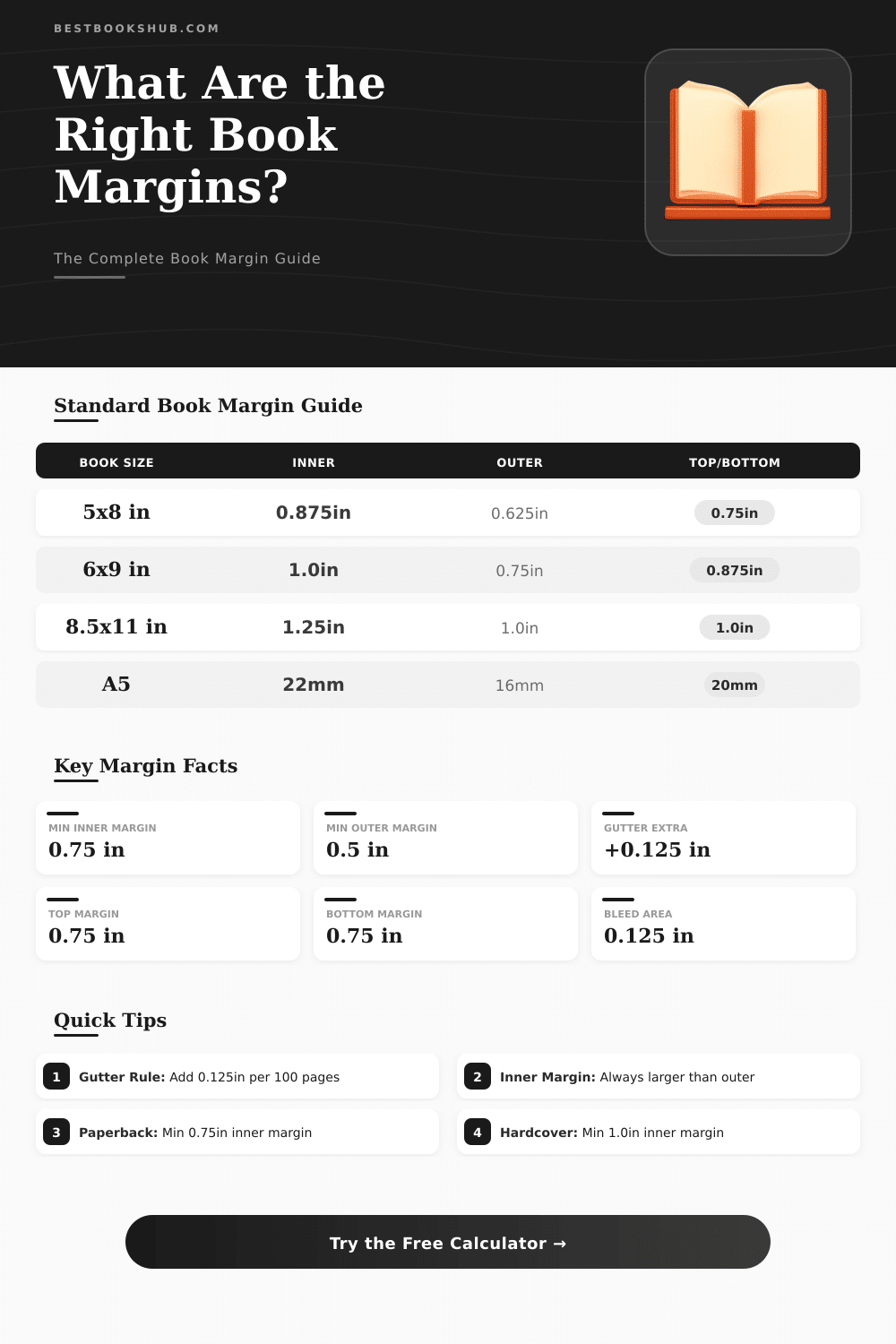
| Book Size | Inner Margin | Outer Margin | Top Margin | Bottom Margin |
|---|---|---|---|---|
| 4.25 x 6.87 in (Mass Market) | 0.75 in / 19mm | 0.5 in / 13mm | 0.75 in / 19mm | 0.75 in / 19mm |
| 5 x 8 in (Pocket) | 0.875 in / 22mm | 0.625 in / 16mm | 0.75 in / 19mm | 0.875 in / 22mm |
| 5.5 x 8.5 in (Trade) | 0.875 in / 22mm | 0.625 in / 16mm | 0.875 in / 22mm | 0.875 in / 22mm |
| 6 x 9 in (Standard Novel) | 1.0 in / 25mm | 0.75 in / 19mm | 0.875 in / 22mm | 1.0 in / 25mm |
| 7 x 10 in (Large Print) | 1.125 in / 29mm | 0.875 in / 22mm | 1.0 in / 25mm | 1.125 in / 29mm |
| 8.5 x 11 in (Textbook) | 1.25 in / 32mm | 1.0 in / 25mm | 1.0 in / 25mm | 1.25 in / 32mm |
| A5 (5.83 x 8.27 in) | 22mm / 0.87 in | 16mm / 0.63 in | 20mm / 0.79 in | 22mm / 0.87 in |
| A4 (8.27 x 11.69 in) | 32mm / 1.26 in | 25mm / 0.98 in | 25mm / 0.98 in | 32mm / 1.26 in |
| Page Count | Extra Gutter (in) | Extra Gutter (mm) | Binding Suitability |
|---|---|---|---|
| 1 – 60 pages | 0.0 in | 0 mm | Saddle Stitch preferred |
| 61 – 100 pages | +0.0625 in | +1.6 mm | Saddle Stitch or Perfect |
| 101 – 200 pages | +0.125 in | +3.2 mm | Perfect Bind standard |
| 201 – 300 pages | +0.25 in | +6.4 mm | Perfect or Case Bound |
| 301 – 400 pages | +0.375 in | +9.5 mm | Case Bound recommended |
| 401 – 600 pages | +0.5 in | +12.7 mm | Case Bound required |
| 601+ pages | +0.625 in | +15.9 mm | Case Bound or split volume |
| Book Size | Page Area (sq in) | Printable Area (sq in) | % Printable |
|---|---|---|---|
| 4.25 x 6.87 in | 29.2 sq in | 17.8 sq in | 61% |
| 5 x 8 in | 40.0 sq in | 25.9 sq in | 65% |
| 5.5 x 8.5 in | 46.8 sq in | 31.1 sq in | 66% |
| 6 x 9 in | 54.0 sq in | 36.7 sq in | 68% |
| 7 x 10 in | 70.0 sq in | 49.6 sq in | 71% |
| 8.5 x 11 in | 93.5 sq in | 66.5 sq in | 71% |
“Book Margin” is one of those words whose meaning changes according to the speaker. It can mean the white area around a page, the idea of personal free space in life, or even an app for tracking books. Each of those parts deserves a look.
DISCLOSURE: This post may contain affiliate links, meaning when you click the links and make a purchase, I receive a commission. As an Amazon Associate I earn from qualifying purchases.
We start with the physical page itself. Margins form the empty areas between the text and the edge of the paper. Designers call that “negative space” and although they are not printed on, they serve a practical role.
What Margin Means
After you decided the size of your book, the next step is to determine where to lay the block of text. The ideal margins depend entirely on the format. A book of 6 by 9 inches requires a totally different setup than one of 8 by 11 inches.
For small books with 6 by 9 inches or smaller, one considers around half an inch for the top, the outer edge and the bottom. The inner margin, where the binding is, usually should be three-quarters of an inch.
Here is the main point: the thicker your book, the bigger those margins must be, especially the inner gutter along the spine. That extra space stops the text from seeming swallowed by the binding, which would make reading almost impossible. Books with spiral binding have their own needs, you need enough margin space for the holes that the binding requires.
Most designers aim for between 55 and 80 characters per line, including spaces. But if your book goes past 400 pages, it is best to choose teh bottom limit and give that gutter enough breathing space.
Quite funnily, those wide margins in old books did not always serve only for beauty. Rodents liked to bite the edges, ripped paper seems ideal for nesting material. Broader margins gave the main content a chance to survive even when little creatures nibbled at the sides.
Margins also help readers very practically. This is wear one makes notes, where folks write their ideas in school books or library ones. There is even a famous quote that says the margin notes in some books end up being more interesting than the main text itself.
The number of pages in a book commonly depends on several factors. The choice of font, the size of the letters and how much spacing one uses can change the same story by dozens of pages, without changing one word.
So, there is Margin, the app. It helps to track books and connect readers with tips. It has even a built-in system similar to Tinder mixed with Goodreads, for seeing what others read.
Recently, there is a real book called “Margin” by doctor Swenson, that looks at the topic totally differently. He describes margin as the distance between your current state and your limits, the free space that is missing. The problem is that many of us live without any margin today, worn out by too much pressure and stress.
According to Swenson, modern life removes that margin, and getting it back is key for mental health, physical wellness, relationships and everything that follows. When one manages to create margin, something changes: suddenly there is time, energy andresources to invest in the folks around you.