📦 Storage packing planner
Book storage box calculator
Estimate how many books fit in a storage box by matching internal box dimensions, book format, stack orientation, fill factor, volume, and safe lifting weight.
| Book format | Typical dimensions | Average weight | Packing note |
|---|---|---|---|
| Mass market paperback | 6.75 x 4.25 x 0.70 in | 0.45 lb | Dense and weight-limited quickly in small boxes. |
| Trade paperback | 8.0 x 5.25 x 0.75 in | 0.85 lb | Good baseline for mixed fiction and nonfiction. |
| Standard hardcover | 9.25 x 6.25 x 1.10 in | 1.25 lb | Often reaches lifting limits before volume is full. |
| Textbook | 10.5 x 8.25 x 1.25 in | 2.80 lb | Use lower fill factors and smaller boxes. |
| Picture book | 11.0 x 8.5 x 0.35 in | 0.90 lb | Flat stacks usually protect corners better. |
| Comic or graphic novel | 10.25 x 6.75 x 0.25 in | 0.28 lb | High counts are possible if weight cap allows. |
| Large art book | 12.0 x 10.0 x 1.0 in | 3.50 lb | Heavy, oversized, and best packed flat. |
| Box type | Internal size | Volume | Book storage use |
|---|---|---|---|
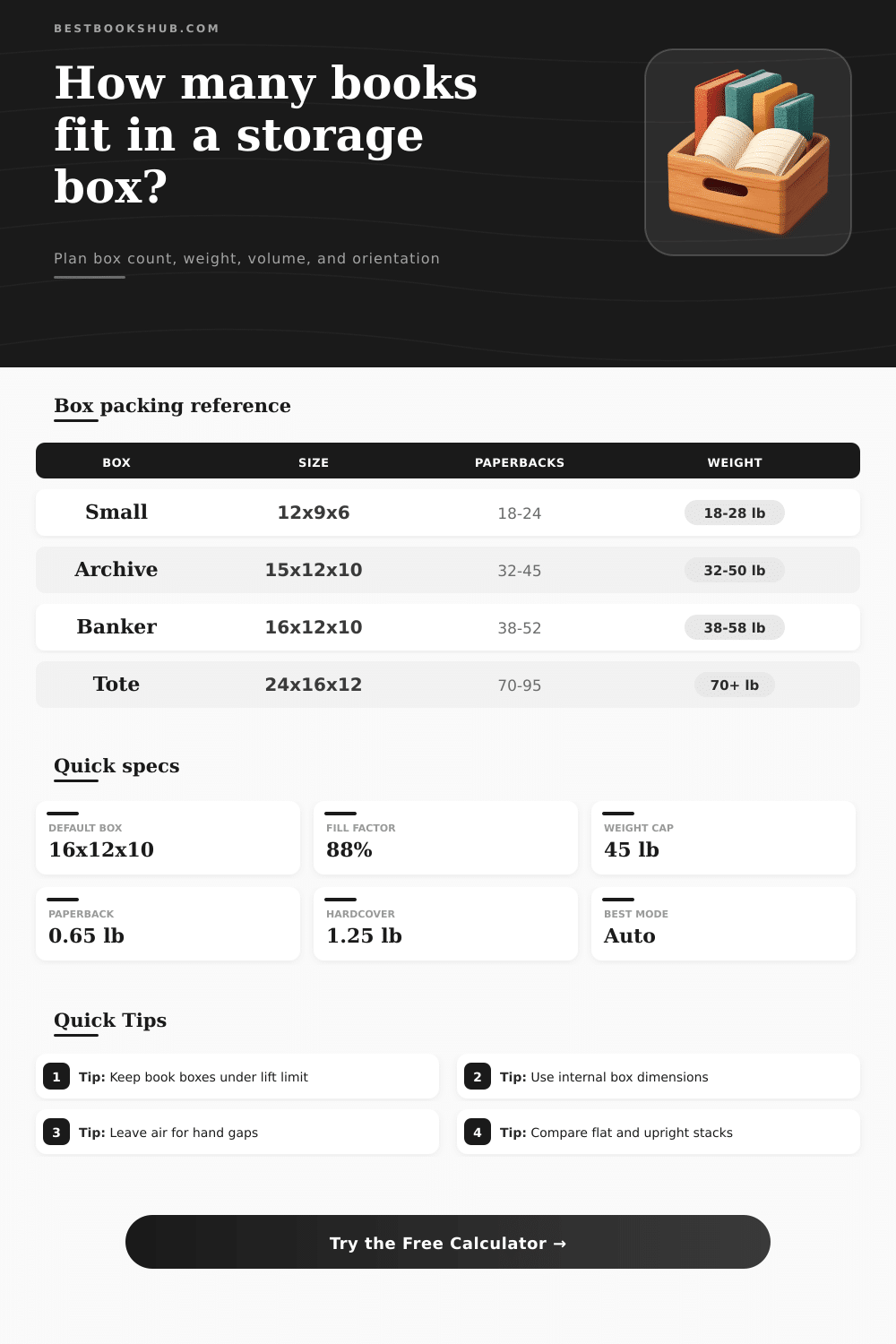
| Small book carton | 12 x 9 x 6 in | 0.38 cu ft | Short moves, heavy hardcovers, and rare books. |
| Archive storage box | 15 x 12 x 10 in | 1.04 cu ft | Balanced size for paperbacks and documents. |
| Banker file box | 16 x 12 x 10 in | 1.11 cu ft | Common choice for upright rows and mixed books. |
| Comic short box | 15.5 x 7.5 x 10.75 in | 0.72 cu ft | Designed around upright comics and slim volumes. |
| Medium moving box | 18 x 14 x 12 in | 1.75 cu ft | Use only if the weight limit is controlled. |
| Plastic tote | 24 x 16 x 12 in | 2.67 cu ft | High volume, but books can become too heavy fast. |
| Orientation | Dimension model | Best for | Watch point |
|---|---|---|---|
| Flat stacks | Book height by cover width, layers by spine | Hardcovers, picture books, art books. | Large footprints can waste side space. |
| Upright rows | Cover width across length, spines through depth | Paperbacks and banker-style boxes. | Book height must fit inside box height. |
| Spines up | Spine by book height grid, cover width vertical | Sorting by title or visible spines. | Can be unstable with uneven book sizes. |
| Mixed by volume | Usable volume divided by book volume | Odd mixes and loose packing estimates. | Needs a realistic fill factor. |
| Planning rule | Typical value | What it protects | Calculator field |
|---|---|---|---|
| Comfortable lift limit | 30 to 45 lb | Hands, backs, and box seams. | Safe loaded box limit. |
| Tight archive fill | 90 to 96% | Maximizes storage for uniform books. | Fill factor. |
| Mixed household fill | 75 to 88% | Leaves room for size variation. | Fill factor. |
| Fragile or rare books | 60 to 75% | Allows padding and less compression. | Fill factor. |
DISCLOSURE: This post may contain affiliate links, meaning when you click the links and make a purchase, I receive a commission. As an Amazon Associate I earn from qualifying purchases.
This will calculate how many boxes you’ll need for your books and also help prevent you from guessing. Just enter your book type(s) as well as size of the box. It calculates exactly how many boxes you’ll need. This will keep your books safe and your back free from pain, to.
If you’re packing paperbacks, it’s easy to overestimate volume. Your big plastic tote might appear full of books, but they’re dense! Paperbacks pack in every nook and cranny so the box grows heavy long before you can pick it up off the floor. Set a safe weight limit on the tool, typically about thirty-five pounds for most people. It’s not an arbitrary number: that’s when your back starts to hurt, and when the cardboard seams starts to give out. When you hit the weight limit, the result might show fewer books per box different than you’d imagined. And this is a good thing; you don’t want to get injured.
Tips for Packing Your Books Safely
Finally, think about how you pack the books on top of each other. Upright packing keeps spines visible and covers flat, but it require uniform heights. Mixing book types like mass-market paperbacks and textbooks creates gap that cause instability. Flat packing (where they lie down, protecting the corner from damage) can hold mixed sizes; the downside is it take up more height within the box. The calculator has button to switch back and forth and shows you what gets packed into the box under each orientation. Go for upright packing if your books are still readable enough for you to use, e.g., in accessible storage. Otherwise, flat packing is great for an archive or moving stuff around where you won’t be needing it soon.
Fill factor is more important than you would think. You don’t want to set it so high that you assume all your books are nice and square and fit neatly onto a grid with no air spaces. Books warp, spines bend. Real life gets messy. And then when you try to put your hands in there they rips a page out. To compensate for this friction, drop down your fill factor to 80% or less. Yes, you might end up needing one more box to do so, but the books won’t be crushed going back and forth while being stored/transported. It’s not only about capacity, but also about control.
Choosing the right box size is less about capacity and more about control. A banker’s box is always a good choice. It hold hardcover books, and it’s a narrow box.” For heavy art books (dense and heavy!), small cartons will do. What about glossy books? You don’t want to try packing them into a big moving box or they’ll get damaged. Switching between presets allows you to see how different container shapes and different formats works together.
Add a 10% buffer to that for overkill/insurance in case you goofed on your calculations. That’s for heavier books that throw off your weight calculations. It’s also for odd shapes that don’t match your typical spine width. You want to end up with a quantity of boxes that doesn’t feel like too much to carry, stack, etc.
Storage planning is also physics-based: Paper and glue have their own set of rules. The spine will be as flexible as the amount of use it gets. Seams is only as strong as the weakest one. Respect the spine and give yourself some wiggle room by understanding dimensions and following weight limit. You’ll have less back trouble when it’s time to unpack, and your books will stay more intact than when you first packed them.