⏳ Lifetime reading planner
Books left to read in lifetime calculator
Estimate how many books still fit in your reading life from your age, horizon, annual pace, page pace, average book length, skipped years, rereads, backlog, and personal goal list.
Each preset fills a different reading life: casual, commute-heavy, long-form, retirement, study, and priority-list planning.
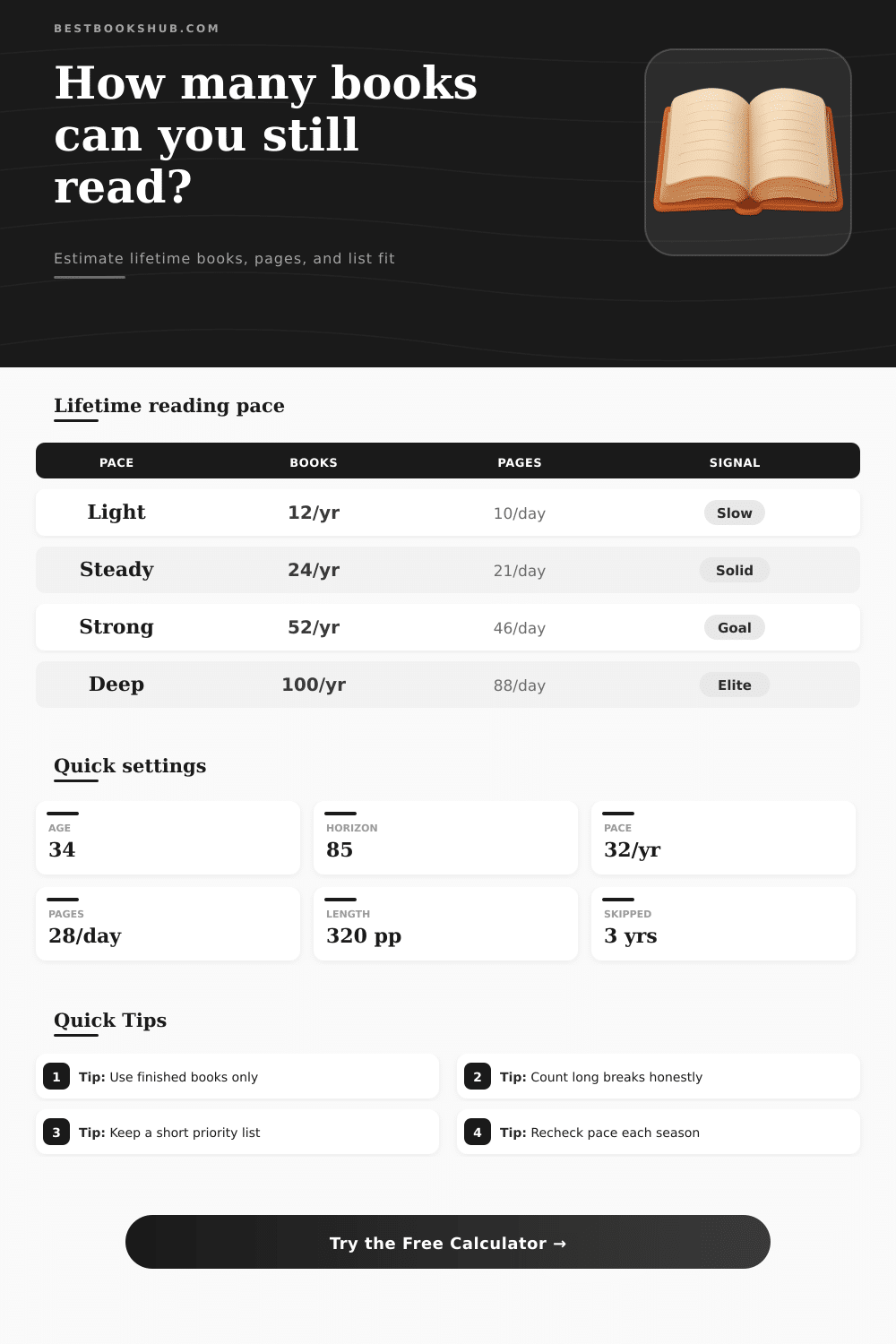
| Reading pace | Books per year | Approx pages per day | Lifetime signal |
|---|---|---|---|
| Casual shelf browser | 6 to 12 | 5 to 11 pages | Best for a narrow priority list and no guilt backlog. |
| Steady general reader | 18 to 36 | 16 to 32 pages | Enough for hundreds of titles across a long horizon. |
| Book-club plus reader | 40 to 60 | 35 to 53 pages | Can clear big lists if long books and breaks are managed. |
| Heavy challenge reader | 75 to 120 | 66 to 105 pages | Powerful capacity, but rereads and burnout deserve space. |
| Average book length | Page profile | 30 pages/day yields | Planning note |
|---|---|---|---|
| Short books and novellas | 160 pages | 68 books/year | Book count rises quickly; track pages too. |
| Typical fiction mix | 300 pages | 36 books/year | A balanced default for many reading logs. |
| Long nonfiction mix | 420 pages | 26 books/year | Count slower study reading separately if needed. |
| Long fantasy or classics | 650 pages | 17 books/year | A small title count can still be a huge reading year. |
| Remaining active years | 20 books/year | 40 books/year | 75 books/year |
|---|---|---|---|
| 10 active years | 200 books | 400 books | 750 books |
| 25 active years | 500 books | 1,000 books | 1,875 books |
| 40 active years | 800 books | 1,600 books | 3,000 books |
| 55 active years | 1,100 books | 2,200 books | 4,125 books |
| Planning choice | What it changes | When to use it | Risk if ignored |
|---|---|---|---|
| Skipped years | Reduces active capacity | Major life shifts or known low-reading periods | Lifetime estimate feels too clean. |
| Reread share | Reduces new-title space | Comfort rereads, study cycles, favorites | Goal list looks easier than it is. |
| Goal-list count | Tests priority fit | Classics list, series list, owned shelf | Backlog grows without a triage rule. |
| Page pace | Audits annual book pace | Mixed book lengths or many long reads | Short books distort the count. |
DISCLOSURE: This post may contain affiliate links, meaning when you click the links and make a purchase, I receive a commission. As an Amazon Associate I earn from qualifying purchases.
Now you’re panicked because you’ve bought another book and realize you have three-hundred sitting on your bookshelf. Money isn’t what this is about anymore; it’s about time. You glance over at the pile and ask yourself, “Will I be able to finish them all before my days run out?”
If you stop viewing reading as a hobby and begin to view it like a limited resource with a defined budget, that anxiety becomes universal, and it can become solvable too. When you plug in your age, your backlog, and your pace, the calculator above do the rest for you so you don’t have to guess whether or not your dreams is grounded in wishful thinking or reality.
How to Use the Reading Calculator
But before you can start making sense of your progress, you have to get the number right. In other words: what do you actualy read? Most of us overestimate our own reading because we remember our peak years while forgetting all the sick days, busy months and nonfiction dumps we abandoned halfway through. That’s why we want your average (not maximum) in there; we’ll adjust for the reality of busy periods, sickness and so forth, plus the fact that maybe you read a bunch of novella.
That’s how the tool works. So how does it work? Enter your daily page count, and we’ll compare that with your total book goal. Those two will either match up, or one of them is lying to you. Chances are, it’s the latter. A light reading year looks like a heavy one when short books bump up the total. The reference table on the page show what happens with different page counts. This lets you see whether you’re really an elite reader or if you simply read a helluva lot of novellas.
There are also rereads. Oh, yes. Here’s where it starts getting real. How many times do you come back and read things you’ve already enjoyed? Because every minute you spend going back and visiting something familiar is a minute that isn’t available for looking at something new. You can input how much wiggle room you want to allow for comfortabley reading, because hey, we all need our anchors.
We’re not doing this forever. We won’t do this forever, not if we want to keep at it long term. Set aside ten or fifteen percent of your bandwidth for re-reading and you’ll not only recognize that some books is so good they’re worth experiencing again, but you’ll also protect yourself against burnout. One little tweak makes all the difference: now you know how much reading time are still available to you.
But there’s this thing called the backlog. Everyone has one. You have signed books from friends, recommendations from well-meaning strangers, and a hundred books purchased on sale. How many? Run them through the calculator. How long would it take at your current speed? The answer depresses you. The answer sets you free.
When you learn you won’t clear the shelf for another dozen years, you know you don’t have to speed-read. You have to curate more carefuly. You begin releasing some of those books. You stop purchasing ones that feel like obligations, choosing only what truly interests you. The tool translates a shapeless pile of pulp into a solid timespan so you can quit without feeling guilty.
Other key inputs include skipped years. Life happens. Burnout. Moves. There is grief. Parenting toddlers. There are career crunches. Zero-reading periods aren’t failures; but if you don’t subtract them from your horizon, your estimate will be wildly optimistic. With the tool, you can deduct those skipped years and get a cleaner view of your active reading window.
It reminds us that reading is like running a marathon with plenty of stoppages in between. It’s not a straight line from twenty-five to eighty-five. So, yes: This isn’t so much about getting through all these books as it is about honoring your attention. You only have so many hours before you die. Some of them will be spent working. Some of them will be spent worrying. Some of them will be spent asleep. Whatever’s left? Well, that’s up to you.
Your goal list (whether you accomplish it or not), serves one important function: It brings clarity. You don’t hide away from possible experiences; you enjoy current ones. Your pile on the shelf no longer represents a monument to all you haven’t gotten around to doing; rather, it represents a menu of choices for what you’ll do before you go.
You won’t read as much, sure. But you will read something with intention which is really where it counts.