📏 Shelf fit and load planner
Bookshelf Capacity Calculator
Estimate how many books a shelf or bookcase can hold from usable shelf length, shelf count, depth, vertical clearance, book format mix, packing allowance, and real book weight data.
Load a named shelf scenario, then adjust the dimensions, format, packing style, and load limit for your own shelves.
| Book format | Typical height x width | Avg spine width | Avg weight | Depth need |
|---|---|---|---|---|
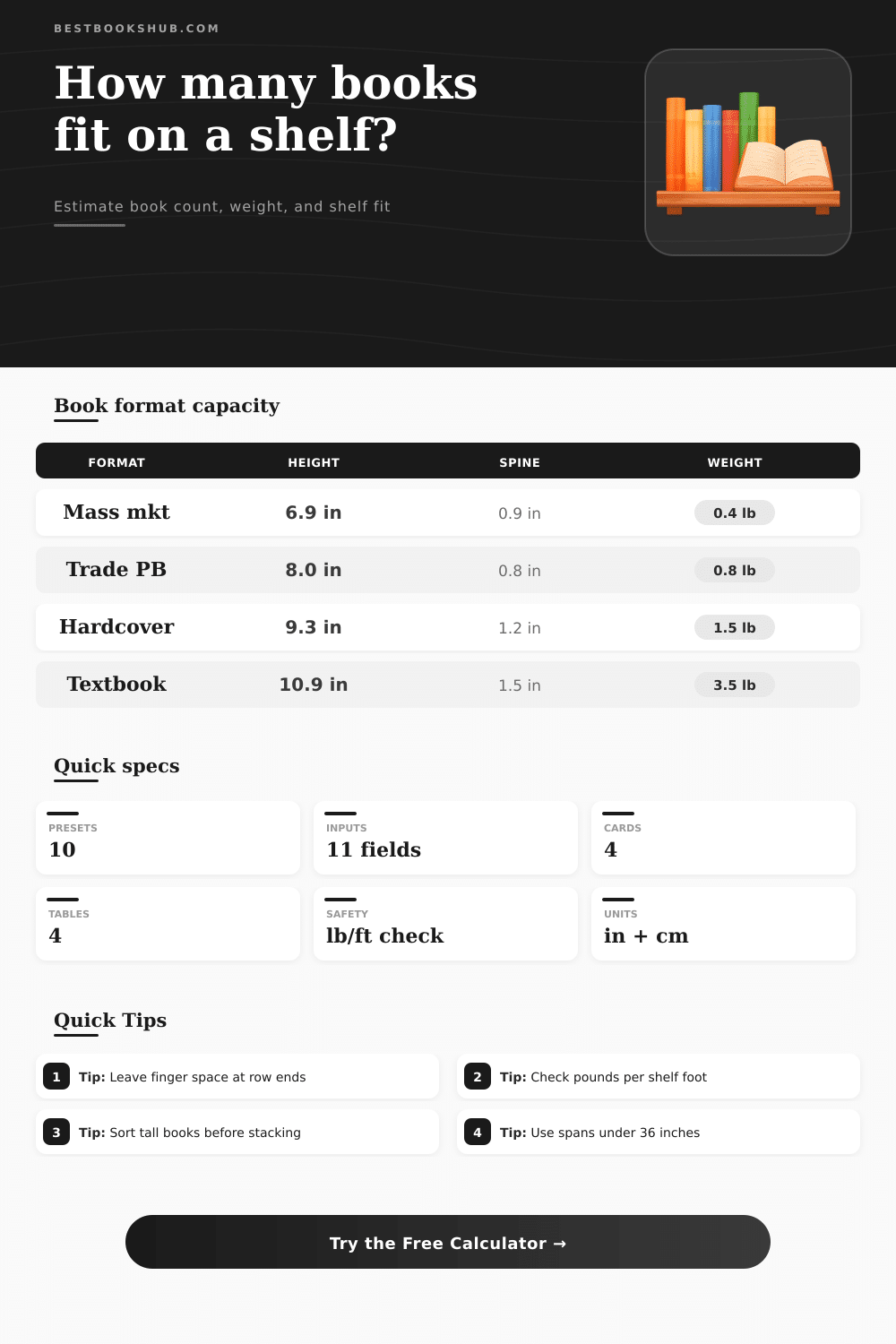
| Mass market paperback | 6.87 x 4.25 in / 17.4 x 10.8 cm | 0.9 in / 2.3 cm | 0.4 lb / 0.18 kg | 4.25 in / 10.8 cm |
| Trade paperback | 8.0 x 5.5 in / 20.3 x 14.0 cm | 0.8 in / 2.0 cm | 0.8 lb / 0.36 kg | 5.5 in / 14.0 cm |
| Hardcover novel | 9.3 x 6.25 in / 23.6 x 15.9 cm | 1.2 in / 3.0 cm | 1.5 lb / 0.68 kg | 6.25 in / 15.9 cm |
| Textbook | 10.9 x 8.5 in / 27.7 x 21.6 cm | 1.5 in / 3.8 cm | 3.5 lb / 1.59 kg | 8.5 in / 21.6 cm |
| Children's picture book | 10.0 x 8.0 in / 25.4 x 20.3 cm | 0.35 in / 0.9 cm | 0.45 lb / 0.20 kg | 8.0 in / 20.3 cm |
| Graphic novel | 10.2 x 6.7 in / 25.9 x 17.0 cm | 0.55 in / 1.4 cm | 0.75 lb / 0.34 kg | 6.7 in / 17.0 cm |
| Manga volume | 7.5 x 5.0 in / 19.1 x 12.7 cm | 0.65 in / 1.7 cm | 0.42 lb / 0.19 kg | 5.0 in / 12.7 cm |
| Large art book | 12.0 x 9.5 in / 30.5 x 24.1 cm | 1.1 in / 2.8 cm | 4.0 lb / 1.81 kg | 9.5 in / 24.1 cm |
| Shelf size | Usable row length | Trade paperbacks | Hardcovers | Notes |
|---|---|---|---|---|
| 24 in shelf / 61 cm | 20.7 in / 52.6 cm | 25 books | 17 books | Assumes 1.5 in gap and 92% packing. |
| 36 in shelf / 91 cm | 31.7 in / 80.5 cm | 39 books | 26 books | Common small bookcase shelf. |
| 48 in shelf / 122 cm | 42.8 in / 108.7 cm | 53 books | 35 books | Check span support for heavy formats. |
| 72 in wall shelf / 183 cm | 64.9 in / 164.8 cm | 81 books | 54 books | Usually needs brackets or dividers. |
| Common setup | Dimensions | Likely format | Approx capacity | Approx load |
|---|---|---|---|---|
| Small shelf 24x8 | 24 x 8 in / 61 x 20 cm | Trade paperback | 25 per shelf | 20 lb / 9 kg |
| Reading nook 48x12 | 48 x 12 in / 122 x 30 cm | Hardcover | 35 per shelf | 53 lb / 24 kg |
| Kids bookshelf 36x24 | 36 in rows, 3 shelves | Picture books | 270 total | 122 lb / 55 kg |
| IKEA Kallax 57x57 | 13.25 in cubbies | Manga or trade PB | 16 cubby rows | Varies by format |
| Wall bookcase 72x36 | 72 in wide, 5 shelves | Mixed hardcover | 270 total | 405 lb / 184 kg |
| Load check | Rule of thumb | What it means | Best use |
|---|---|---|---|
| Light row | Under 12 lb/ft / 18 kg/m | Most paperbacks on short spans. | Floating shelves with good anchors. |
| Normal row | 12-25 lb/ft / 18-37 kg/m | Trade books and mixed hardcovers. | Fixed bookcases and supported shelves. |
| Heavy row | 25-45 lb/ft / 37-67 kg/m | Textbooks, art books, dense hardcovers. | Short spans, thick shelves, center posts. |
| High risk row | Over 45 lb/ft / 67 kg/m | Sag or anchor failure becomes likely. | Use structural support or split the row. |
DISCLOSURE: This post may contain affiliate links, meaning when you click the links and make a purchase, I receive a commission. As an Amazon Associate I earn from qualifying purchases.
We get frustrated when we purchase furnitures solely for its appearance. We find this beautiful bookcase made from wood and haul it home, only to discover that it can’t hold nearly as many books as you’d hoped. Or maybe the weight of those hardcover volumes sags the shelves, maybe your books don’t fit at all.
Measuring isn’t just a matter of inches; it’s knowing how things behave in relation to dimensional boundaries in three dimensions. Typical: Most folks will just measure the visible portion of the shelf and assume their books is average size. But they’re not! Their spines might be uneven. They’ll leave some finger room to pull out books. There’s space between side panels. These invisible storage costs matter!
Why Measuring Your Bookshelf Is Important
Enter your dimensions into the calculator and let it do the math for you. It eliminates guesswork about the correct conversion factors and coefficients. Forces you to confront what makes your row length usable (gross width) vs. What you think it is. The difference here is where most expectations goes wrong.
Think carefully about the spine width. College textbooks require over an inch and a half while a mass market paperback requires half an inch. If you assume all books are an inch thick, then you’re going to make mistakes and have structural issues. Generally trade paperbacks fall somewhere in between and is well-balanced in terms of both their weight and density. You can choose your primary format with this tool.
Why? Because things like encyclopedias is heavier than graphic novels. Shelf failure almost entirely comes down to weight. Fifty thin paperbacks won’t buckle a shelf but twenty fat art books will.
Depth is more important than width, though it is talked about less. Shelves are typically ten inches deep. They are fine for most novels. But they leave space for bigger books, or force you to stack the small books two high. Shallow shelves mean you waste space; and you risk tipping over. The books topple forward. Depending on your depth, you might be able to use single or double rows, otherwise the books tip over.
The math takes that into account. And it accounts for vertical space. No matter how skinny the book’s spine, a ten-inch textbook doesn’t fit on a nine-inch shelf.
The other thing that greatly affects this outcome is packing allowance. Edge to edge packing seems space-efficient, but it makes getting at any book more awkward. Leaving some space between books make them easier to use. Plus, it relieves strain on the bindings. Faster tightness leads to faster wear. You have a shelf of storage units, not a library.
And then there’s sag. Big loads across long sections of wood cause sagging, as the wood simply bows under all that weight. This tool will check how much weight is too much for each foot of wood. If you’re exceeding the limits on a piece of wood, it will let you know. It would of been best to know before installing the shelf that it requires a center brace. But not after you’ve already moved twenty pounds of books onto it.
“Leave room for expansion, because an empty spot is worth something. Leave room for expansion, because an empty spot is worth something. Leaving room for growth prevents the need to replace furniture in five years. “Avoid making your shelves look like they are cluttered. Keep them curated. “It’s about creating a system that allows your collection to grow but doesn’t fail you. A good bookcase brings you peace of mind, accessibility, and stability.”