📏 Shelf run planner
Bookshelf Linear Feet Calculator
Estimate the linear feet of shelving your books need from book count, format mix, packing density, shelf width, row depth, and growth allowance.
Load a real shelf scenario, then adjust the book count, average spine width, clear row length, packing style, and growth room.
| Book format | Average spine | Approx books per linear foot | Typical depth | Average weight |
|---|---|---|---|---|
| Mass market paperback | 0.90 in / 2.29 cm | 13.3 before gaps | 4.25 in / 10.8 cm | 0.40 lb / 0.18 kg |
| Trade paperback | 0.80 in / 2.03 cm | 15.0 before gaps | 5.50 in / 14.0 cm | 0.80 lb / 0.36 kg |
| Hardcover novel | 1.20 in / 3.05 cm | 10.0 before gaps | 6.25 in / 15.9 cm | 1.50 lb / 0.68 kg |
| Textbook | 1.50 in / 3.81 cm | 8.0 before gaps | 8.50 in / 21.6 cm | 3.50 lb / 1.59 kg |
| Children's picture book | 0.35 in / 0.89 cm | 34.3 before gaps | 8.00 in / 20.3 cm | 0.45 lb / 0.20 kg |
| Graphic novel | 0.55 in / 1.40 cm | 21.8 before gaps | 6.70 in / 17.0 cm | 0.75 lb / 0.34 kg |
| Manga volume | 0.65 in / 1.65 cm | 18.5 before gaps | 5.00 in / 12.7 cm | 0.42 lb / 0.19 kg |
| Large art book | 1.10 in / 2.79 cm | 10.9 before gaps | 9.50 in / 24.1 cm | 4.00 lb / 1.81 kg |
| Collection size | Trade paperbacks at 92% | Hardcovers at 92% | Textbooks at 88% | Graphic novels at 96% |
|---|---|---|---|---|
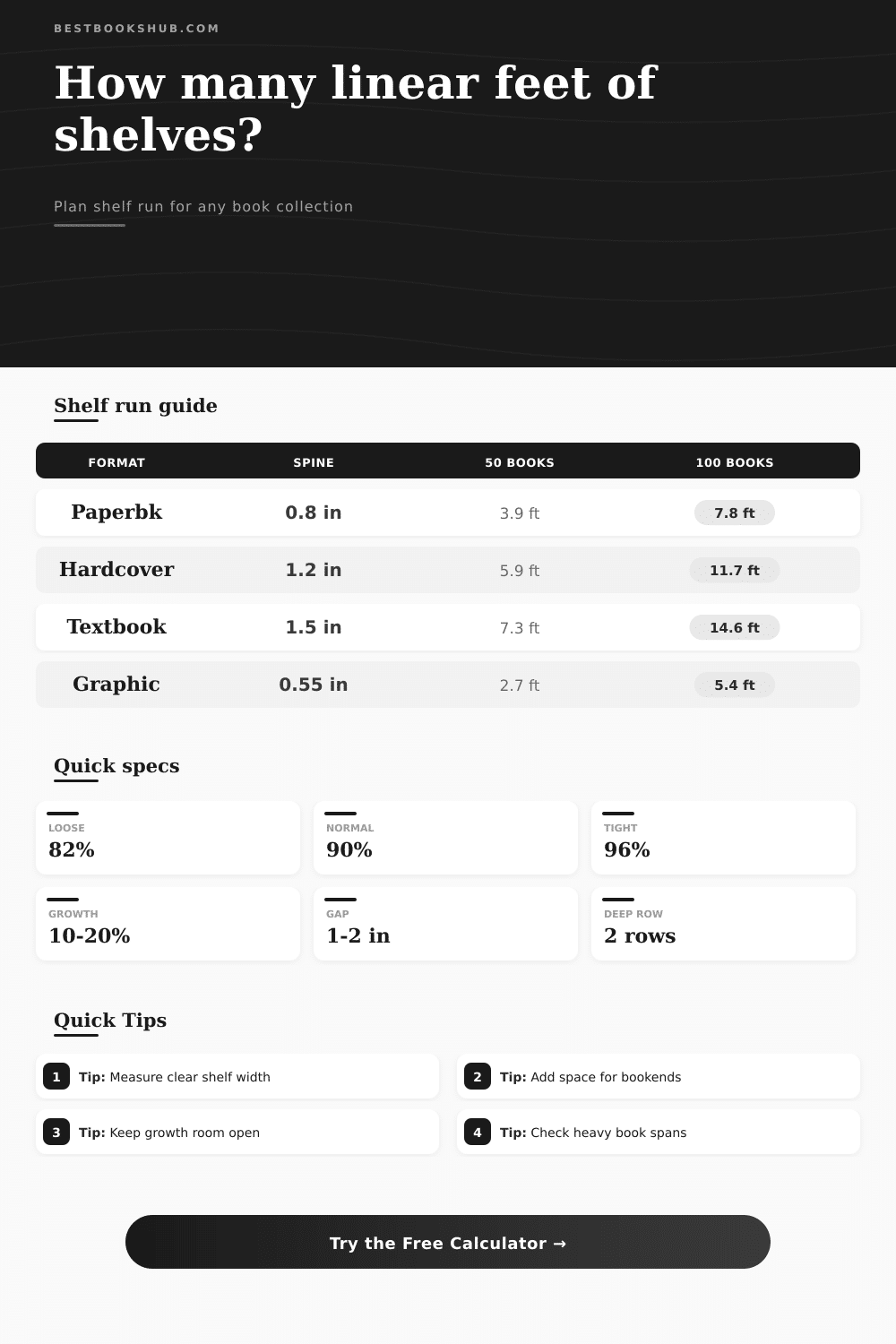
| 50 books | 3.9 ft / 1.19 m | 5.9 ft / 1.80 m | 7.1 ft / 2.17 m | 2.4 ft / 0.73 m |
| 100 books | 7.8 ft / 2.39 m | 11.7 ft / 3.58 m | 14.2 ft / 4.33 m | 4.8 ft / 1.46 m |
| 250 books | 19.6 ft / 5.96 m | 29.3 ft / 8.94 m | 35.5 ft / 10.82 m | 11.9 ft / 3.64 m |
| 500 books | 39.1 ft / 11.93 m | 58.7 ft / 17.89 m | 71.0 ft / 21.65 m | 23.9 ft / 7.28 m |
| Shelf setup | Clear row width | Rows | Total single-row run | Trade paperback fit |
|---|---|---|---|---|
| Compact dorm shelf | 24 in / 61 cm | 3 | 5.6 ft / 1.70 m | 72 books with gaps |
| Reading nook shelves | 48 in / 122 cm | 2 | 7.8 ft / 2.38 m | 100 books with gaps |
| Four-shelf bookcase | 36 in / 91 cm | 4 | 11.5 ft / 3.51 m | 147 books with gaps |
| Wall bookcase | 72 in / 183 cm | 5 | 29.4 ft / 8.95 m | 376 books with gaps |
| Deep double-row wall | 72 in / 183 cm | 5 | 58.8 ft / 17.91 m | 752 books with gaps |
| Packing style | Density used | Best for | Practical effect |
|---|---|---|---|
| Loose display | 82% | Decorative shelf runs | More air, fewer books per foot |
| Comfortable shelves | 88% | Frequently handled books | Easy pull space on each row |
| Normal full shelf | 92% | Most home bookcases | Full but still workable |
| Tight storage | 96% | Archive overflow shelves | Maximum capacity, little air |
DISCLOSURE: This post may contain affiliate links, meaning when you click the links and make a purchase, I receive a commission. As an Amazon Associate I earn from qualifying purchases.
With a tape measure in hand, you walk over to your wall and measure it. Done? Maybe not. Knowing the physical length of your room don’t tell you much about what that room can hold. How wide is each book on your shelves? How big a gap do you want between them, and how does that impact amount of books you’ll have? What’s the maximum your shelves can supports anyway? Getting linear feet right matter; it can mean the difference between having a beautifully organized library and an unruly stack of paperback books.
Once you enter your format preferences and how many book are in each category, the calculator do the rest (no need for anyone to guess about spacing and density numbers). First it considers what average size of a book’s spine is in the format that dominates your library. The reference table show approximate books per linear foot for formats like thick textbooks. Hardcover novels? Mass-Market paperbacks takes up much less horizontal room. Adjust the mix factor accordingly if you’ve got a combination.
How to Measure Your Bookshelves Correctly
If you assume all books are the same thickness, you’ll wind up with shelves that won’t shut the door on too-full rows. You might also end up with a ton of wasted shelf space. Most estimates fail here. They estimate packing density and then assume that books is packed closely together from end to end on a shelf. But in reality, there must be enough air (finger gaps) so that when you pull a book out, you don’t also pull your neighbor’s book down along with it.
A normal full shelf run at about 92% capacity. This is just enough air to handle it, while maximizing storage space. If you like to browse a lot, you may want to leave more space (and buy extra shelving length as a result). For archive boxes, or books that you’ll never touch again, tight storage makes sense. But it’s hellish for everyday reading.
Also, consider weight distribution and vertical dimension. How many linear feet is the horizontal run? That’s one factor; another is how much weight does each row of shelves holds? Large art books and textbooks are heavy. They can cause a long unsupported span to sag over time. For instance, paperbacks may work fine on thirty-six-inch-wide shelves, but a row of encyclopedias might not. You’ll get a warning if you try to design something that looks good but is too ambitious and collapses. The tool takes this into account and allows you to specify load limit per row.
2) Growth allowance: You know what happens when books multiply? You buy one, then you want the whole series. Buy a few extra shelves now with some room for growth. Ten to twenty percent, and you avoids ripping them out within two years. This is an investment in wasted space that’ll pay dividends down the road when you discover a rare edition or decide to collect graphic novels. Otherwise, your well-organized library turns into a maze of leaning towers and wedged-in volumes.
The other thing about all that linear footage is how much of it you’ll need to take up with shelving. Most books will fit nicely on a typical 10 inch deep shelf. With deeper shelves, though, you may want to try placing rows on top of each other. This lets you use double the amount of space without needing twice as long than a wall. That’s great if your shelves are already pretty deep (like built ins or book cases) and you can display the items on the front row but keep reference material or backups in the back.
The calculator will automaticly see if your shelves is deep enough for this set-up. For example, on the page there’s a handy reference table that shows you how many linear feet per book various formats are (which is helpful if you need to do some rough calculations in your head and don’t want to sit down and enter all those details just yet). For example, you could look at it quickly and say, “Oh my gosh, all these manga volumes are going to take up so little space! I’ll have lots of room left over for coffee-table books!” Or you could look at it and say “hmm, I’m going to need some extra structural support for my textbook stash, no way is that going to fit in a regular particle board thing.”
All this adds up to, of course: Physics + Aesthetics = A Book Shelf Plan. It is sturdy but not bulky, and filled but not stuffed. Making sure you get the linear feet part correct, well, it makes your dream match up with your reality. It transforms an empty wall into an actual part of your mind.