📖 Cloze readability lab
Bormuth readability calculator
Paste a passage to approximate Bormuth-style cloze readability from average word length, average sentence length, hard-word ratio, grade band, and a selected comprehension target.
Load realistic text samples for classroom, trade, technical, fiction, and revision scenarios. Each preset fills the controls and calculates automatically.
| Rank | Sentence preview | Words | Avg chars | Hard % | Estimated drag | Revision cue |
|---|---|---|---|---|---|---|
| Sentence rows appear after calculation. | ||||||
| Estimated cloze | Reader condition | Typical grade signal | Use case | Watch for |
|---|---|---|---|---|
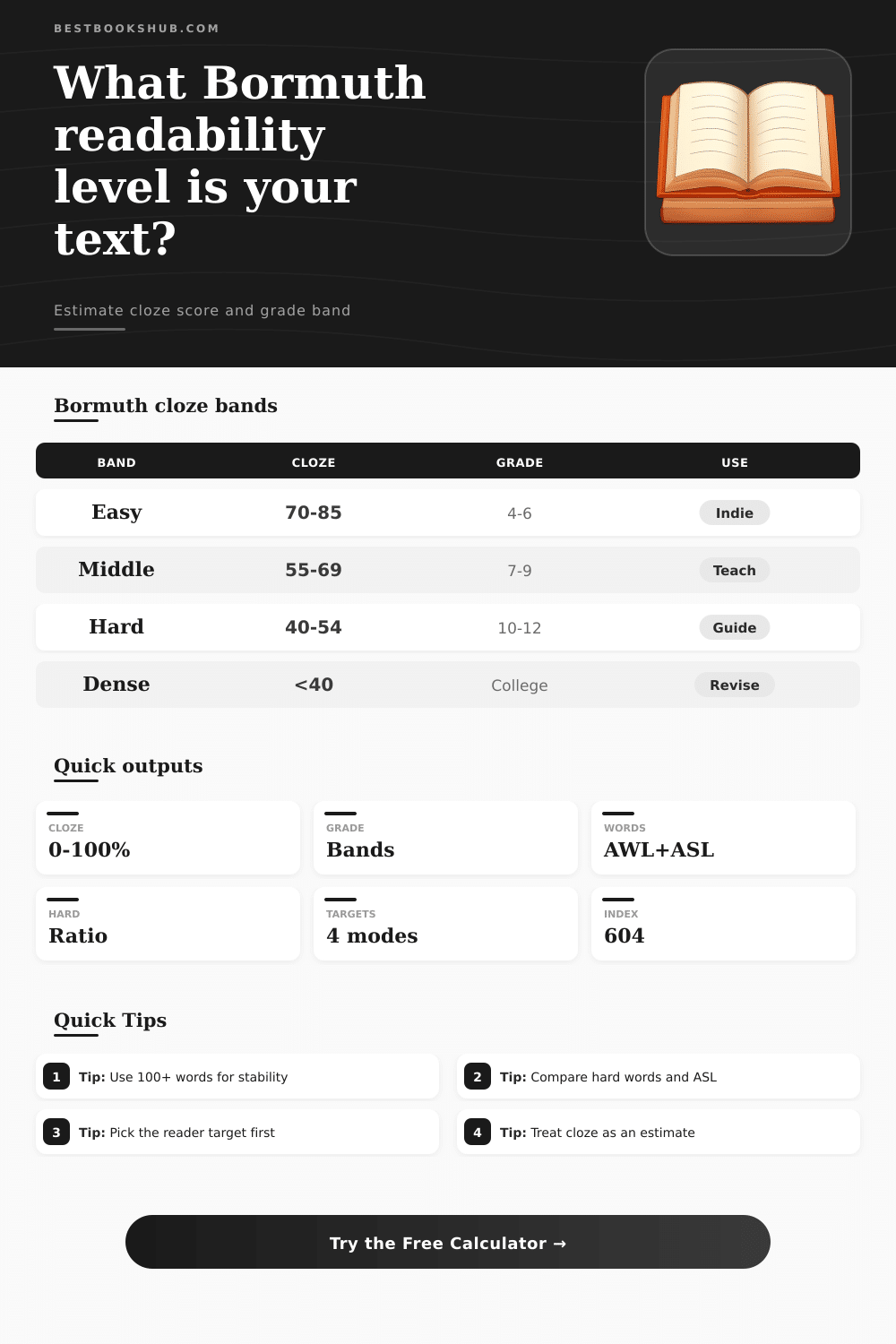
| 70-85% | Easy or independent | Grade 4-6 | Plain public explanations and early textbooks. | May be too simple for advanced audiences. |
| 55-69% | Mostly independent | Grade 7-9 | General articles, study guides, and accessible nonfiction. | Hard terms still need context. |
| 45-54% | Instructional | Grade 9-12 | Classroom reading with support or specialist introductions. | Sentence load can slow comprehension. |
| 35-44% | Challenging | Grade 12-college | Technical, policy, and academic material. | Readers may need definitions and examples. |
| Below 35% | Frustration risk | College plus | Expert-only passages or rough drafts. | Revise hard terms, nominalizations, and sentence chains. |
| Band | Cloze range | AWL signal | ASL signal | Hard-word signal |
|---|---|---|---|---|
| Elementary | 70% or higher | About 4.0-4.7 chars | 8-14 words | Under 8% |
| Middle school | 58-69% | 4.5-5.0 chars | 12-18 words | 8-14% |
| High school | 45-57% | 4.9-5.5 chars | 16-24 words | 14-22% |
| College | 35-44% | 5.3-6.0 chars | 22-32 words | 22-32% |
| Expert dense | Below 35% | 6.0+ chars | 30+ words | 32%+ |
| Target setting | Cloze target | Meaning | Best use | Action if below target |
|---|---|---|---|---|
| Minimum | 35% | Readers may extract some meaning. | Expert notes or first triage. | Define core terms first. |
| Instructional | 45% | Reader can work with support. | Classroom or guided study. | Add examples and shorter sentences. |
| Independent | 55% | Reader can proceed alone. | Public guides and self-study. | Reduce hard-word clusters. |
| Confident | 60% | Comfortable comprehension margin. | Help pages and broad audiences. | Prefer familiar wording. |
| Word count | Reliability | Best interpretation | Risk | Suggestion |
|---|---|---|---|---|
| 1-99 words | Low | Directional only. | One sentence can dominate. | Paste a longer passage. |
| 100-249 words | Fair | Useful draft signal. | Topic terms can skew hard words. | Check several sections. |
| 250-599 words | Good | Stable editing estimate. | Mixed sections may blur results. | Analyze by section too. |
| 600+ words | Strong | Good overview estimate. | Long documents hide hotspots. | Review hardest sentence rows. |
DISCLOSURE: This post may contain affiliate links, meaning when you click the links and make a purchase, I receive a commission. As an Amazon Associate I earn from qualifying purchases.
Try this Bormuth readability calculator to calculate the target fit, hard-word ratio, average sentence length, average word length, grade band, and estimated cloze comprehension score.
Have you ever opened up a document… Whether it’s a policy memo, a patient handout, or even a textbook, where the words immediately feel leaden? What the Bormuth approach aim to quantify is that intuitive tug-before-they-suck-you-in sensation well before reader starts fighting it. Rather than a wild guess about if your draft will fly with a specific audience, the tool reduces all that word-length/sentence-rhythm/strange-words stuff down to one easy-to-understand number expressed as a cloze-style percentage: The higher the number, the greater likelihood that a reader could fill in missing words and still follow meaning. Anything lower indicates a danger of readers’ heads exploding unless you provide some assistance.
How to Use the Bormuth Readability Calculator
The beauty of system lies in its focus on real-world reading behaviour, not just syllables. One type of cloze test used to delete every fifth word and make readers guess what was missing; the calculator improves this by guessing how hard those blanks would feel to them. Density is captured through average word length, while average sentence length measure how much info the reader needs to keep in their working memory. The hard-word ratio identify words that are beyond what most readers regularly encounter in daily life.
Tweak any of these dials and you’ll see expected comprehension change, often more significantly. But what about numbers? And proper nouns? After reading “Washington” once, it shouldn’t appear on the difficult list again, but most formulas counts all capital letters equally. With this calculator, you choose whether to assume that readers will recognize common numerals and even remember recurring names.
These are tiny decisions, depending on your audience (engineers vs. Middle-schoolers), but they can make an otherwise clear set of instructions seem needlessly cluttered if you gets your settings wrong. Everything downstream flows from target comprehension level you select. If you’re targeting specialists, deeply familiar with your subject, then maybe 35 percent is good enough? Raise it to 60 percent. All of a sudden, your text require simpler words and fewer steps in the logic.
Most people miss this because they think of readability as a fixed number. Instead, it is a sliding scale based off who you want to read it and why. In the real world, sentences don’t always conveniently fit into bands. Sometimes they requires college-level terms followed by plain language in the same paragraph. The hardest-sentence view within the calculator show exactly where these spikes happen. You can then choose to break up the sentence, define that term, or rely on context to carry the load. Seeing the hard-word ratio plunge with just one rewrite is far more gratifying than any grade label ever was.
Still, all formulas aside, background knowledge matter most of all. Even though both are 10th graders, one who has spent his life tinkering on engines will fly through technical writing that stymies his classmate who hasn’t laid a finger on a wrench. That’s what the calculator doesn’t know, and there lies its greatest use, not as the last word but more like an early alarm bell. Read multiple excerpts from the same piece; note the most difficult chunks; then edit for your intended audience.
More often than writers care to admit, sentence length pulls one way while word choice pressure pull the other. You can have short sentences and still lose your reader if every noun is a long, complex word. And it’s also possible to write longer, graceful sentences constructed out of familiar words, and end up being clear anyway. The key: know what your real problem is before you begin making cuts.
The point isn’t that you got a 100%. The point is that you are confident it lands where you want it to. Use the percent as a way to talk with your draft. Just lower the bar so far that your target reader can lean into the ideas rather than glancing at them from across the street. When your gut check matches the cloze estimate, you’ve done the heavy lifting.