📚 Multi-volume reading planner
Box Set Reading Time Calculator
Estimate the time needed to finish a full box set by volume count, pages per book, reading speed, daily minutes, days off, buffer time, edition type, and check-in cadence.
Choose a named reading scenario, then adjust the page pattern, pace, edition, buffer, and check-in rhythm to match the set on your shelf.
DISCLOSURE: This post may contain affiliate links, meaning when you click the links and make a purchase, I receive a commission. As an Amazon Associate I earn from qualifying purchases.
Each card estimates pages, adjusted reading time, and the target finish day for that volume. Longer patterns spread around the average page count instead of treating every book as identical.
| Reader pace | Words per minute | Pages per hour at 275 wpp | Best use |
|---|---|---|---|
| Close note-taker | 120-170 wpm | 26-37 pages | Annotations, classics, study reads |
| Steady leisure | 200-260 wpm | 44-57 pages | Most novels and narrative nonfiction |
| Fast familiar | 300-380 wpm | 65-83 pages | Light rereads and familiar genres |
| Skim pass | 450-600 wpm | 98-131 pages | Recaps, previews, and low-note scans |
| Edition type | Words per page factor | Time load | When to pick it |
|---|---|---|---|
| Trade paperback | 1.00x | 1.00x | Modern paperback or standard trim novels |
| Mass market | 1.12x | 1.02x | Compact pages with tighter type |
| Hardcover | 0.95x | 0.98x | Roomier type and wider pages |
| Ebook | 0.92x | 0.96x | Adjusted font size or fast device reading |
| Illustrated or annotated | 0.85x | 1.18x | Notes, captions, plates, maps, appendices |
| Graphic novel or manga | 0.38x | 1.10x | Panels and art review matter more than words |
| Cadence | How checkpoints are counted | Good for | Planning note |
|---|---|---|---|
| Every volume | One check at each book finish | Box sets with natural book breaks | Best for series discussion threads |
| Weekly | Every 7 calendar days | Solo schedules and habit tracking | Pairs well with days-off planning |
| Every two weeks | Every 14 calendar days | Slow long-form projects | Useful for classics or dense nonfiction |
| Quarter marks | 25%, 50%, 75%, and finish | Simple readalongs | Works even when volume lengths vary |
| Monthly | Every 30 calendar days | Large sagas and collection cases | Better for projects over two months |
| Set style | Typical volumes | Typical pages | Planning risk |
|---|---|---|---|
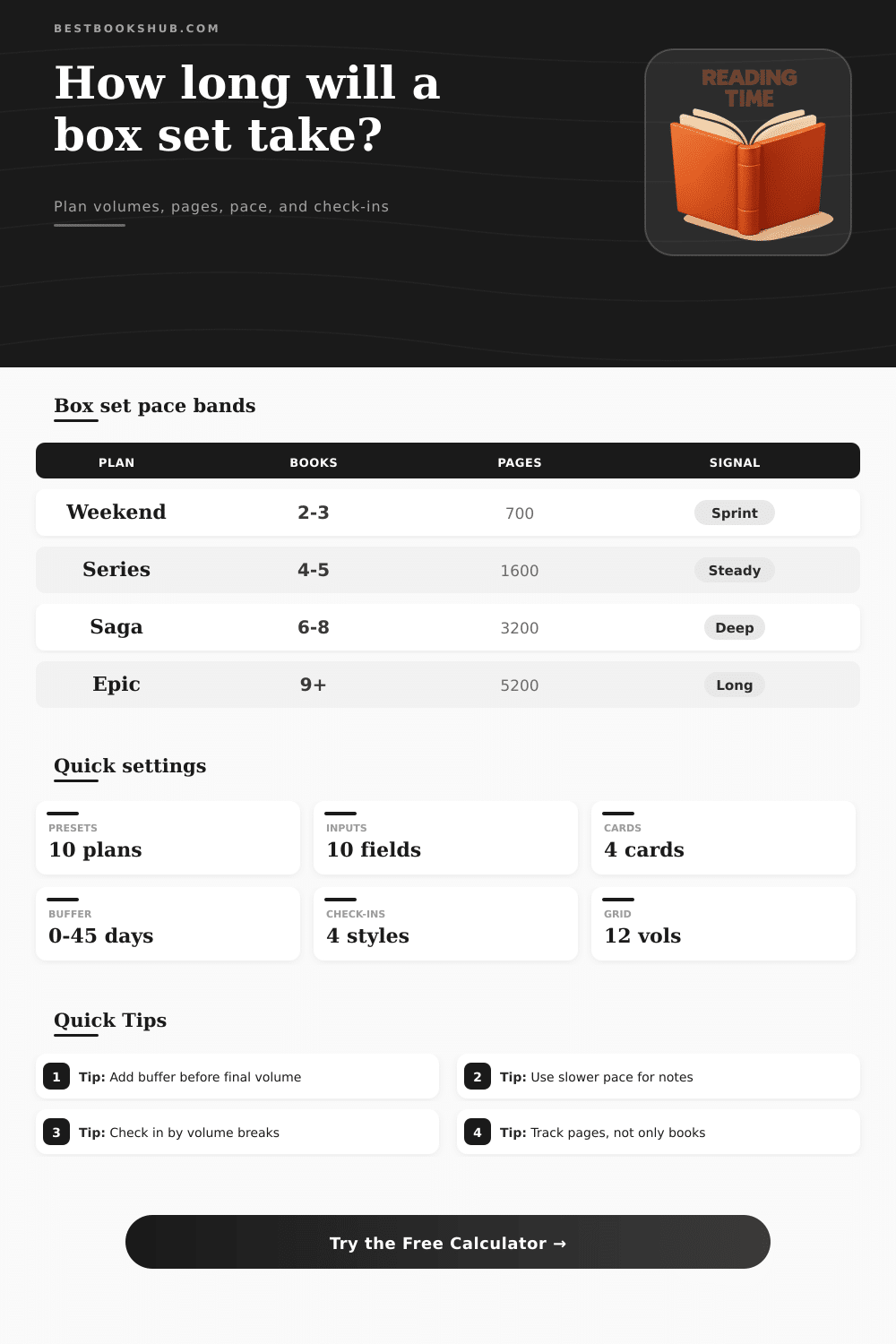
| Weekend trilogy | 2-3 books | 650-1050 pages | Short window leaves little recovery time |
| Genre quartet | 4 books | 1200-1800 pages | Middle-book drag can shift the finish date |
| Large paperback set | 5-7 books | 1800-3400 pages | Best with volume-level check-ins |
| Epic saga case | 8-12 books | 3600-7000 pages | Buffer and days off dominate the calendar |
Put most of your buffer near the final volume. Long box sets often slow down late, especially when the ending invites rereading, notes, or discussion.
When volume sizes vary, check progress by pages instead of book count. A short second book can make the whole schedule look easier than it is.
Having a stack of fantasy books on your bedside table make you feel good. Until you look down and see you’ve committed yourself to a thousand pages of world building and still haven’t got out. It’s all well and good getting excited about that boxset of books, but once you own them, then what? They become a longer-term commitment, something you are less likely to stick to than the free time you have. That is why it’s better to plan things out before committing to multi-volume read.
Sure, you might be able to get excited enough to go out and buy the entire series as a boxed set, but to actualy finish it means approaching the act of reading like scheduling instead of just something to do sometime. By doing this, you’re turning vague hopes into concrete timelines. You plug in details (which most folks don’t think about until it’s too late) and let the calculator do the rest.
How to Plan Your Reading Schedule
For a ballpark figure, most people begins with page numbers (and volume count), but that only takes into account the number of pages; it doesn’t consider the friction of reading habits. Skimming through a thriller? You’re going to be able to read more quick. Dissecting a dense historical biography? Not so much. To account for this, you can tweaks words per minute by genre, because all pages is not created equal. Graphic novels move at different pace than textbooks, even though they have the same-sized physical sheet. Selecting the right edition type will adjust math to match. Read a thin-margin, small-font mass-market paperback and you’re going to read slower then a comfortabley hardcover with lots of space. The reference table break down those multipliers and shows you how format affect your daily quota.
How do you spend your off-days? That is just as important. Optimistic schedules presumes you’ll spend each day reading for weeks straight. Life doesn’t always work out like that. One day, you might just want a break from the weight of a complicated story, or you might travel, or get busy. Planned days off extend the schedule in a realistic way without penalizing yourself for livig your own life. They stop the guilt spiral where you miss one day and say screw it, I’m throwing this whole thing away. Likewise, buffer days protects your end-date from unexpected slippage. Think of buffer as burnout insurance. It is a small investment in peace of mind that keeps last book in sight.
For long-term projects, this is where this tool really help with check-ins. Until it’s too late to change course, how do you know if you’re on pace without milestones? You can set a schedule: Check-in once a week, or when you finish each volume, and now you have data points to see how you’re doing. Are you always falling off the target by the third book? Raise your daily page goal, or accept that the collection will be bigger than you expected. It is better to know ahead of time then to panic halfway through a twelve-book saga because you won’t finish before winter. It turns a daunting mountain into a series of manageable hills.
There’s also a hidden variable that catches out casual planners; complexity. When you’re slowing down to look things up, take notes, and reread complex sections, you’ll find that you reads much slower. That’s why there’s a complexity slider. It recognizes that “slow” isn’t necessarily “failed.” Sometimes slow mean deeply engaging with the material. And it calculates the cost of that focus in terms of time, because otherwise we might under-estimate how long it will take us to get through a tricky passage. This applies particularly if you’re reading classic literature or something else written for school, which require more than a passing glance to understand.
All that said, ultimately it’s all about managing both your time and your expectations. If you’re reading at whatever speed feels right for you (read: not necessarily faster), it isn’t about reading faster, it’s about planning better. When you define your pace, accept your rest days, and build in some safety margins, you transform what could be a stressful activity into one that’s more structured and pleasurable. Let the math deal with the logistics while you have time to get lost in the story. That’s how you end up reaching the final page without burning yourself out half way through because you should of planned better.