🧬 Brunet's Index Calculator
Calculate hair pigmentation index using melanin granule counts and total hair cortex cells
| Hair Color Type | BI Range | Eumelanin Level | Pheomelanin Level | Typical Appearance |
|---|---|---|---|---|
| Very Light Blonde | 0 – 10 | Very Low | High | Platinum / White-Blonde |
| Light Blonde | 11 – 30 | Low | Moderate-High | Golden Blonde |
| Dark Blonde | 31 – 50 | Low-Moderate | Moderate | Ash / Honey Blonde |
| Light Brown | 51 – 65 | Moderate | Low-Moderate | Light Chestnut |
| Medium Brown | 66 – 79 | Moderate-High | Low | Chestnut Brown |
| Dark Brown | 80 – 89 | High | Very Low | Deep Brunette |
| Very Dark Brown | 90 – 96 | Very High | Trace | Near-Black Brown |
| Black | 97 – 100 | Maximum | None | Jet Black |
| Samples Counted | Cells Per Sample | Total Cells Counted | Reliability Level | Recommended For |
|---|---|---|---|---|
| 1 Sample | 100 | 100 | Baseline | Quick estimation |
| 1 Sample | 200 | 200 | Good | Standard research |
| 2 Samples | 100 each | 200 | Better | General forensics |
| 3 Samples | 100 each | 300 | High | Academic studies |
| 3 Samples | 200 each | 600 | Very High | Precise research |
| 5+ Samples | 200 each | 1000+ | Maximum | Forensic evidence |
| Parameter | Formula | Description | Range |
|---|---|---|---|
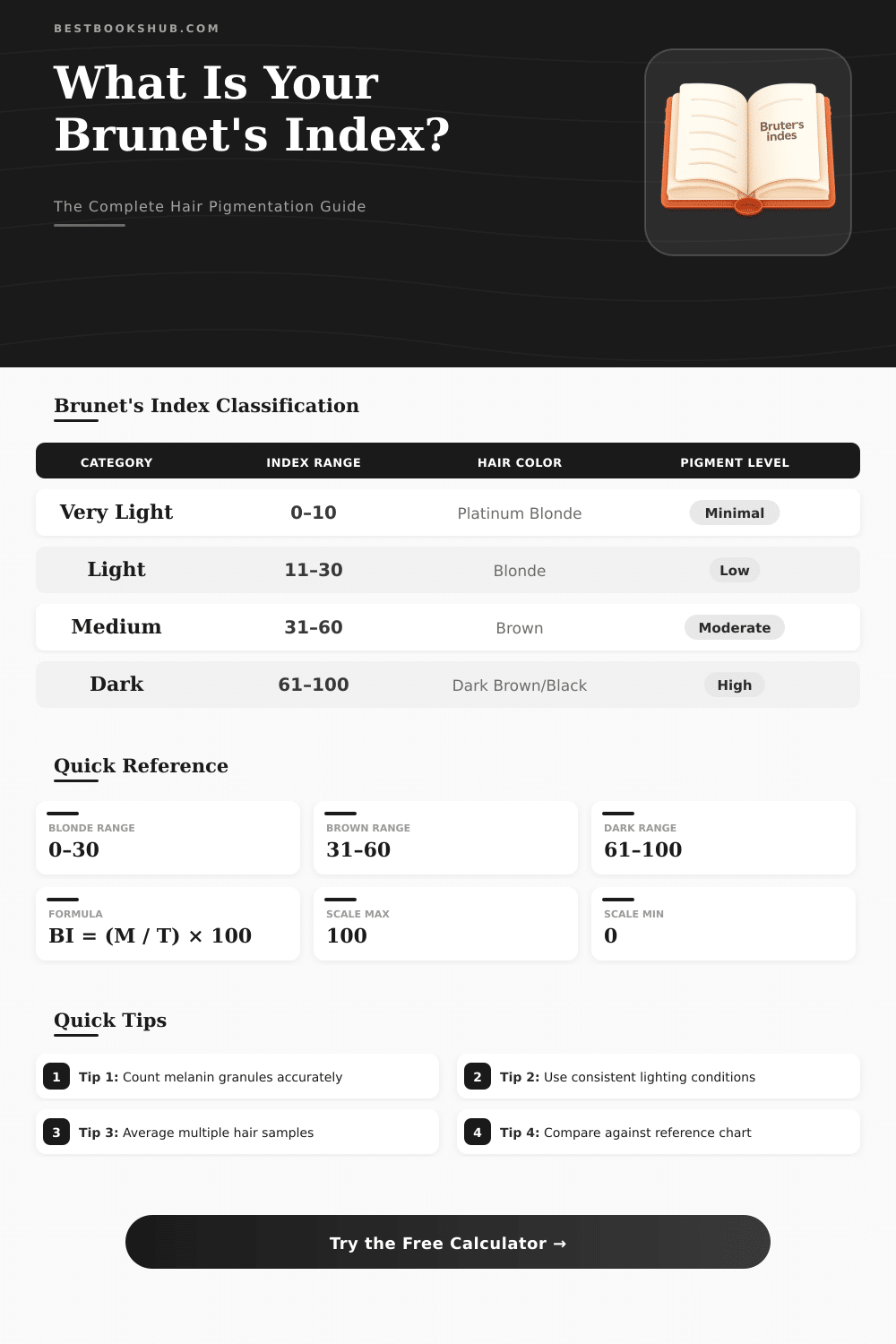
| Brunet's Index (BI) | BI = (M / T) × 100 | Core pigmentation ratio | 0 – 100 |
| Melanin Ratio | M / T | Raw ratio before scaling | 0.00 – 1.00 |
| Averaged BI (2 samples) | (BI1 + BI2) / 2 | Mean of two counts | 0 – 100 |
| Averaged BI (3 samples) | (BI1 + BI2 + BI3) / 3 | Mean of three counts | 0 – 100 |
| Combined BI | (∑M / ∑T) × 100 | Pooled count method | 0 – 100 |
| Pigmentation % | BI / 100 × 100% | Percentage expression | 0% – 100% |
| Melanin Type | Color Produced | Hair Colors Associated | Chemical Nature |
|---|---|---|---|
| Eumelanin (Black) | Black | Black, very dark brown | Nitrogen-containing polymer |
| Eumelanin (Brown) | Brown | Brown shades | Nitrogen-containing polymer |
| Pheomelanin | Yellow-Red | Blonde, red, strawberry | Sulfur-containing polymer |
| Mixed Melanin | Variable | Dark blonde to light brown | Combined polymers |
| Absence | White/Grey | White, grey hair | No melanin produced |
Our Brunet’s Index Calculator allows you to calculate level of hair pigmentation based off the number of melanin granules in your hair. Based on that calculation, it automatically classifies you among the eight known hair color classes. While we tend to think of hair as being one solid color, it is not; depending on light conditions, same hair might appear completely different. Even if two individual have brown hair, they may look very different since there is no way for human eye to accurately estimate their pigment levels.
DISCLOSURE: This post may contain affiliate links, meaning when you click the links and make a purchase, I receive a commission. As an Amazon Associate I earn from qualifying purchases.
With Brunet’s Index, you get a precise measurement of melanin granule density within your hair samples. This translates artistic judgement into scientific and repeatable data.
How Hair Color Is Measured Using Science
It started with some of the earliest microscope examinations of hair cross-sections. Scientists discovered that melanin granules packed inside cortex are key to a strand’s color. The more of these little structures there is, the darker the hair. Rather than arguing over whether a person has dark blonde hair or light brown hair, instead you tally up number of granules per unit of space and perform a basic ratio.
That’s where the calculator comes in; it performs math as soon as you input your counts. Then it immediately positions that figure on scale ranging from zero to one hundred. So what’s the deal with this number? It shows difference between pheomelanin behavior and eumelanin. Pheomelanin is responsible for those redder, warmer undertones common in blondes, while eumelanin results in black and deeper brown colors. Why is it that some blondes turn out cool-toned and others go more golden? If your index is lower than average, chances are sulfur-based pigment is dominating and creating a warm undertone. Knowing this difference goes a long way when trying to understand how hair dye work differently on each individual. Home color kits don’t consider this variation.
Your inputs are important. More than most people would guess. Counting 50 cells is not the same as counting two hundred, for example. While that might seem like splitting hairs, the variation between cell in a single hair makes a picture of two hundred cells more consistent then one based off only fifty cells. Even more so, tool will allow you to take multiple samples of your hair from various locations across your head. After all, a hair sample near the crown may vary from one near nape. Averaging these provide most reliable result. Without having to perform math yourself, you can add additional samples using the tool.
The problem with hair color is that we tend to think there are nice tidy boxes for each shade, but instead, it’s all quite incremental. If we use a number system, however, what we find is that we’re able to observe slight changes from one level to the next, from light blonde shades into browns and then further into blacks. By laying this out on classification scale, we’re able to see where something falls on spectrum and understand how it has begun to show signs of producing more eumelanin even if it still appears blonde to an untrained eye (such as a low thirties reading).
Good technique make a big difference in accuracy. Steady lighting decreases error. Careful focus on cortex rather than the outer cuticle also decreases error. Using the same magnification setting consistently further decreases error. Averaging over multiple fields of view also helps. Whether you’re documenting hair for forensic purposes, conducting basic research, or simply satisfying your own curiosity about why your color looks the way it does, these little habits is what differentiate casual estimates from data you can actualy trust.
The biological nature of hair color has been measured and put on display thanks to Brunet’s Index. Look into your strands the next time you’re staring in the mirror: There is an exact story unfolding within each strand, bit by bit. Thanks to these numbers, the story become clearer.