📝 List structure tool
Bulleted list density calculator
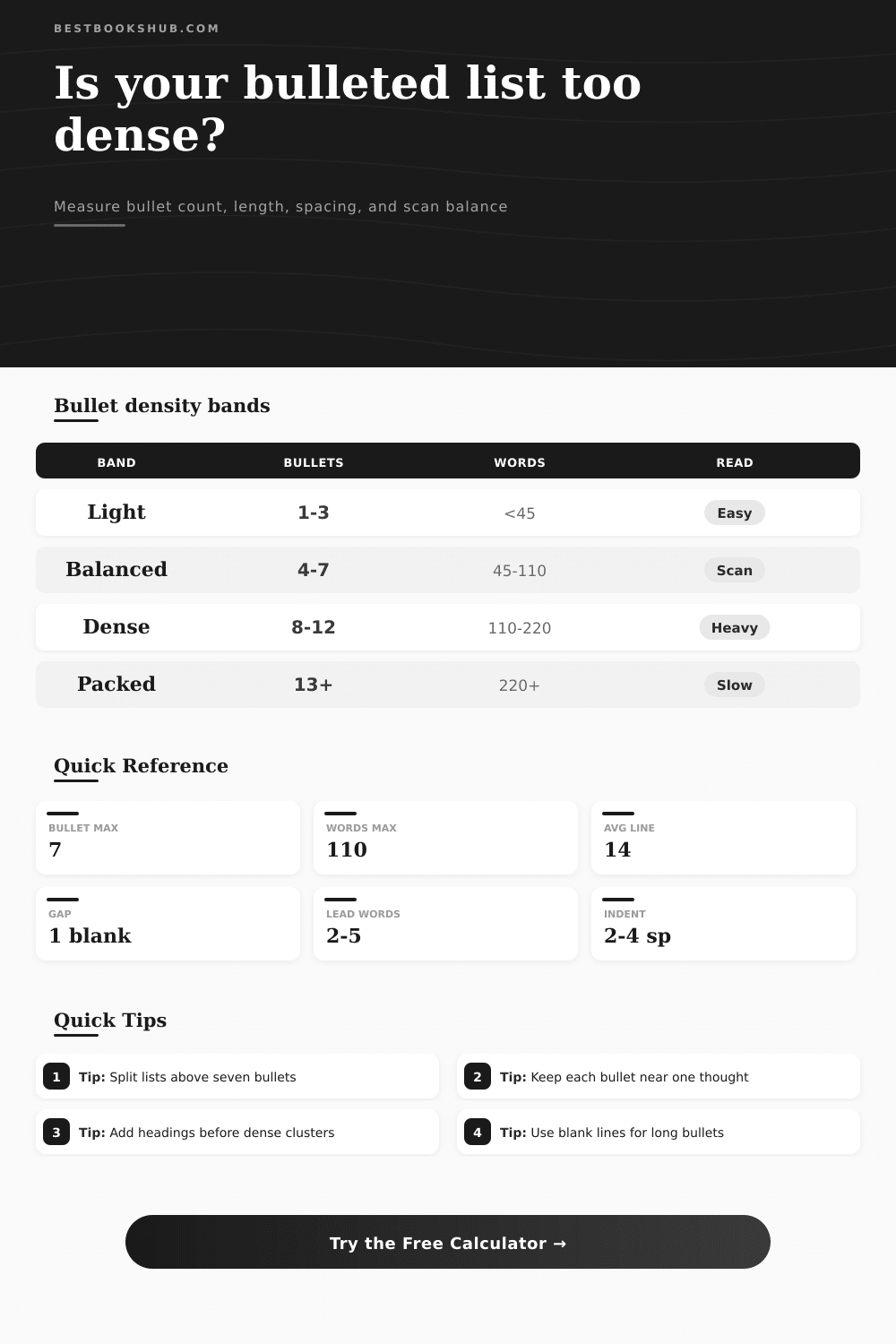
Paste a list-heavy page, checklist, outline, or reading note set to measure bullet count, average bullet length, spacing pressure, and scan balance.
| Density band | Score range | Typical signal | Best adjustment |
|---|---|---|---|
| Light | 0-24 | Few short bullets | Add detail only where needed |
| Balanced | 25-49 | Readable scan pattern | Keep structure steady |
| Dense | 50-74 | Many or long bullets | Split into headed groups |
| Packed | 75-100 | Heavy list wall | Shorten, group, or convert |
| Marker style | Detected examples | Best for | Density note |
|---|---|---|---|
| Dash | - item | Draft notes | Fast and compact |
| Asterisk | * item | Plain text notes | Good in raw text |
| Numbered | 1. item | Ordered steps | Adds sequence pressure |
| Checkbox | [ ] item | Tasks | Best for action lists |
| Avg words | Read feel | Line behavior | Useful format |
|---|---|---|---|
| 1-8 | Very quick | Single line | Checklist |
| 9-16 | Skimmable | Mostly one line | Notes list |
| 17-28 | Detailed | Often wraps | Annotated bullets |
| 29+ | Paragraph-like | Multi-line | Convert or split |
| List type | Typical count | Target avg words | Scan goal |
|---|---|---|---|
| Chapter outline | 5-9 bullets | 6-12 | Fast structure |
| Reading notes | 6-12 bullets | 10-18 | Idea capture |
| Checklist | 4-10 bullets | 3-9 | Action scan |
| Research list | 8-14 bullets | 14-24 | Grouped evidence |
Checklist
Best when each bullet starts with an action word and stays below one short line.
Outline
DISCLOSURE: This post may contain affiliate links, meaning when you click the links and make a purchase, I receive a commission. As an Amazon Associate I earn from qualifying purchases.
Best when bullets group under headings and avoid repeating the same lead phrase.
Notes
Best when longer bullets are broken by blank space or separated into subtopics.
Dense brief
Best when rewritten into fewer bullets, short paragraphs, or a compact table.
I think this has more to do with bullet points than the text. In my experience, if there’s too much text packed into a bullet point without enough breathing room, it will fail, sometimes you’ll even read the same sentence two or three times, yet not absorb what it says.
Why? Because a list of thick paragraphs can feel like a wall, it doesn’t scan well; it looks formatted but isn’t realy. The issue is usually density. When bullets combines without space, your brain shifts from scanning to skimming. This mean you don’t notice the point at all.
How to Make Bullet Points Easy to Read
This one’s solved by measuring your list structure. Bullets is writers’ free pass on details; they think that as long as there’s a dash up front, they’re golden. But a bulleted list is realy an unspoken agreement: each point should convey a scannable unit of info. If you break that contract, the tool measures the pressure by how much you exceeded it.
What’s the bullet count? How long are words in it? How spaced out is everything? Does your list read like something you can scan quickly? Or is it so jam-packed together that you have to read it?
The thing about that is that today’s word processors break up long bullets into several displayed lines. It looks like fewer words, you’ll paste them together in one line again and discover what the real word count is. But it also means you’re looking at a false sense of brevity, so you want to be able to tell calculator what to do with all these wrapped lines.
By default, most will have the default setting (which is fine for normal drafts), but if you’ve pasted something from a formatted document where indentations is gone, you may want to mess around with continuation settings. A very small change, but it makes a big difference on the density score.
Think of this like a traffic light for readability. The output gives you a scan balance band. If it’s green, your list is balanced. Red? It’s packed. Typically a balanced list have about four to seven items with an average length so that each bullet point fits on one line (sometimes two).
As soon as you get above eight or nine bullets; or when the words pile up past fifteen per bullet, the mental effort spikes. By the time your reader gets to the seventh bullet, he has forgotten what first bullet said. Meanwhile, he is trying to process the third one. The third bullet require him to keep the first one in his head. That’s why breaking lists is more than a matter of style: it’s a memory aid.
The scoring links to reference tables that connect back to common kinds of documents. There is a chapter outline that is fast and light. You can add more complexity when grouping headings together in a research brief. You can also use the calculator to compare your draft different than those standards. It won’t write the list for you (it doesn’t write anything) but it will point out where the friction is.
When you have a dense score, the solution isn’t “add more text”, that’s very rarely the fix. More often you should of delete words, split clusters, or add blank lines so the eye has somewhere to rest.
Blank lines are often the most under-rated tool; they don’t alter word count if you have two dense bullets next to one another, but they do reset the reader’s attention span, signaling pause-in-thought or shift-in-topic. They make list digestible, where before the reader has just a blur. And the tool takes account of those expected blank lines. If the number is high, then your text look visually compressed and needs opening up.
And lastly, if you’re used to using bullet points to write novels, stop it now. Bullets aren’t for reading; they’re for scanning. When you put complete paragraphs within them, you’ve overused the form. Turn them into prose, and reserve your bullets for the quick hit, the action, the highlight.
Make the mental effort as low as possible while still keeping all information, that’s the sweet spot, which this calculator can help you identify. It honors the reader’s attention (and time), and when you nail down the density, the list no longer stands in the way. The list becomes a map, and maps is designed to be followed.