📖 Clarity scan
Buzzword Density Calculator
Paste jacket copy, editorial notes, book proposals, reviews, blurbs, bios, or classroom prose to count buzzwords, repeated claims, phrase clusters, and density per 100 words.
Load realistic samples for book-adjacent writing, from polished copy to overloaded pitch language. Each preset fills every setting and recalculates instantly.
DISCLOSURE: This post may contain affiliate links, meaning when you click the links and make a purchase, I receive a commission. As an Amazon Associate I earn from qualifying purchases.
The calculator matches common publishing, business, academic, and promotional buzzwords, then scores density, repetition, multiword phrases, and sentence-level concentration.
| Buzzword or phrase | Category | Count | Share | Priority |
|---|---|---|---|---|
| Paste text or load a preset to see matched buzzwords. | ||||
| Rank | Matches | Density | Sentence excerpt |
|---|---|---|---|
| The densest sentences will appear after calculation. | |||
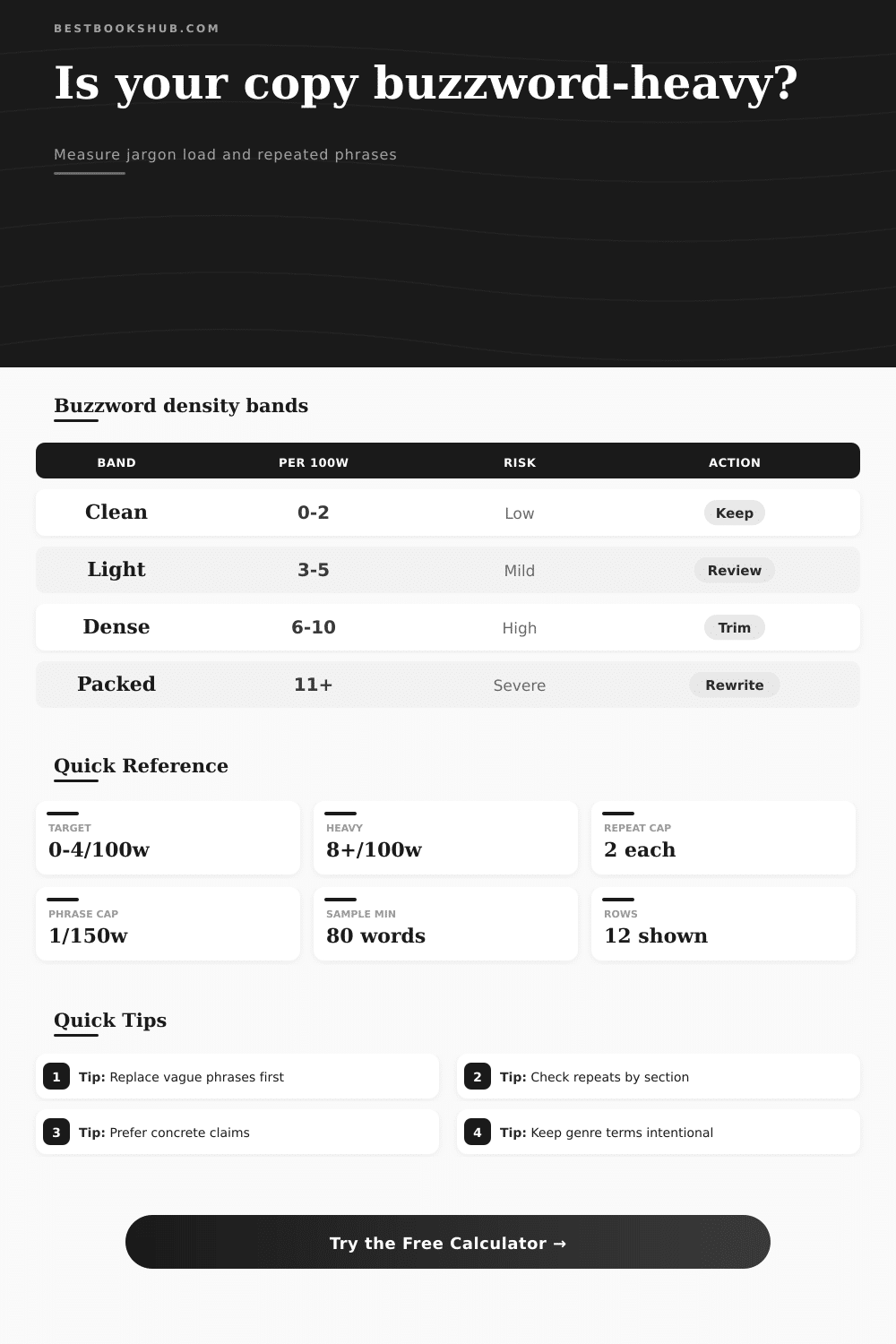
| Density band | Buzzwords per 100 words | Typical feel | Editing response |
|---|---|---|---|
| Clean | 0 to 2 | Concrete and plain-spoken | Keep terms that carry exact meaning. |
| Light | 3 to 5 | Mostly clear with a few stock phrases | Review repeated claims and abstract nouns. |
| Dense | 6 to 10 | Promotional or padded | Replace vague terms with specific evidence. |
| Packed | 11 or more | Hard to trust or hard to parse | Rewrite sentence by sentence. |
| Category | Common terms | Why it can weaken copy | Concrete replacement angle |
|---|---|---|---|
| Publishing hype | gripping, unputdownable, page-turning | Signals feeling without proof from the text. | Name the conflict, stakes, or reading pace. |
| Business language | innovative, strategic, scalable | Turns claims into broad labels. | Describe the method, result, or audience. |
| Academic abstraction | framework, discourse, paradigm | Can hide the actual argument. | State the claim and the evidence path. |
| Soft cliche | journey, powerful, transformative | Familiar words lose edge when repeated. | Use a scene, action, or measurable change. |
| Sample length | Best use | Reliability | Calculator note |
|---|---|---|---|
| Under 80 words | Headline or short blurb | Volatile | One phrase can swing density sharply. |
| 80 to 250 words | Jacket copy or review paragraph | Useful | Good for checking front-facing copy. |
| 250 to 800 words | Proposal, essay, or chapter section | Strong | Shows repeat patterns across paragraphs. |
| 800 or more words | Long draft sample | Very strong | Use sentence rows to target dense passages. |
Buzzword matches use a curated list plus your custom terms. Results are estimates for editing and should be read alongside context, audience, and genre expectations.
This is likely familiar if you’ve ever been in a pitch meeting or watched someone speak from a stage. They lean in, go fast… But nothing sticks. It sounds like something important was said, but it doesn’t leave an impression. Maybe the concepts is great; maybe communication itself is lacking in texture.
That’s where a buzzword density calculator will show you. It’s a measure of ratio between concrete details and stock phrases used in your text. Paste in author bio or jacket blurb and it’ll scan for terms that suggest feeling without offering proof.
Why You Should Use a Buzzword Density Calculator
Nowhere is it against the law to say something is groundbreaking or transformative, but these words are heavy, they need support. The calculator will flag these word so you know whether you’ve earned the right to use them. It also scans for repetition. If you use same abstract noun three times in two paragraph, the tool notices. Repetition flattens meaning while giving illusion of depth.
When most of us write that our book is about such-and-such an issue or experience, we believe ourselves to be being descriptive; what we’re really doing is being vague. This: my book’s about human condition. And this: my book’s about a woman who loses her job and rebuilds her life. The first has no weight at all. The second have some. The density score in the calculator gives you a way to see which is which.
If you’ve got low number, you’re probably being concrete. If you have a high one, you’re probably padding your argument with language that sounds busy but doesn’t lift the idea. Table on the page shows that clearly. However, the real lesson here is about trust. Readers trust specifics and suspect generalities.
The tool has settings that match whatever type of genre you’re writing. For example, a mystery novel blurb isn’t going to include as many abstract term as an academic piece of writing. It lets you pick profile to handle this. When you write a book proposal, you know that agents is looking for some words (scalable, strategic), so you put those in there. But you also don’t want those word floating free. You still want them anchored.
The tool doesn’t prohibit those words. Instead, it simply flags how frequent they occur. You don’t want to have every other word be a buzzword. But if you’ve got solid nouns and verbs, sprinkled with one or two buzzwords, that’s fine.
What I like best, though, is the sentence concentration view. That’s where it tell you which lines are overloaded. Frequently, it’s a single dense sentence that collapses in on itself. Rewrite that sentence, and the entire paragraph get better. It is better than starting over again. You do not need a different voice; you are simply tightening the screws.
This has nothing to do with dumbing things down. Dumbing things down means saying there is nothing more to say. Editing for clarity is about removing the noise so signal can come through. It’s about stripping away the hype and seeing what you actualy have to contribute. That’s what the calculator helps you find. And that’s why it spares you the embarrassment of sending off something that sounds profound but turns out to be empty.
Use the calculator before you send, then read the result not as a grade. As a map. Not as a grade. As a map. A map showing you where your ideas is hiding inside all that jargon.
Get them out in the open. Your readers will appreciate the effort. They’ll remember the story, not the buzzwords.