📖 Reading recovery lab
Catch-up days calculator
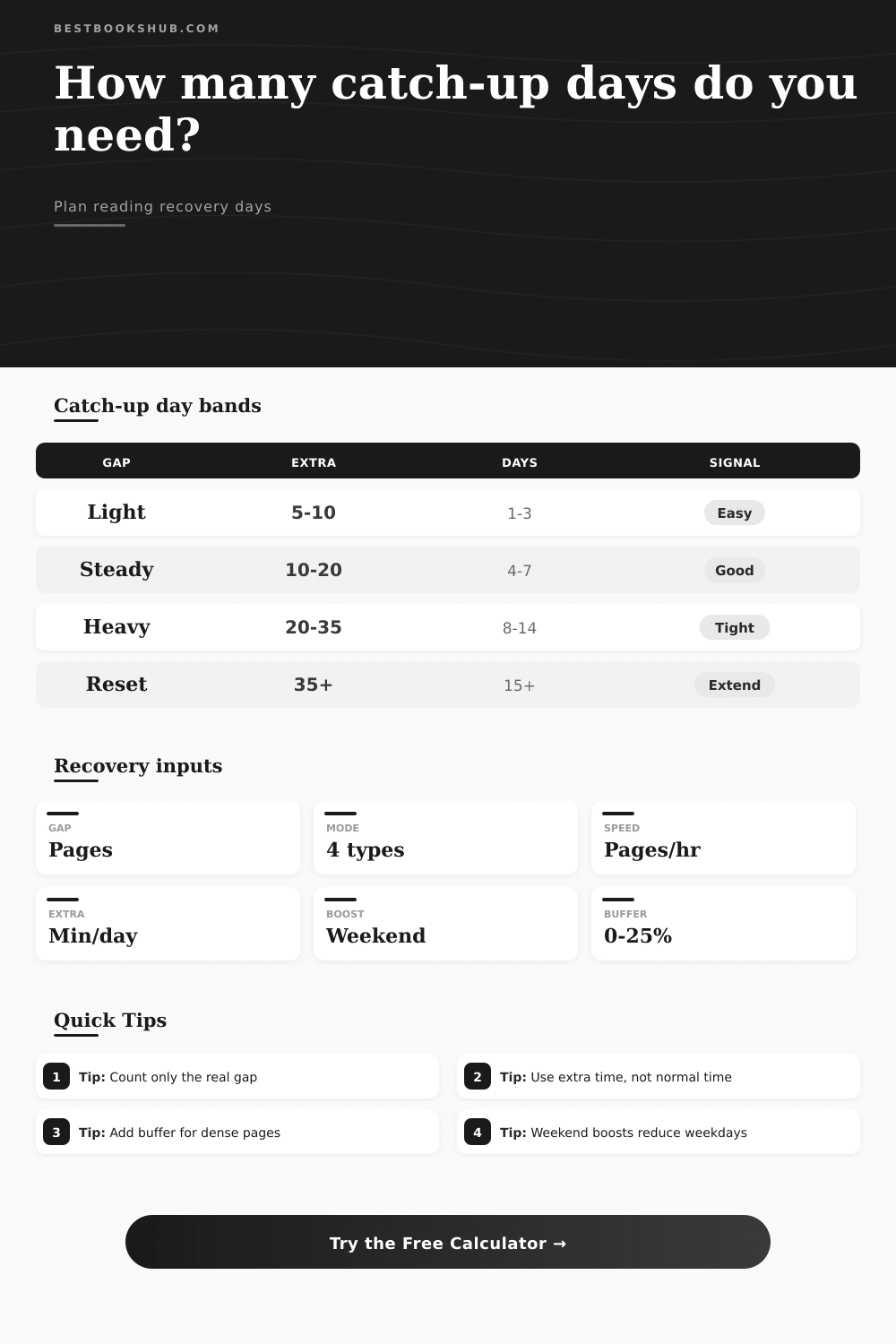
Estimate the number of focused catch-up days needed to erase a reading deficit while your normal plan continues in the background.
Enter where the plan expected you to be and where you actually are. Catch-up days use only the extra work above your normal reading pace.
| Reading speed | 15 extra min | 30 extra min | 45 extra min | 60 extra min |
|---|---|---|---|---|
| 20 pages/hour | 5 pages | 10 pages | 15 pages | 20 pages |
| 30 pages/hour | 8 pages | 15 pages | 23 pages | 30 pages |
| 40 pages/hour | 10 pages | 20 pages | 30 pages | 40 pages |
| 50 pages/hour | 13 pages | 25 pages | 38 pages | 50 pages |
| 60 pages/hour | 15 pages | 30 pages | 45 pages | 60 pages |
| Current gap | 10 extra/day | 20 extra/day | 35 extra/day | Best use |
|---|---|---|---|---|
| 40 pages | 4 days | 2 days | 2 days | Small slump |
| 80 pages | 8 days | 4 days | 3 days | Book club |
| 150 pages | 15 days | 8 days | 5 days | Deadline |
| 240 pages | 24 days | 12 days | 7 days | Course load |
| 400 pages | 40 days | 20 days | 12 days | Series gap |
| Material type | Density factor | Common pace | Catch-up note |
|---|---|---|---|
| Light fiction | 0.75x | 50-70 pph | Extra pages clear quickly. |
| Standard novel | 1.00x | 35-45 pph | Use measured pace if known. |
| Dense fiction | 1.20x | 25-35 pph | Add short reread buffer. |
| Nonfiction notes | 1.45x | 18-30 pph | Protect annotation time. |
| Academic text | 1.70x | 12-22 pph | Expect slower recovery. |
| Pattern | How it counts days | Best when | Watch point |
|---|---|---|---|
| Daily extra | Same extra every reading day | Gap is small or steady | Can drag if the gap is large. |
| Hybrid | Daily extra plus weekend boost | Weekdays are limited | Do not rely on one block only. |
| Weekend weighted | Boost carries more of the gap | Open weekend is realistic | One lost weekend resets the math. |
| Gentle cap | Extra pace is reduced by 20% | Burnout risk is high | Needs more calendar runway. |
DISCLOSURE: This post may contain affiliate links, meaning when you click the links and make a purchase, I receive a commission. As an Amazon Associate I earn from qualifying purchases.
So you start off with a week’s worth of reading planned out, but then life happens. It throws your plans all to hell. You’re suddenly forty pages behind and now instead of a book club discussion being a chance to learn new things, it feels more like you’re under investigation. Panic ensues and you start thinking about skimming, starting to speedread. But this isn’t typically a problem solved by reading quicker. This is a problem solved by measuring the distance and filling in the gap deliberatey.
Most reading plans treats time as infinite and energy as renewable. But most reading plans act as though they are. They don’t consider mental exhaustion due to thick non-fiction books or lack of sleep. They also don’t consider bouts with illness. If you fall behind schedule, you tend to cram more pages into your day-to-day life… Which usually results in burnout by chapter ten.
How to Catch Up on Your Reading
To avoid this, you need to distinguishes between your “normal” pace and your “recovery” pace. Why? Because your brain functions differently when it’s maintaining a habit vs. It is erasing a deficit. The calculator do the math for you, but knowing the reason it tells these inputs apart will alter how you behave.
Different kinds of reading material move at different speeds. Complex, academic material packed with arguments moves slower then a page of light, quick fiction containing short sentences. Treat them both as equal units and you’ll underestimate the time it takes to catch up. You need to include your reading style in your calculation here. You might think you can read twenty extra pages in an hour which sounds reasonable until you realize those twenty pages contain three new theories and a dozen citations. Sounds good… until you discover they’re full of a dozen citations and a half-dozen new theorys. Naturaly your pace slows down when comprehension matters more than just coverage.
Most importantly, you have the ability to plug in a buffer. This is a 10 percent (or even a 15 percent) cushion against real-life friction. Your eyes may want a break away from screen or maybe you’ll just get distracted by an email. If there’s no buffer, each little speed bump risks derailing your recovery plan. But with a buffer in place, the plan rolls onward, absorbing any shocks that come its way. It’s a small thing, but oh how much it matter when it comes time to stay on course.
There’s also the weekend boost. On Saturdays and Sundays most of us have greater flexibility in our schedule than we do on a Tuesday morning before work. You might be able to squeeze out fewer weekday session by exploiting these open blocks of time. This works, however, assuming that you can leverage open blocks on your weekends for reading. If you don’t have any free weekends, if you’re spending your Saturday doing chores instead of reading… The math will fall apart pretty fast.
See the reference table on page for how total timeline changes with a change in effort. Missing a day is not a moral failing. It’s a data point. You’re where you are. That’s fine. What matters is the gap. Trying to pretend that you’ll read twice as much next week, trying to pretend you didn’t miss any days; don’t work (not very often). Instead, face reality, adjust for how dense material is, include a realistic margin of error for distractions and go with the plan. This isn’t about punishing yourself for falling behind. It’s about getting back on track with a clear head so you can close the gap. Then you’ll be able to get back up to speed again without looking back.