📖 Chapter pacing lab
Chapter cliffhanger spacing calculator
Map chapter-ending hooks, quiet breaks, act turns, and intensity pressure so cliffhangers arrive with rhythm instead of reader fatigue.
Load a common manuscript pattern, then adjust the ending map and targets for your own draft pass.
| Chapter | Ending type | Act zone | Since hook | Turn distance | Spacing note |
|---|---|---|---|---|---|
| Edit the map to build the spacing schedule. | |||||
| Story lane | Typical hook gap | Major-hook share | Spacing note |
|---|---|---|---|
| Thriller or suspense | 1 to 3 chapters | 30% to 45% | High pressure works when fallout is brief but visible. |
| Mystery or crime | 2 to 4 chapters | 20% to 35% | Clue questions and suspect shifts can alternate with soft hooks. |
| Romance | 2 to 5 chapters | 15% to 30% | Emotional reversals need quieter aftermath to feel earned. |
| Fantasy adventure | 2 to 4 chapters | 22% to 38% | Mix travel, world turns, reveals, and danger without stacking every chapter. |
| Literary fiction | 4 to 7 chapters | 8% to 20% | Meaning, image, and unresolved choice often replace hard cliffhangers. |
| Memoir or narrative nonfiction | 3 to 6 chapters | 10% to 25% | Revelation pacing should leave space for interpretation. |
| Code | Ending type | Use when | Common overuse signal |
|---|---|---|---|
| M | Major cliffhanger | A reveal, threat, breakup, reversal, or irreversible choice changes the next chapter. | Every ending shouts, so none feels special. |
| S | Soft hook | A question, promise, image, clue, or emotional tilt pulls the reader onward. | The hook feels vague because nothing actually shifted. |
| R | Resolved fallout | The chapter closes a consequence while pointing toward the next decision. | Too many resolved endings can flatten mid-book drive. |
| N | Neutral rest | A chapter intentionally lets readers breathe after high pressure. | Long neutral chains feel like stalled momentum. |
| Signal | Likely spacing issue | First check | Revision move |
|---|---|---|---|
| Readers stop mid-act | Quiet gap is too long | Find the longest run without M or S. | Add a soft hook to the middle of the gap. |
| Readers feel manipulated | Major hooks are stacked | Count back-to-back M endings. | Convert one major into fallout or a softer promise. |
| Twists feel weightless | No fallout after major turns | Look at the chapter after each M. | Add R after the biggest reversals. |
| Middle feels flat | Act turns lack ending pressure | Compare M/S chapters to listed turns. | Move a stronger hook within one chapter of the turn. |
| Finale feels thin | Every late chapter is maximum pressure | Check final-quarter major-run length. | Use one soft hook or resolved beat before the last shock. |
DISCLOSURE: This post may contain affiliate links, meaning when you click the links and make a purchase, I receive a commission. As an Amazon Associate I earn from qualifying purchases.
If you’ve ever had one of those beta reads where reviewer says something like “The pacing was really erratic,” then you know the sickening sensation. They were riveted for the first few chapters…then, bang, they’re skimming because it feels like filler three chapters later. The problem is almost never weak characters or bad prose. More often than not, it’s structural rhythm, specifically, how you end your chapter.
Most writers thinks of cliffhangers as stand-alone occurrences instead of parts of an ongoing pressure system. If your writing has great twists, no problem! But when they’re bunched up together in a single section, or widely separated from each other, readers lose the beat. They don’t feel like there is any forward motion.
How to Fix Your Story Pacing
By plotting your hooks on a graph, the calculator show you your story’s rhythm: When do the action scenes happen? What about quiet moments? Where does tension run high and where do gaps occurs? It makes all your gut-level pacing questions turn into hard numbers about intensity runs and gaps. Spacing is more complicated than it sounds, which is why I’m glad there’s a tool for it.
To write a story that keep the readers interested through hundreds of pages, you have to vary how you end each chapter. One chapter on a big reveal followed by another on a big reveal soon loses its shine. Eventually, the stakes are so high they’re background noise. On the other hand, no revelation for too long mean the reader starts checking out.
This tool take into account several types of endings. Some resolve consequences. Others set up something bigger, such as a threat or a reversal. Some raise an emotional hook. Some raises questions as a soft hook. Finally, some just give the reader time to breathe.
Knowing when to use a soft versus a hard hook matters. If you’re introducing immediate danger or flipping the plot in a new direction, then it’s a major hook. If it’s a soft hook, maybe it’s an emotional tilt or a dangling question at best. Both will make the reader turn the page, but they puts different kinds of pressure on the story.
How does this play out in your sequence? Think about the aftermath. Shock value can only go so far, the reader wants time to react to your big reveal before the next big thing hits them. That’s why fallout chapters is important to track. They tell you if you’re running two major cliffhangers together and stacking shocks without letting the first one land. Because now the reader is dashing off to see what happens next and the last plot point never had the chance to happen.
This is what the calculator will help you spot: how to add a neutral/resolved chapter between a series of high moments so that the next surprise lands instead of feeling like another bullet on your list of dramatic events. This keeps things from getting fatiguing and makes sure the big moments matters rather than just being another dramatic checkmark.
How tightly or loosely you space your hooks is also very influenced by genre expectation. If it’s a thriller, the stakes are imminent, involving high-stakes suspense or outright survival. You’ll want to have less space between major turns and more hooks per chapter, since the stakes is higher and immediate. On the other hand, if it’s literary fiction, there may be broader spacing allowed since the tension is typically more about themes or inner feelings, not derived from plot itself.
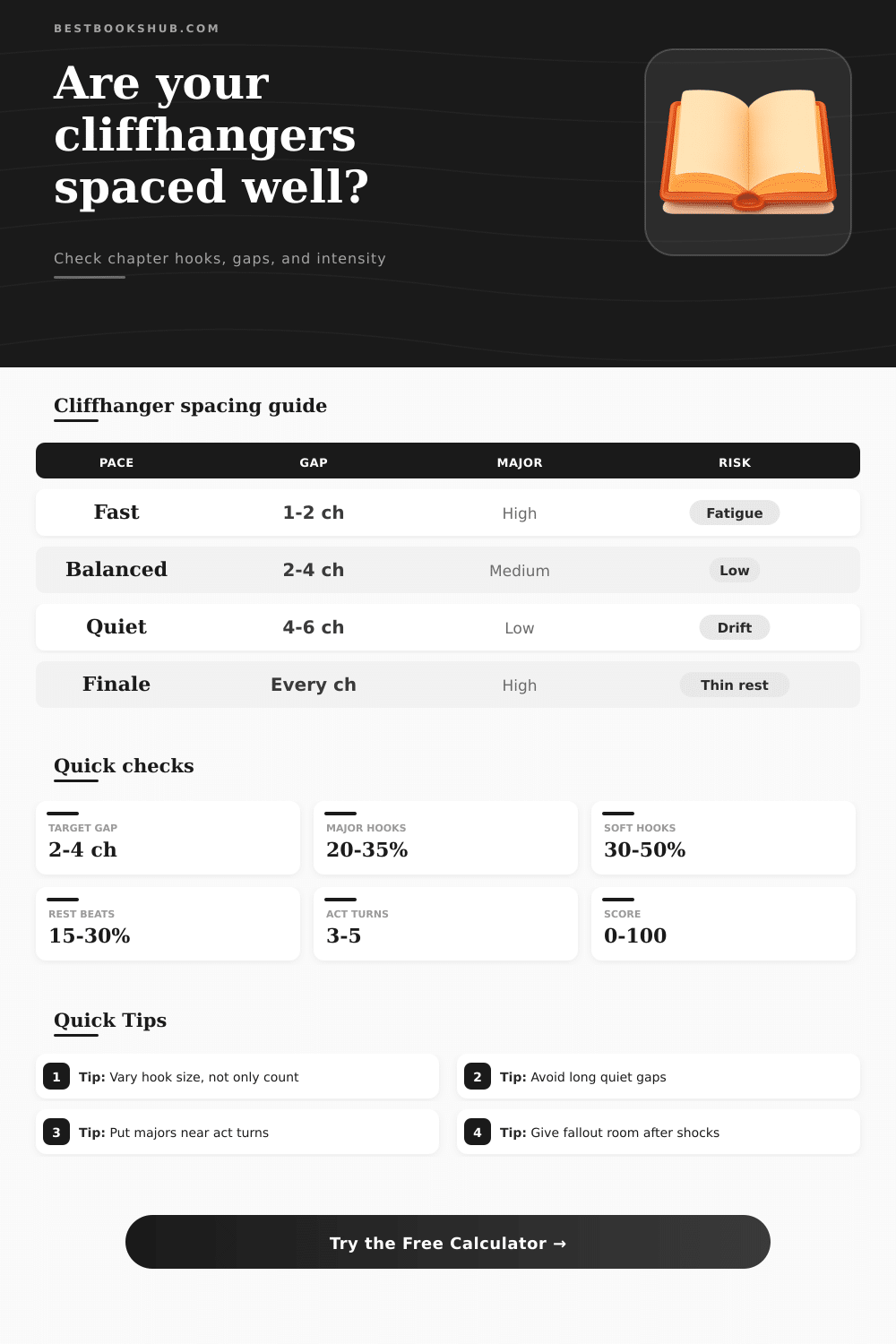
To see this graphically, I’ve put together a chart on the page that shows general genre norms for major-hook share and typical gap between hooks. As you can see, thrillers shoot for hooks as large as 30-45% of their chapters, whereas literary or romance genres can work well at far lower percentages. Knowing what “normal” looks like for a genre will help adjust your targets so you’re meeting reader expectations but still keeping true to your distinctive voice.
Varying pacing isn’t rule-breaking; it’s about controlling energy so the ultimate payoff doesn’t feel accidental, but earned. Actualy, it is moddern approach.
In short, trust your reader. Trust yourself. Promise them a level of pacing, and then deliver it in a way they can count on.
Refer back to your chapter map. Where does your manuscript rush? Where do you drag? Identify areas where long quiet gaps could lose interest. Make sure the act turns matches up with the stronger endings to have maximum impact at these structural pivots.
You should of checked this earlier. It is a little thing. But it matters.
When the rhythm is right, they don’t even notice the mechanics anymore. They just keep going, all the way to the last page.