📖 Chapter rhythm lab
Chapter Pacing Calculator
Audit chapter word counts against a target pace curve, tension beat load, scene density, cliffhanger spacing, fast and slow chapter flags, and variance tolerance.
| Chapter | Words | Target curve | Actual pace | Flag | Revision cue |
|---|
| Segment | Chapters | Words | Avg words | Pace signal |
|---|
| Genre band | Chapter word range | Hook spacing | Variance target | Pacing signal |
|---|---|---|---|---|
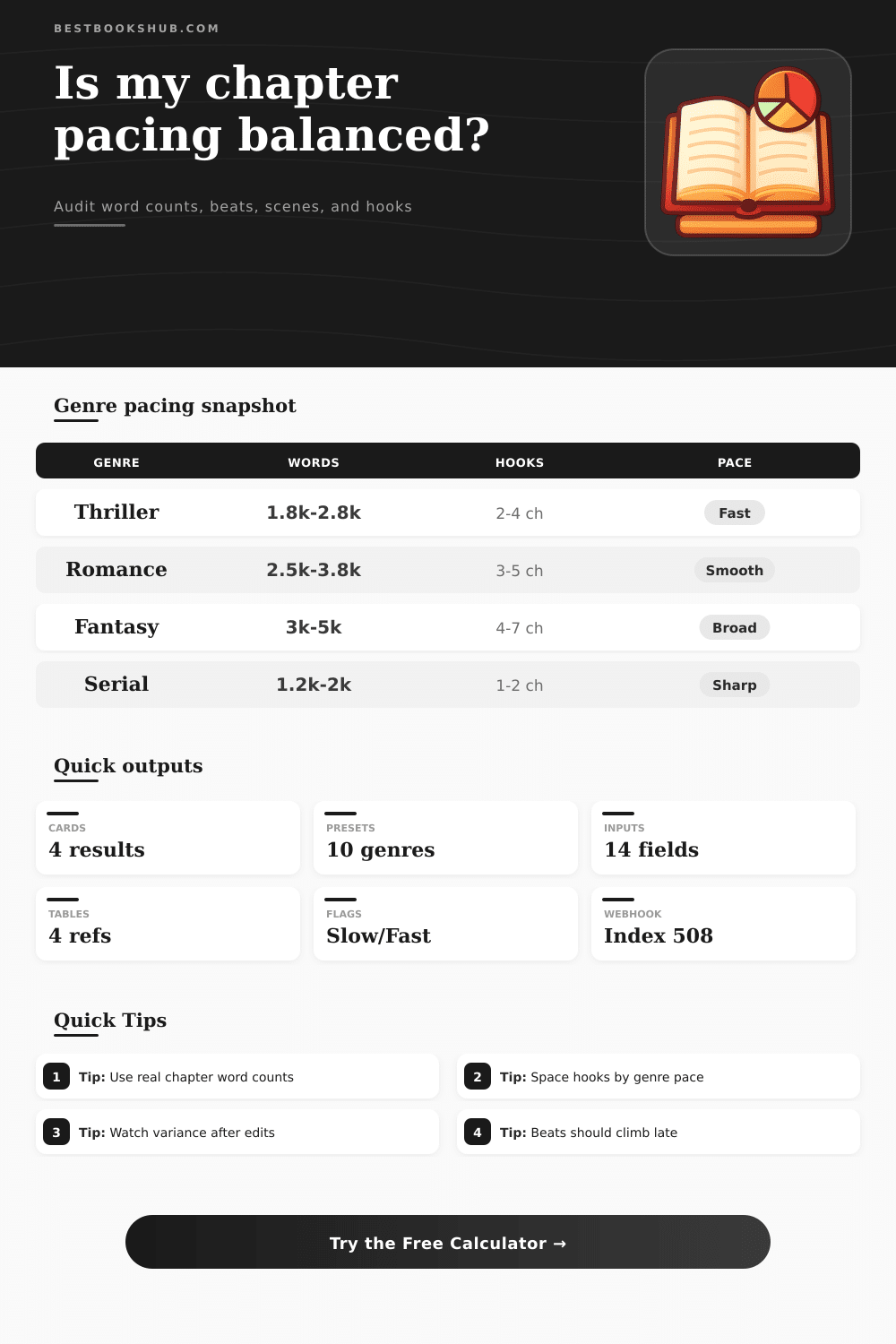
| Thriller or suspense | 1,800-2,800 words | Every 2-4 chapters | 18-30% | Short chapters should cluster near reveals, chases, reversals, and endgame turns. |
| Romance or contemporary | 2,500-3,800 words | Every 3-5 chapters | 14-24% | Emotional turns can alternate with calmer aftermath chapters. |
| Epic fantasy or historical | 3,000-5,000 words | Every 4-7 chapters | 18-32% | Long chapters need internal scene turns so the pace does not flatten. |
| Literary fiction | 3,200-5,500 words | Every 5-8 chapters | 12-22% | Quiet chapters can work when pattern, contrast, and consequence stay clear. |
| Serial web fiction | 1,200-2,000 words | Every 1-2 chapters | 20-36% | Frequent hooks are expected, but repeated false cliffhangers weaken trust. |
| Curve type | Best fit | Where speed should rise | Watch point |
|---|---|---|---|
| Rising pressure | Most commercial novels | Each quarter climbs toward the ending. | Middle chapters need visible turns, not only setup. |
| Slow burn | Romance, dread, literary suspense | Late middle and final quarter. | The opening still needs stakes, promise, or curiosity. |
| Wave pattern | Fantasy, mystery, ensemble casts | After breathers, reveals, and travel turns. | Too many valleys can read as stalled momentum. |
| Front-loaded action | Action, heist, survival, portal openings | Opening and final quarter. | The middle needs fresh pressure after the initial burst. |
| Episodic rhythm | Serials, quests, case files | At installment edges and mini-climaxes. | Standalone arcs still need a larger throughline. |
DISCLOSURE: This post may contain affiliate links, meaning when you click the links and make a purchase, I receive a commission. As an Amazon Associate I earn from qualifying purchases.
Chapter pacing determine the speed at which a reader continue through the story. Chapter pacing can create a sensation for the reader that the story is dragging or that it is rushing by them. Writers often use an chapter pacing calculator to identify the issues with their chapter pacing.
Chapter length is one of the primary elements that determines chapter pacing. If chapter lengths vary throughout a manuscript, the reader will feel friction while reading the chapters. The more greater the friction that is created within a manuscript, the more likely that readers will feel that the story is uneven.
How to Use a Chapter Pacing Calculator
By using a chapter pacing calculator, writers can input the word count of each chapter to observe how their chapters compare to a target curve for that novel. The target curve for a story is the target for the chapter length of that story to match the expectations of the particular genre of that story. For instance, the target chapter length for a thriller may be much shorter then the target length for a novel that falls into the literary fiction category.
Using the calculator, writers can compare the length of each of their chapters to the target curves for various genre to ensure that their chapter lengths match the genre of the novel that they are writing. Scene density and the placement of tension beats within a chapter can change the pacing of the story even if each chapter has the same word count. For example, two chapters can have the same word count but one chapter can contain many short scenes while the other contains a few long scenes.
The scenes and the tension beats within those scenes can create the sensation within the reader of a fast or slow chapter. The scene counts and the placement of the tension beats can be entered into the chapter pacing calculator so that the calculator is able to understand how the different chapters may feel to the readers despite their comparable word counts. The variance of chapter lengths can also impact chapter pacing.
A small variance within chapter lengths is typically seen as helpful for the story as it indicates a naturaly rhythm for the chapters. However, a high variance in chapter lengths can make a story feel choppily. Writers can use the variance tolerance setting on the chapter pacing calculator to determine the variance within chapter lengths that is acceptable within their novel.
The calculator will flag any chapter that have a variance outside of the tolerance that is selected. Chapter pacing calculators also provide writers with flags that indicates areas of potential pacing issues within the novel. For instance, a fast flag can indicate that a chapter needs more internal movement while a slow flag may indicate that a chapter needs more separate scenes.
The reference tables that are included with the calculators can indicate the range of word counts and the spacing of hooks for the genres that are represented in those tables. These tables can help writers to more easy understand the flags that the calculator presents. By using a chapter pacing calculator prior to a writer begins major revisions of their novel, they can observe which sections of their novel is drifting from their target curve.
Based on these observation, writers can make targeted adjustment to the lengths of their chapters. This targeted adjustment of chapters is typically more efficient than major rewriting of chapters that are felt to need to be altered. Thus, the calculator will not write the story for writers, but it will make invisible elements of the story like chapter pacing visible for writers to make their adjustment.