📖 Daily chapter planner
One Chapter Per Day Finish Calculator
Estimate exactly when a one-chapter-a-day reading plan will finish after rest days, long chapter cushions, average pages, current chapter, start date, and missed-day buffer.
Load a realistic reading situation, then tune chapter count, rest rhythm, long chapters, and buffer days for your actual book.
DISCLOSURE: This post may contain affiliate links, meaning when you click the links and make a purchase, I receive a commission. As an Amazon Associate I earn from qualifying purchases.
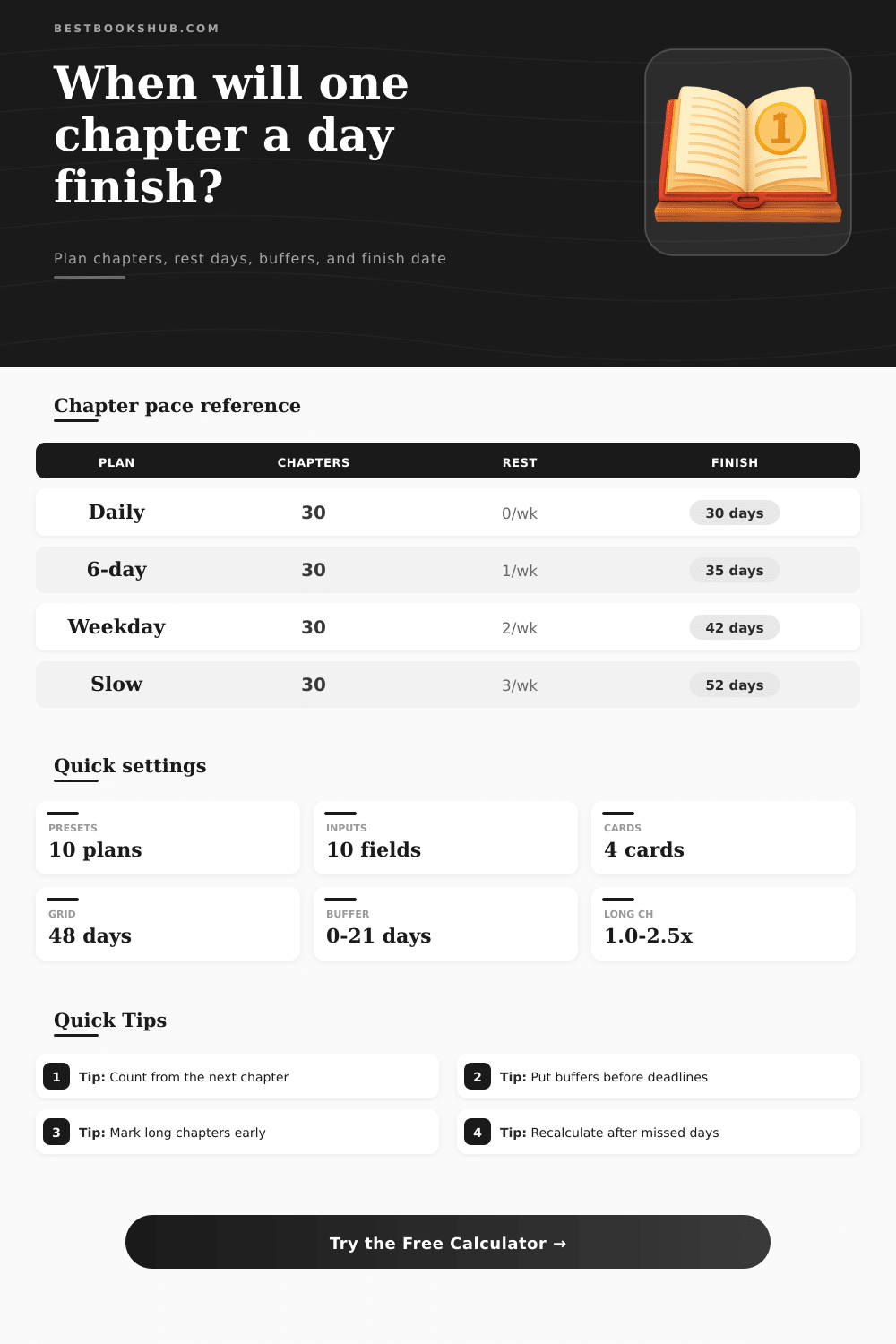
The grid shows the first 48 calendar days from your start date. Reading days get chapter assignments; skipped days show rest or buffer.
| Scenario | Rest pattern | Buffer | Finish date | Calendar span |
|---|---|---|---|---|
| Current inputs | - | - | - | - |
| Book shape | Typical chapters | Pages per chapter | One-chapter note |
|---|---|---|---|
| Short contemporary novel | 24 to 36 | 8 to 14 | Often fits a daily habit easily. |
| Classic or literary novel | 30 to 60 | 10 to 20 | Watch for dense chapters and slower pace. |
| Epic fantasy or long series book | 40 to 80 | 12 to 28 | Add long-chapter cushion early. |
| Nonfiction with sections | 10 to 25 | 18 to 45 | One chapter can mean a full study block. |
| Rest pattern | Reading days | 30 chapters finish in | Best use |
|---|---|---|---|
| No rest days | 7 per week | 30 calendar days | Short challenge or already easy chapters. |
| One fixed day off | 6 per week | 35 calendar days | Steady plan with one weekly reset. |
| Weekends off | 5 per week | 42 calendar days | Workday reading or commute habit. |
| Weekend reading only | 2 per week | 100 to 105 calendar days | Busy weeks, large books, or relaxed goals. |
| Long-chapter load | Meaning | Added cushion per 8 long chapters | How to use it |
|---|---|---|---|
| 1.25x | A little longer than usual | 2 sessions | Use when chapters are only slightly uneven. |
| 1.50x | Noticeably long or dense | 4 sessions | Good default for classics and nonfiction. |
| 2.00x | Feels like two chapters | 8 sessions | Use for very long sections or annotation. |
| 2.50x | Major chapter or study unit | 12 sessions | Use for doorstop chapters with low energy margin. |
Maybe you’ve been three chapters behind on a book club pick with just two weeks to go. Maybe you nobly purchased the book, maybe even highlighted the first paragraph, only to have life get in the way. It throws in meetings or laundry, or worse yet, reminds you that you still haven’t made dinner.
On paper, the one chapter per day plan look easy enough. And it seems like a gentle, even pace… Not a sprint! But most folks forget about the friction of their real lives. They calculate based off ideal days, not real ones. They assume ideal days.
Why Rest Days Are Important for Your Reading Plan
So they need a system that can handles the messy reality of life as a reader: Rest days. There is dense parts. There are days where you miss an afternoon altogether. It does all the math for you (input your start and your constraints, then click) so it prevents you from underestimating just how much those buffer days add up.
Sure, it’s easy to think “if I can write 30 chapters, that means it’ll take me 30 days.” But that’s a logical mistake. That turns into five weeks if you’re taking Sunday to recharge. The tool helps you account for those variables, like when you travel or get sick. And while that sounds small in the world of math, it’s enormous when you’re looking at a deadline.
Most people don’t fail because they’re lacking in willpower, they fail because their schedule is a robot’s schedule and they live with a human’s body. They have bad days. They travel. They get sick. This forces you to face these variables up front, you can’t pretend like they aren’t there. People underestimate how important the rest pattern are.
Sure, a week of reading where all 5 days count sounds doable. This continues until you wake up and find out that you’re playing catch-up for the next week. Marking off weekends as rest days means you’ve just agreed that you’re going to stop making progress on reading…twice per week.
The calculator will recalculate the end date and distribute the chapters across whatever day remain during the week. That allows you to avoid freaking out about having to jam two chapters into one night after skipping Monday. It also lets you know whether or not the rate you set is realistic.
Does the estimated completion date come at the end of next month? And does it need to be completed by Friday? Then you know right away if this rate will work for you. Adjust the buffer or concede defeat; either way, honesty trumps optimism when planning projects.
What about long chapters? They pose their own problem. There’s no such thing as one-size-fits-all in terms of chapters. Some require only ten minutes to read, while others span out into a doorstopper demanding an hour of your time.
The calculator lets you deal with these outliers by multiplying the weightier chapters so they has more reading sessions built-in. This gives you a little cushion of additional reading session across the plan. Instead of hitting yourself with all the heavy lifting at once, you get to absorb the shock gradually. And this tiny detail matter when you’re trying to stay consistent. One hefty chapter can throw off the whole streak if you don’t give yourself the cushion.
The most truthful thing about any planning tool is that life happens and you’ll miss days. Pre-pay for those with the buffer so it doesn’t become an emergency down the road. If I set aside three or four extra days in the schedule, then when I inevitably miss a night, the plan don’t fall apart. It just absorbs the hit.
That’s the key to this kind of thinking, instead of seeing missed days as failures, you see them as expected costs. The page lays out what your total span is depending on which rhythm of rest you follow (with reference tables showing how various rhythms affect overall span), helping you to see the tradeoff between consistency from day-to-day vs. Duration on the calendar.
In the end, it’s less about how fast you can finish a book than how reliable you are. It’s better to have a great plan that survives contact with reality than a perfect plan that collapses at the first sign of a problem. Knowing the heaviness of heavy material and the importance of rest allows you to set up a schedule that flexes but doesn’t break.
You are still on track, but no longer stressed out. Not only do you make sure you’re reading, but you get to enjoy the experience as well. You enjoy yourself instead of adding another thing to worry about.
Begin reading from wherever you are next, not where you left off last time. Let the numbers take care of themselves.