📖 Reading progress planner
Chapters remaining calculator
Estimate chapters left, pages left, words left, reading time, finish pace, and session load from a current chapter number or a completed-chapter count.
Start with a common reading situation, then adjust the current chapter, partial progress, average chapter size, and deadline settings.
| Reading situation | Typical chapter size | Good daily target | Planning note |
|---|---|---|---|
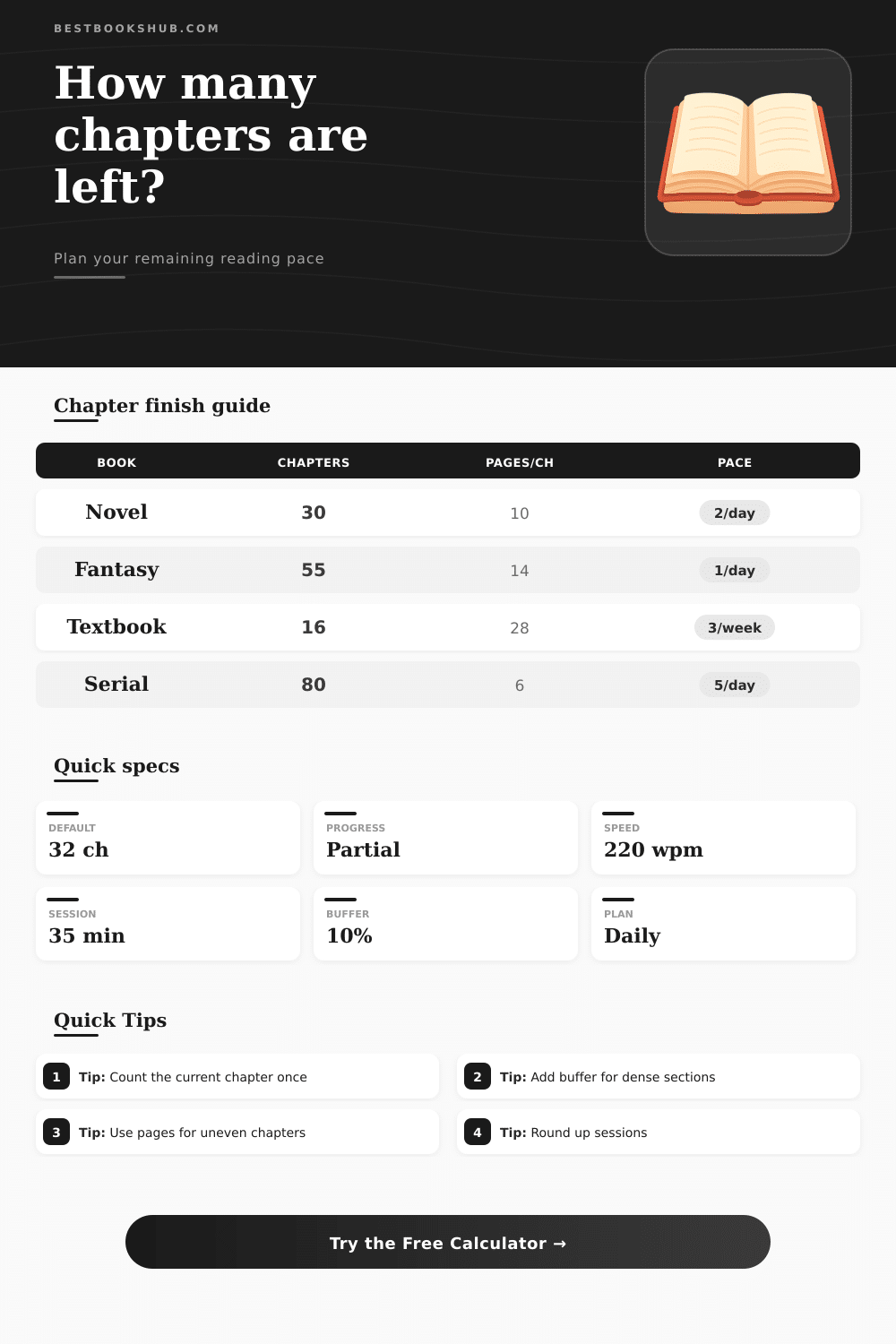
| Casual paperback | 8-14 pages or 2,500-4,000 words | 1-3 chapters per day | Chapter count is usually a useful progress unit. |
| Long fantasy or thriller | 12-22 pages or 4,000-7,000 words | 1-2 chapters per day | Use the buffer if viewpoint sections run long. |
| Book club reading | 10-18 pages or 3,000-5,500 words | Meeting pages divided by days | Pair chapters with a date target for steadier pacing. |
| Academic textbook | 20-40 pages plus figures and review | 0.25-1 chapter per day | Lower WPM to include notes, examples, and problem sets. |
| Web serial or fanfic | 1,500-4,000 words per episode | 3-8 chapters per day | Word count gives a better time estimate than page count. |
| Beta manuscript | 3,000-6,000 words per chapter | 2-5 chapters per session | Add buffer for margin notes and continuity checks. |
| Chapters left | 3 days | 7 days | 14 days | 30 days |
|---|---|---|---|---|
| 5 chapters left | 1.67 ch/day | 0.71 ch/day | 0.36 ch/day | 0.17 ch/day |
| 10 chapters left | 3.33 ch/day | 1.43 ch/day | 0.71 ch/day | 0.33 ch/day |
| 20 chapters left | 6.67 ch/day | 2.86 ch/day | 1.43 ch/day | 0.67 ch/day |
| 35 chapters left | 11.67 ch/day | 5.00 ch/day | 2.50 ch/day | 1.17 ch/day |
| Input method | Best for | How it is counted | Common mistake |
|---|---|---|---|
| Current chapter number | Readers inside a chapter | Finished chapters plus partial current chapter | Entering chapter 12 as if 12 chapters are already done. |
| Completed chapters | Trackers and checklists | The entered number is already complete | Also adding current chapter progress, which double counts. |
| Pages per chapter | Print books and PDFs | Remaining chapter-equivalent multiplied by pages | Using page count when chapters are very uneven. |
| Words per chapter | Ebooks, drafts, fanfic, serials | Remaining chapter-equivalent multiplied by words | Using publisher page estimates from another edition. |
DISCLOSURE: This post may contain affiliate links, meaning when you click the links and make a purchase, I receive a commission. As an Amazon Associate I earn from qualifying purchases.
If you are 40% through chapter 12, the calculator treats chapters 1-11 as complete plus 0.40 of chapter 12. That avoids overcounting the current chapter.
Some books have tiny prologue chapters and huge middle chapters. For those, average pages or words per chapter gives the finish plan a better anchor.
It’s that moment, your book club date is looming (three days away!) and you’re at chapter 12 of a 40-chapter novel. You know how to solve this. You panic about the math: Will it be two weeks? Five hours? But it isn’t the content that triggers your panic, it’s the math. That is, it’s the unknown.
What exactly does “a chapter” mean, anyway? How long is each one? A chapter isnt a uniform measure of time. It’s just a way for authors to format their books. This means it doesn’t have anything to do with your own day-to-day reality. And yet, that’s what we use as our measure of progress. This makes it hard to track by chapter number.
How to Plan Your Reading Time Easily
Enter the calculator. It turns all that unclear “how-much-is-left?” data into something concrete, such as minutes-per-day. The second thing is to recognize that you don’t have a fixed reading speed: it vary with what you’re reading. Fiction usualy comes out around 200 words per minute. It will be slower if it is fantasy with complex worlds or technical language. It might also take more brain power, like technical nonfiction. To adjust for this, the tool lets you slow down based off how hard book is for you.
Which is important, since one of the big reasons people quit books is they underestimates how long it should of take them to get through some texts. You might think you are halfway through based on page count, but if those pages is packed with footnotes and diagrams, you are actualy barely started in terms of mental effort. On the pages, you can be well short of the halfway point mentally even though you’re two-thirds of the way there page-wise.
Most people have a plan that fails at step one: accurately inputting where they’re starting from. You shouldn’t count the chapter you’re on as finished! You might be thirty percent through chapter eleven. That means if you count it as finished, you’re inflating your progress and deflating your remaining workload. It sounds precise and accurate (I’m done with chapter eleven!). But mathematically speaking, it’s wrong. The calculator lets you input partial progress, treating the chapter you’re currently on not as a whole number but as a fraction. When you’re trying to cram in a few minutes reading between jobs, that kind of accuracy makes all the difference, turning a vague goal into a concrete target, such as fifteen minutes on chapter twelve.
The buffer is another factor that messes with plans. We are all thrown out of synch by the buffer since chapters does not conveniently stop right where we want. A 10%; 15% buffer gives room for confusion (rereading that tricky section), interruption (life happens) or just plain getting worn out after a long day. With no wiggle room in the system, even the smallest hitch derails your whole plan, and the reference tables is there to give you a sanity check on those buffers.
The average chapter length by genre shows what to expect, helping set your expectations. An episode in a web serial may only have fifteen hundred words but a chapter from a textbook might have thirty pages. Frustration comes if you treat one like other unit of work. Finishing is more about planning than willpower (once you break the rest down into days), it’s doable.
It turns into a series of little hills instead of one big mountain, and you let go of how many chapter there are and just focus on what you’re doing today. You don’t want to blaze through book, after all; you want to find a pace that helps keep you reading right to the end. Letting go of an abstract chapter number and grounding your progress in concrete time estimates eliminates the guessing game and allows you to see how you get from here to there without freaking out.
If you give it honest numbers about how much time you have and how fast you can move through this stuff, the math doesn’t lie.