🏫 Classroom reading scheduler
Classroom Read-Aloud Time Calculator
Estimate reading minutes, discussion time, interruptions, class meetings, chapter targets, and a likely finish date for a classroom read-aloud.
Choose a classroom pattern, then adjust class period length, WPM, discussion, chapters, school days per week, interruptions, and start date.
DISCLOSURE: This post may contain affiliate links, meaning when you click the links and make a purchase, I receive a commission. As an Amazon Associate I earn from qualifying purchases.
The first ten planned meetings show cumulative progress, discussion time, and suggested chapter range. Recalculate after changing days or interruptions.
| Meeting | Date | Reading minutes | Words target | Chapter target | Discussion |
|---|---|---|---|---|---|
| 1 | -- | -- | -- | -- | -- |
| Class context | Typical WPM | Discussion block | Planning signal |
|---|---|---|---|
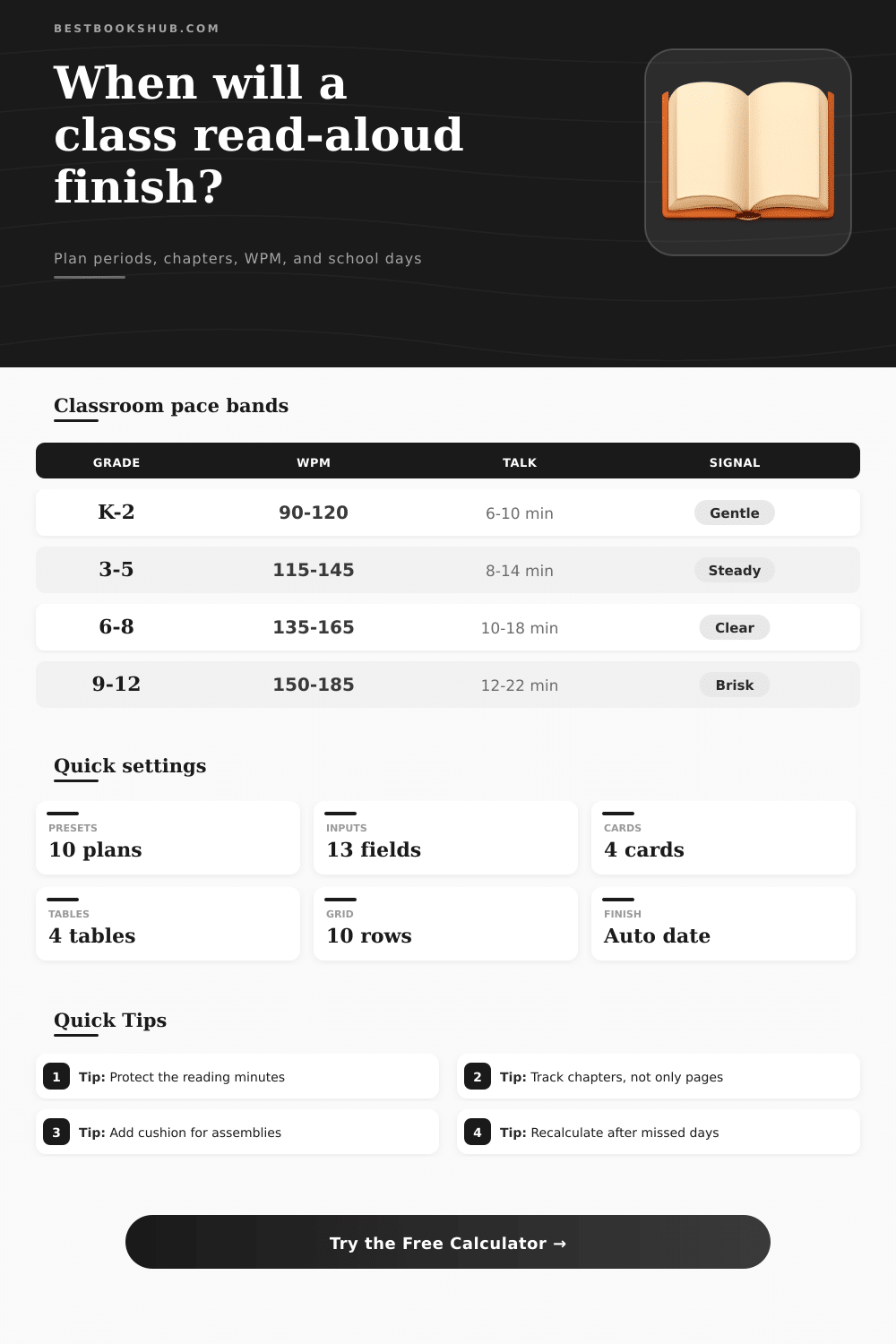
| Primary read-aloud | 90-120 | 6-10 minutes | Expect repeated phrases, picture pauses, and quick comprehension checks. |
| Upper elementary novel | 115-145 | 8-14 minutes | Works well when daily reading minutes stay protected. |
| Middle school shared text | 135-165 | 10-18 minutes | Leave room for vocabulary, annotation, and partner response. |
| High school literature | 150-185 | 12-22 minutes | Discussion may take as much time as oral reading. |
| Book structure | Chapters | Chapter length cue | Classroom approach |
|---|---|---|---|
| Short chapter book | 8-14 | 700-1,500 words | One chapter often fits with a short discussion block. |
| Middle-grade novel | 18-32 | 1,500-3,000 words | Plan partial chapters when class periods are short. |
| Classic or dense novel | 24-45 | 2,500-5,000 words | Break chapters into scenes or page ranges. |
| Verse or graphic hybrid | 30-80 | Variable | Use minutes and stopping points more than chapter count. |
| Read-aloud rhythm | Meetings per week | Best use | Watch item |
|---|---|---|---|
| Daily opening routine | 5 | Finishing a full novel inside a compact unit. | Routines must stay short enough to protect minutes. |
| Four-day ELA block | 4 | Common weekly plan with one flexible day. | Missed days can quickly push the finish date. |
| Alternate-day read | 2-3 | Shared reading alongside writing or stations. | Long gaps need recap time before new reading. |
| Weekly library visit | 1 | Picture books, excerpts, and episodic series. | Chapter novels may stretch across many weeks. |
| Time slice | Common range | Calculator input | Why it matters |
|---|---|---|---|
| Opening and closing | 3-12 min | Routine minutes | Attendance, materials, and closing directions reduce read-aloud time. |
| Oral reading | 8-35 min | Period minus non-reading time | This is the engine behind sessions needed and finish date. |
| Discussion | 5-25 min | Discussion minutes | Talk, vocabulary, written response, and checks are planned separately. |
| Interruptions | 0-8 min | Count times length | Announcements, transitions, and behavior resets compound across a unit. |
So you begin with high hopes. You grab a book at your grade level. The first few weeks pass by easy enough. Then you spend some time chatting about use of metaphor or get interrupted in class. Every day, the finish line retreats.
You don’t want to sacrifice quality of reading just to move faster then you don’t want to lose grasp on what’s happening either. What was once naturaly turns into math as planning becomes more about arithmetic than instinct.
Why Your Reading Plan Fails
A read aloud does not always mean pure listening time. There is direct instruction. There are routines involved in getting started. There is the actual act of reading plus the conversation that follows it. When you plan your read aloud like it will be pure reading time, then you’re already behind when you crack the cover.
Not all of this time actualy advances the narrative. Separate out discussion time and other routine overhead and plug it in to the calculator. See how many minutes you talk versus how many minutes you read. Consider how many words a minute you input.
Teachers often assume that they reads at the same pace as a native speaker listening to an audiobook, but the classroom changes the pace. You have to slow down to look at pictures with younger kids. Older student may need you to stop and discuss characters. Some reference tables suggests word rates per grade bands. Inputting a higher rate of words than you can comfortabley get out means the finish date will be optimistic. The optimism will then fail under weight of reality.
Reading schedules is killed off by interruptions which don’t seem like much: two minutes here; three there. Over twenty times, however, they add up. If you have two short pauses each session, you lose almost half an hour each week. That’s another class period of reading time. Enter this into the tool so you can understand what it is doing to your schedule. Decide if you want to tighten transitions, or simply move the end date back.
The math is cleaner on some chapter structures different than others. Some books have short chapters that take up only 15 minutes. Other books has dense chunks that you need to split over the course of two days. Word-based tracking is more precise than chapter-based tracking. If you’re trying to get to a certain test date, this is helpful. It makes your goal concrete, something you can measure day-to-day. No longer do you wonder whether or not you’ll complete it. Instead, it turns an abstract goal into a measurable daily target.
Resilience rounds out the equation, since no schedule survive the school year intact. Field trips occur and testing windows change. From the beginning, include a cushion for missed days to ensure the conversation remains on track. You wait until week three and realize you’re behind. You’ll start cutting corners. When you plan for it to be disrupted, you allow yourself the space to stop if necessary. Disruption becomes a variable that is managed, not a crisis.
This honors the experience of coming in and reading with one another. With a set number of days remaining, you are able to choose what conversations to have on purpose. Instead of leaving the pacing up to the calendar, you’re controlling the pacing. Having that regularity, knowing your characters are coming back tomorrow, helps students appreciate the steady rhythm of it all. It transforms the stress into something predictable within the school day.
You should of planned for this.