📖 Story structure planner
Climax Placement Calculator
Estimate where the climax should start, peak, and resolve across words, pages, chapters, and scenes, then compare that target against your current draft.
Load a common manuscript profile, then adjust the model, length, current climax marker, and how much space the final confrontation needs.
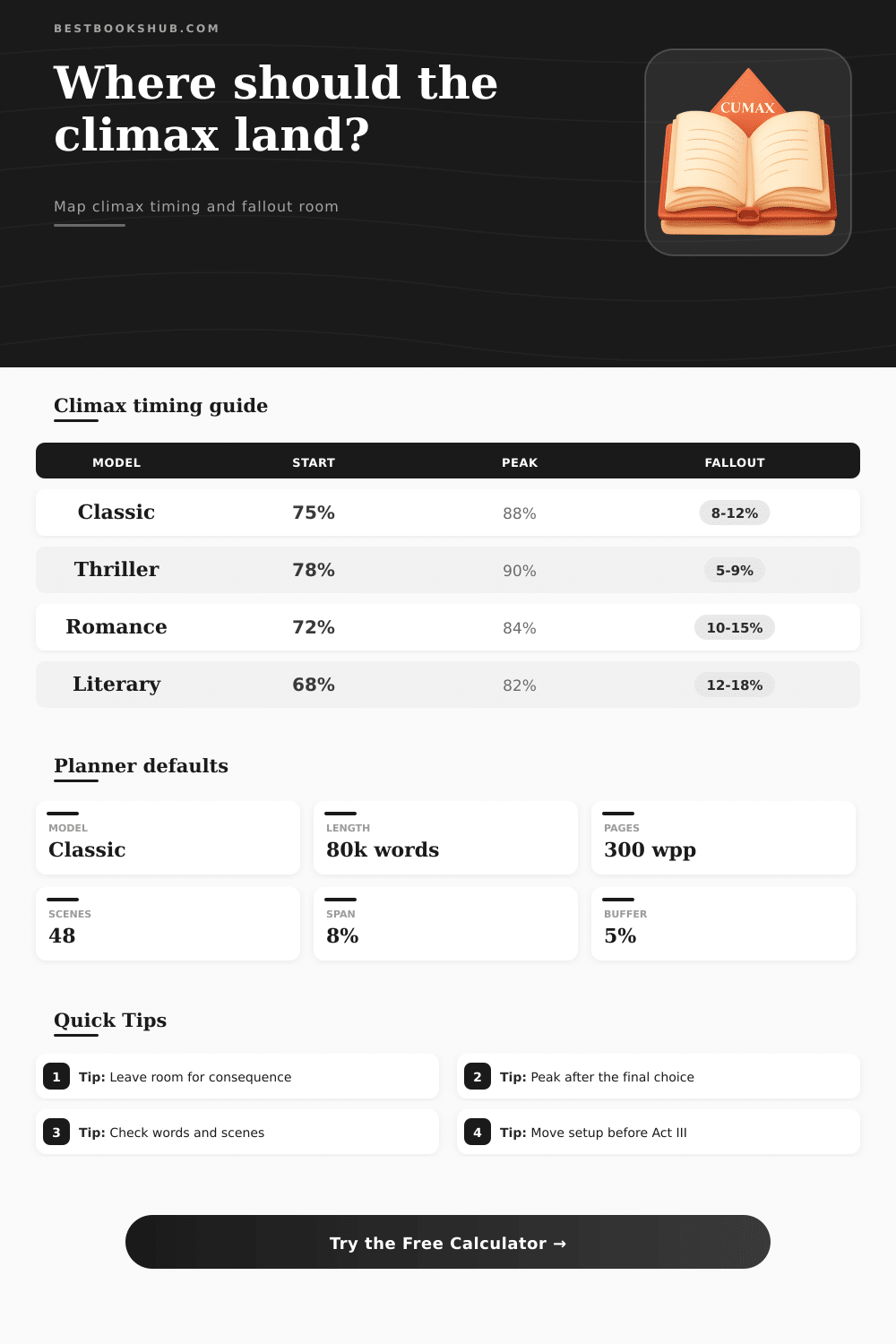
| Story model | Climax start | Peak target | Aftermath target |
|---|---|---|---|
| Classic commercial novel | 75-80% after midpoint pressure has fully reversed | 86-90% | 8-12% for consequences and final image |
| Thriller or suspense | 78-83% with pursuit, trap, countdown, or exposure | 88-92% | 5-9% for reveal cleanup and survival cost |
| Romance arc | 68-75% around breakup, grand gesture setup, or moral choice | 80-86% | 10-15% for repair, recommitment, and emotional proof |
| Mystery reveal | 74-80% when the final clue changes the suspect map | 86-91% | 7-12% for accusation, evidence, and restoration |
| Literary / character led | 64-72% as recognition begins to overtake external action | 78-84% | 12-18% for resonance and altered self-understanding |
| Epic fantasy or ensemble | 72-78% when threads converge toward the decisive field | 84-90% | 9-16% for casualties, returns, politics, and closure |
| Draft length | 78% start | 88% peak | 10% fallout |
|---|---|---|---|
| 45,000-word novella | 35,100 words / page 117 at 300 wpp | 39,600 words / page 132 | 4,500 words |
| 70,000-word novel | 54,600 words / page 182 at 300 wpp | 61,600 words / page 205 | 7,000 words |
| 90,000-word novel | 70,200 words / page 234 at 300 wpp | 79,200 words / page 264 | 9,000 words |
| 120,000-word fantasy | 93,600 words / page 312 at 300 wpp | 105,600 words / page 352 | 12,000 words |
| Symptom | Likely placement issue | Calculator signal | Revision move |
|---|---|---|---|
| The ending feels rushed | Peak lands too late or fallout is too small | Current gap is late and room after peak is below model | Move a setup reveal earlier or shorten the final battle |
| The story deflates before the end | Peak arrives early without a strong aftermath problem | Current gap is early by more than tolerance | Add an escalation turn or deepen the final choice |
| Act III feels like setup | Final-turn marker is too close to the peak | Setup-to-peak span is smaller than target window | Move exposition, clue logic, or travel before the start mark |
| Climax feels mechanical | External action peaks before internal choice | Marker may be technically placed but note quality is weak | Anchor the peak to a choice, sacrifice, or irreversible truth |
DISCLOSURE: This post may contain affiliate links, meaning when you click the links and make a purchase, I receive a commission. As an Amazon Associate I earn from qualifying purchases.
Nothing feels worse in literature than when, as you’re about to land your story, it deflates into a popped balloon. You lay the breadcrumbs, create the characters, and invest time. You get yourself all worked up, and then BOOM, you runs out of pages. The climax ends up arriving too soon or fizzling out without anywhere else to go.
This typically is not an imagination problem; rather, it’s a structural mismatch: the peak happens in a spot that doesn’t leave enough room for aftermath. Everyone’s heard that you should of a climax at the end. When? That’s wildly different than genre: Thrillers want to run all the way up to the wire (virtually without stopping for breath), while a literary character study will often peak earlier, giving time for some internal change and quiet resonance.
Why Your Story Ending Feels Weak
Once you input your estimated length and chapter count, the calculator do the math for you so you don’t spend every day guessing if page two-hundred is early, on-time, or late for your particular word count. It converts vague structural guidance into concrete markers you can follow along as you write. It’s not about remembering percentages; it’s about understanding what goes into them.
Choosing a story model are another way of picking the shape of your story’s tension. Most classics of the commercial novel tend toward the climax around 88% because there is still room for consequence, but not so much as to drag things out. Thrillers tend to aim at that same point or beyond (ninety percent or beyond) because you want the speed to remain high right up to the big reveal. Romance arcs tends to peak earlier, like 84%, since the emotional repair work takes considerable page time.
It is also possible that if you have marked your place in draft and see that you are still a good distance from the target climax, you haven’t done anything wrong. Not by a long shot. Does it mean you don’t have enough fallout room? Most writers gets hung up here. They worry about setting off the big scene and don’t realize that they need to look ahead at what happens next.
The aftermath require room for all those thing we want in a good ending: rewards, costs, changed relationships. What if your climax arrive at 95% of your 1k word novella? You barely have any space left for the emotional landing. It shows you exactly how many scenes/pages you’ll have left AFTER the climax; helping to see the tradeoff. That’s why folks tend to get hung up here: they get focused on the explosion and lose sight of the echo.
Take one more glance at the final-turn setup marker. It is the point of no return. This is the moment when the last irreversible choice begin in earnest, known as the dark night of the soul. Ideally, it shouldn’t be so near the summit that your Act Three seem like setup instead of payoff. There must be a pressure zone separating the decision from the consequence. And the page reference table spells it out, displaying how each genre carves up this growing window. For example, mystery novels requires time to restore evidence and make accusations, which means they’ll require a broader aftermath target different than something high-octane like an action thriller.
These aren’t hard-and-fast rules; after all, there’s no such thing as a linear draft. The calculator has a fairly wide tolerance setting to compensate for the occasional braided narrative, or ensemble cast whose various storylines mixes at varying intervals. And if your peak falls short now and you’ve developed the last one a good bit further, maybe it’ll fly. The numbers just signal possible pacing problems when the structure fail to match the emotion you intend for any given scene.
In the end, form follows feeling. A technically perfect climax feels empty if you do not find an emotional one, such as a shift in the character’s arc or moral compass. Let the tool prove your scaffold’s soundness; rely on your gut for the scene’s heart.
If Act Three’s too packed, push the set-up up top. If time’s dwindling and there’s no more fallout room, trim the fight. Also, know that a good finale needs a swift peak as well as a soft landing. The math guarantee the tale can land with weight instead of fading away.