📖 Cloze test lab
Cloze Readability Score Calculator
Score a cloze passage from total blanks, correct responses, exact matches, lenient matches, group averages, independent or instructional bands, and passage difficulty.
Load a classroom, tutoring, ELL, vocabulary, or pilot test scenario. Each preset includes a passage, answer key, response rows, and scoring settings.
| Blank | Answer key | Common response | Exact hits | Lenient credit | Miss rate | Review cue |
|---|---|---|---|---|---|---|
| Calculate to see item analysis. | ||||||
| Score band | Typical label | Passage signal | Suggested use |
|---|---|---|---|
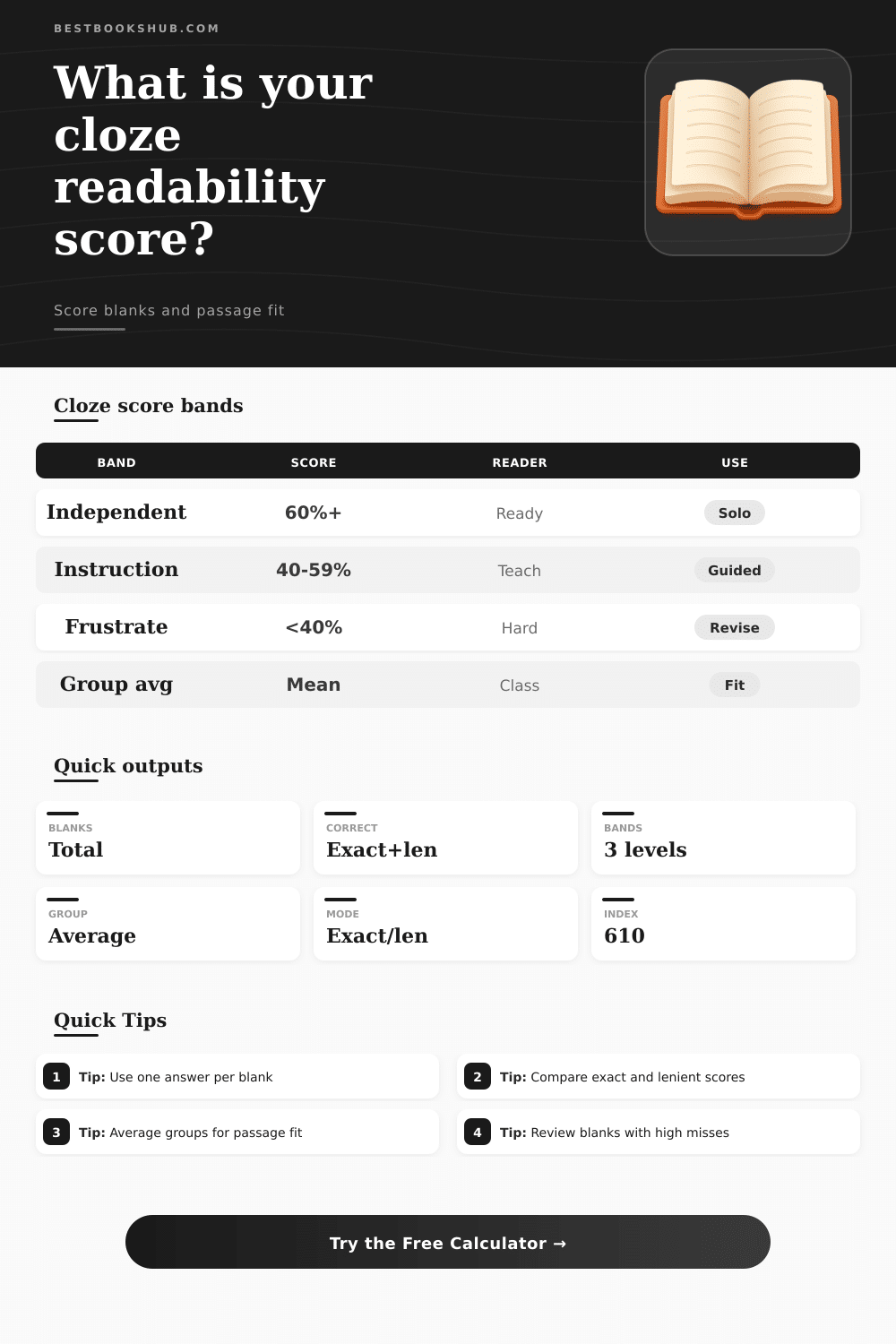
| Independent | At or above independent threshold | Readers can usually handle the passage alone | Use for independent practice or confirmation |
| Instructional | Between instructional and independent thresholds | Passage is teachable with support | Use for guided reading, tutoring, or class work |
| Frustration | Below instructional threshold | Passage is too hard for the current readers | Revise, preteach, or select an easier passage |
| Group average | Mean score across response rows | Shows passage fit for the tested group | Compare sections before assigning text |
| Scoring choice | What counts | Best for | Caution |
|---|---|---|---|
| Exact | Only answer-key alternatives after selected cleanup | Formal cloze tests and answer-key audits | May punish spelling or inflection errors |
| Lenient full | Exact plus close spellings, plurals, stems, and variants | Instructional checks and ELL practice | Review close matches manually if stakes are high |
| Lenient half | Exact gets 1 point, close variants get half credit | Mixed vocabulary and comprehension scoring | Average scores can include decimals |
| Cleanup modes | Case, punctuation, and article handling | Consistent classroom scoring | Keep the same rules across test versions |
| Preset test type | Blank range | Common scoring mode | Difficulty read |
|---|---|---|---|
| Short pilot | 5 to 8 blanks | Lenient full | Fast check, low reliability |
| Classroom passage | 8 to 15 blanks | Exact or half lenient | Good for lesson placement |
| Vocabulary review | 10 to 20 blanks | Exact primary | Item misses show terms to reteach |
| Assessment group | 15 or more blanks | Exact primary with group average | Best for passage fit decisions |
DISCLOSURE: This post may contain affiliate links, meaning when you click the links and make a purchase, I receive a commission. As an Amazon Associate I earn from qualifying purchases.
There’s a cloze readability score calculator, where you fill in the blank and compare your answer with exact one or a lenient one. Then you average all of the groups’ scores and determine the difficulty of passage. The objective: judge passage difficulty.
With the cloze procedure, you give a student a paragraph where every fifth word is removed and have them fill in the blanks. Seems like an easy task. But it exposes whether or not that text align with the student’s skill level. For decades, the cloze procedure has been around because it eliminates guesswork. Instead of using formulas that count syllables, it measure true comprehension based off a context.
How to Use the Cloze Test
Be fair. If they spell it exactly as you did or a very similar way, you know they are getting it. There is more truth in the scoring than most realize. Do you mark for absolutely perfect spelling? Or do you count variants if they show an understanding? That decision will impact your opinion of how ready class is.
Many teachers didn’t realize this until they had graded same passage in different ways and were forced to be strict. Here’s an example from a middle school science book on photosynthesis. A few kids complete blanks properly. A few know the words but misspell them. If you grade strictly for exact matches, the stats say it’s over their heads. So you go lenient: close spelling counts. The group mean jumps back up into teaching range. No changes were made in textbook; you simply changed lenses.
Good teachers gets both marks and keep ’em running parallel until they set homework assignments. The score means that if a student scores above 60%, he is reading independently. He can get through this by himself. 40% is threshold for material that works with guidance. Frustration sets in when he reads below the instructional line. He guesses, and guesses wrong. Remembering nothing. This reader may be able to read the exact same passage if you develop some background knowledge for him. Or teach him three new vocabulary words.
The score isn’t inaccurate; it just doesn’t tell you why there’s a disconnect. Individuals struggle, but group averages obscure them. It may be that one strong reader hides a bunch of struggler. Look at the range of attempts from highest to lowest. More than the mean, it’s this range that matters. The wider the range, the more likely passage will confuse some kids and help others. This information is valuable before you invest classroom time.
They make common errors, such as matching responses incorrectly. They score the fifth blank with the fourth student answer, or something like that. They produce too few blanks. That makes result statistically shaky. For most passages, the sweet spot is eight to fifteen deletion blanks. Fewer than this can mean scores are inflated by random guessing. More than this overwhelms even strong readers.
But it’s also about context beyond the number: Scores are higher for a student if they’ve already read passage before. This can happen regardless of their true reading level. There should be different cutoffs for students learning English, because their vocabulary gaps is different than native speakers who struggle with inference. Simple syntax but cultural references in literature reduce scores.
Cloze is diagnostic, not a last word. It is a snapshot of how the text fit the reader now. And it’s used as data to build or adjust accordingly. A great teacher views each score as a launch point into discussion. What are your students having difficulty with? Where did they stumble on blanks? What do their mistakes tell you about what needs more support?
But, a single percentage does not do justice to a reader’s capacity. Yet it could of save you from assigning something they are likely to struggle through. Cloze becomes a practical tool when we know what those numbers represent. That way, you can use it to pair readers with texts where there is actualy growth.