∶ Editorial punctuation tool
Colon frequency counter
Paste book text, notes, headings, citations, or metadata to measure colon rate, lead-in patterns, stacked label lines, and non-prose colon signals.
| # | Type | Before | After | Context |
|---|---|---|---|---|
| No colon hits yet. | ||||
| Band | Colon rate | Span rate | Reading signal |
|---|---|---|---|
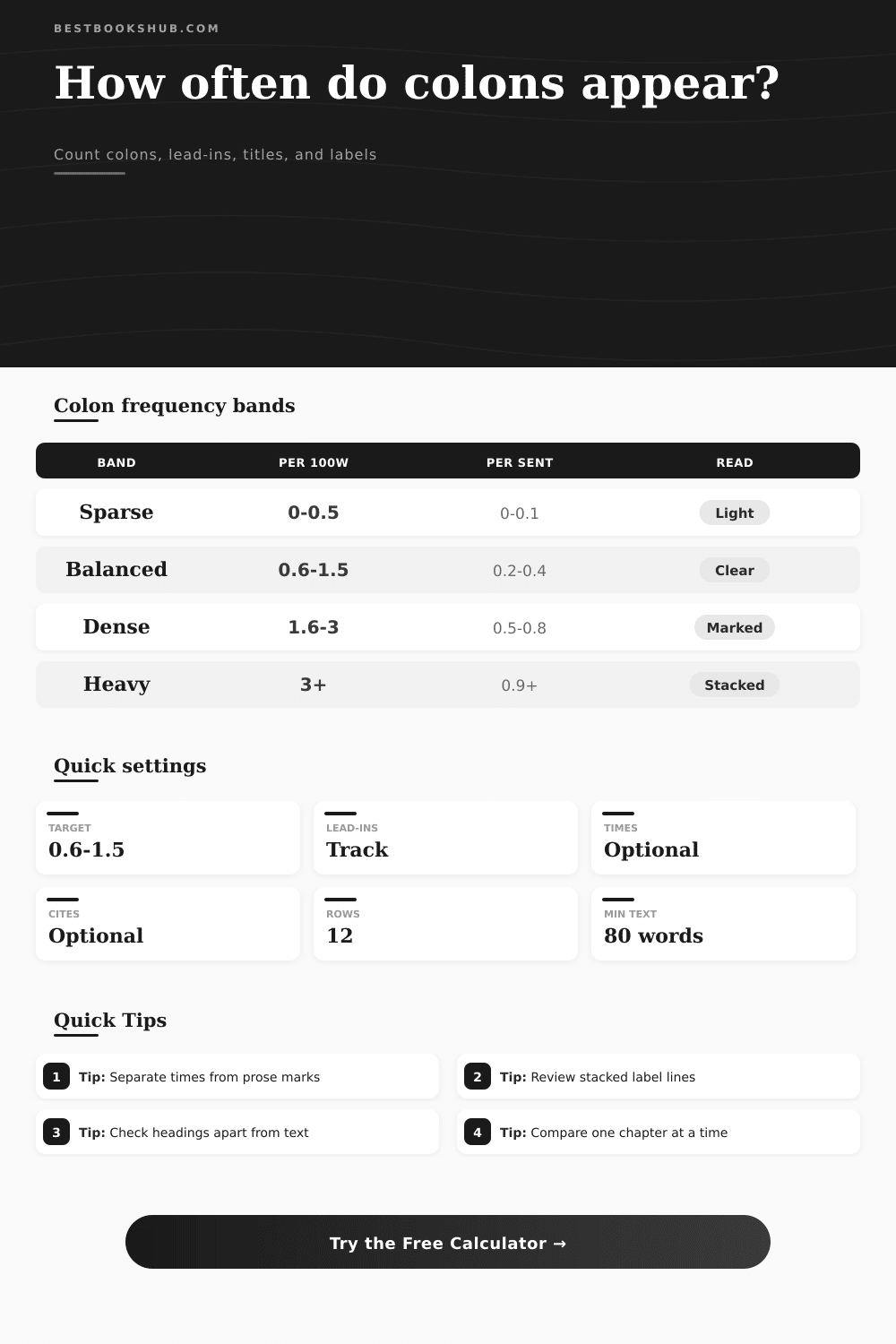
| Sparse | 0-0.5 per 100 words | 0-0.1 per span | Light punctuation presence |
| Balanced | 0.6-1.5 per 100 words | 0.2-0.4 per span | Clear explanatory emphasis |
| Structured | 1.6-3 per 100 words | 0.5-0.8 per span | Noticeable labels or clauses |
| Heavy | 3+ per 100 words | 0.9+ per span | Stacked records or dense style |
| Colon function | Example shape | Counter label | Best handling |
|---|---|---|---|
| Lead-in | The result: clear | Prose | Count in style score |
| Field label | Title: River Atlas | Label | Track separately in records |
| Time | 10:45 | Technical | Exclude for prose edits |
| Citation | 12:4 or 3:21 | Technical | Keep for reference checks |
| Source profile | Common colon use | Risk if dense | Suggested setting |
|---|---|---|---|
| General prose | Introductions | Overexplained rhythm | Score prose only |
| Academic notes | Claims and citations | Mixed technical counts | Separate technical |
| Catalog fields | Labels and metadata | False style alarms | Labels only |
| Script text | Speaker labels | Stacked dialogue labels | Linebreak spans |
| Detection signal | Strong when | Weak when | Editor action |
|---|---|---|---|
| Label pattern | Short text before colon | Long clause before mark | Check record format |
| Lead-in pattern | Full clause before colon | Only a name appears | Read sentence aloud |
| Technical pattern | Digits surround colon | Digits are catalog codes | Set technical mode |
| Stacked pattern | Many colon lines repeat | One heading only | Review table-like text |
Prose lead-ins
Colons can announce an explanation, list, consequence, or definition after a complete setup clause.
Metadata fields
DISCLOSURE: This post may contain affiliate links, meaning when you click the links and make a purchase, I receive a commission. As an Amazon Associate I earn from qualifying purchases.
Catalog and note records may use many label colons without making the writing feel punctuation-heavy.
Reference marks
Times, ratios, verses, and citations should usually be measured apart from editorial style.
Dense stacking
Repeated colon-led lines can be useful in lists but distracting inside continuous paragraph prose.
A little dot makes a big difference. A colon mark the difference between reading a database and reading prose. You may be able to craft a coherent sentence, but when most of them begin with a colon and a label, they stop being words for the reader. They become rows. And this change happen at an unconscious level; more than nearly anything else, it colors how someone reads what you have written.
How do you know what’s necessary structurally and what’s just cluttery style? A colon might be vital to your script. It might be vital to a citation block or to a metadata record. It makes sense. But in the flow of continuous prose, it can pile up on itself before you even realize it. Suddenly there’s a rhythmic stutter where there shouldn’t be one. Where there used to be a paragraph now there’s a list pretending to be one.
Why You Should Use Fewer Colons
That’s where the calculator comes in. Plug in your text and let it handle the math for you. It pulls out actual story flow from all the other technical signals.
Why does this matter? Because if you treat a verse reference the same way you’d treat a timestamp or a rhetorical pause, then you distort your understanding of the piece. Take the example of a label versus a lead in. A lead-in colon is preceded by a full thought. It announces a list. Or an explanation. It’s a breath. The label colon are more likely to follow a partial phrase. Think of it like a key-value pair, where the colon marks a key and the rest of the line are its value.
Review what you’ve written. Look at any two lines that are back-to-back and both end with colons. They form a pattern that creates visual noise. Each single line may be grammatically fine, but together they turn prose into a spreadsheet. By identifying a bunch of lines close together the tool helps you identify this kind of cluster. It lets you know when the rhythm go off the rails.
The point is that most people have no idea how much their punctuation depends on the situation. Of course if it’s academic notes, it’s going to be skewed in that direction: full of citations and structured references. Marketing copy tend toward colons, which look good and make an impact. A benefit or feature are announced. Run your fiction chapter through the exact same system as your bibliography, and you’re going to end up confused by the result.
That’s where this chart comes into play. It displays the different profile types and shows the thresholds for what counts as normal based off those profiles. Adjust your expectation accordingly, not only by sheer number but also by genre.
Consider also the quiet surrounding the colon. The colon shout for notice. It signals “this next bit matters.” Use too many, and you diminish its impact. They all blend into white noise, and the reader doesn’t stop on cue.
That’s when we start using those frequency bands. The balance range let the punctuation stay without taking over the text. It lets the text continue to flow while giving the reader enough markers to make sense of structure. Too far beyond that, and you’re labeling too much, explaining too much. Both of these is indications that you don’t have confidence in your own material.
Even if you delete all the technical colons, though, your text may fall into the dense category. In that case, you have a larger problem: you rely too much on fragments instead of full sentences. It’s easy enough to do when texting or tweeting (you know, when speed takes precedence over structure). In such cases, the fix typically involves expanding the clauses preceding the colon. Convert the label into an appropriate introductory phrase. Or just delete the colon and let the sentence go at it alone.
Don’t get me wrong: I’m not suggesting a ban on this mark altogether. Rather, I’d like to see you use it to support the rhythm, not create it. Punctuation is the last pass, but it’s also a kind of editing. It is the polishing of the well-oiled machine. But if you’re concentrating on content, it’s all too easy to overlook these patterns. This is why having something outside yourself helps. It helps take away your familiarity bias.
Now the words become data. And data doesn’t lie about repetition. Then you’ll spot where things get heavier. You can see where they need smoothing out. What remains is a more confident voice. It is a cleaner one. One that flows the reader along but never trips over itself with punctuation.
Ultimately, though, the colon is nothing more than a clarity device, not a decorative one. When used well, it connects ideas neatly. Over-employment, however, can tear that connective tissue apart, leaving the narrative in shambles. You want them to see the connection, not the punctuation. A little bit here and there, placed where it fits, will make sure the structure enhances the story, never obscures it. It is a tiny detail, but an important one.