💥 Comic Book Title Generator
Generate epic, genre-perfect comic book titles instantly — mix heroes, tones, settings & story types
e.g. Titan, Apex, Valor
e.g. Void, Nexus, Epoch
e.g. Ember, Rune, Abyss
e.g. Specter, Dread, Rift
e.g. Blade, Shadow, Cinder
e.g. Dust, Iron, Frontier
e.g. Siege, Vanguard, Ash
e.g. Eternal, Veil, Starfall
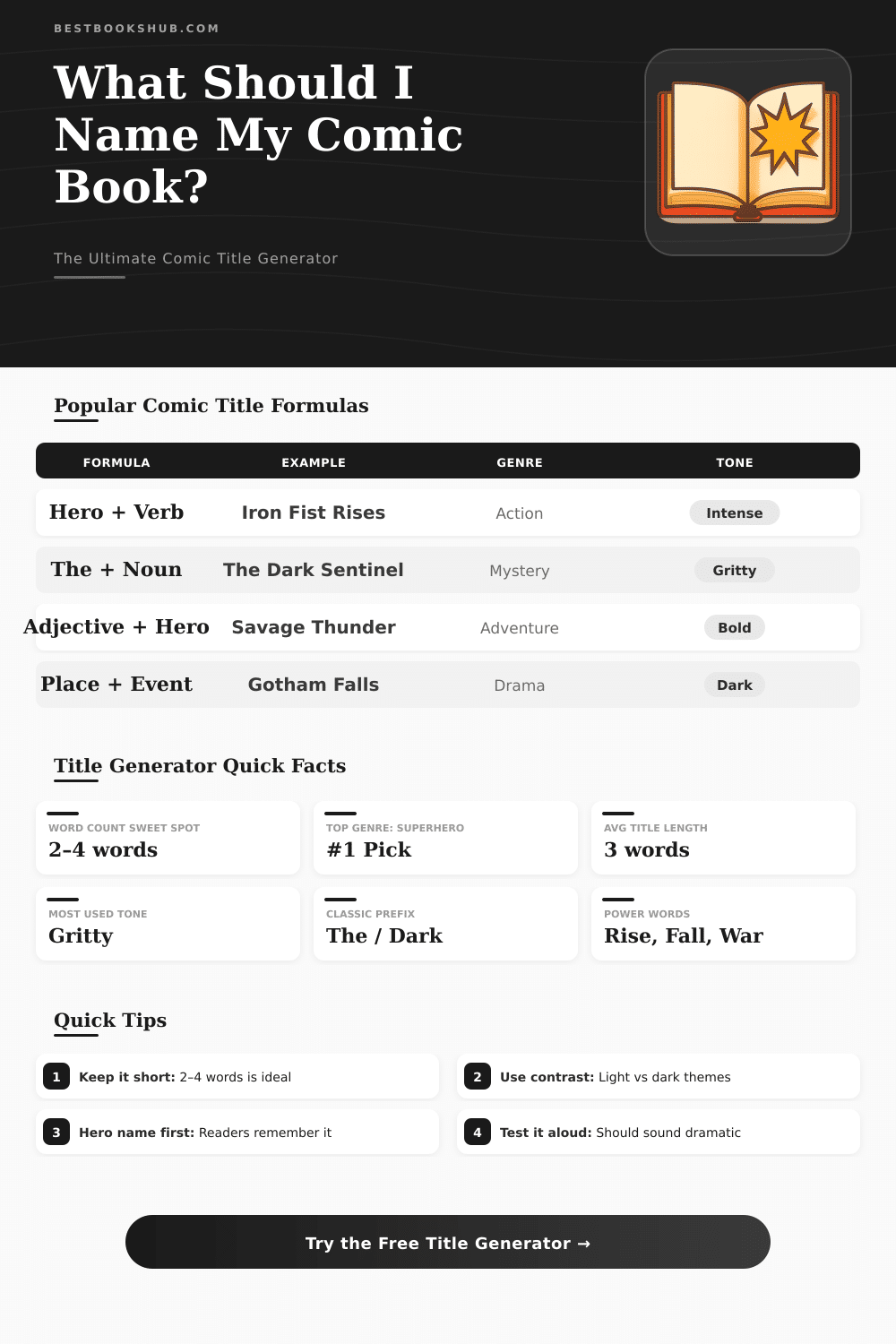
| Formula | Structure | Example | Best For |
|---|---|---|---|
| The + Noun | [The] + [Power Word] | The Obsidian Guard | Solo heroes, mysteries |
| Verb + Noun | [Action] + [Subject] | Rising Titan | Action arcs, origins |
| Name + Subtitle | [Hero] + [: Subtitle] | Nova: The Last Signal | Character-driven series |
| Adjective + Noun | [Tone Word] + [Subject] | Scarlet Dominion | Atmosphere-heavy stories |
| Of + Noun | [Age/Rise/Fall of] + [Subject] | Age of Ash | Epic world-building |
| Place Name | [Setting Word] alone or compound | Ironhaven Zero | Location-focused stories |
| Number + Noun | [Number] + [Group/Event] | Seven Ravens | Team books, heist arcs |
| Abstract Noun | [Concept] alone | Fracture | Psychological, horror |
| Tone | Opening Words | Core Nouns | Avoid |
|---|---|---|---|
| Gritty & Dark | Shadows, Broken, Black | Steel, Ash, Scar | Bright, Sunny, Sweet |
| Epic & Grand | Rise, Age, Dawn | Titan, Empire, Dominion | Tiny, Quiet, Soft |
| Hopeful | Light, Star, New | Hope, Valor, Spark | Void, Dread, Ruin |
| Noir | The Last, Dark, Cold | Rain, Blade, Smoke | Bright, Cheerful, Pure |
| Humorous | Super, Amazing, Mighty | Sidekick, League, Agency | Blood, Death, Abyss |
| Cosmic | Void, Null, Beyond | Rift, Epoch, Singularity | Street, Town, Local |
| Publisher Style | Typical Title Length | Common Pattern | Example |
|---|---|---|---|
| Marvel (ongoing) | 1–3 words | Hero Name [+ Volume] | Wolverine Vol. 4 |
| DC (ongoing) | 1–4 words | [The] + Hero + [Title] | The Batman Who Laughs |
| Image (indie) | 1–2 words | Abstract / Conceptual | Saga, Spawn, Invincible |
| Dark Horse | 2–4 words | Name + Descriptor | Hellboy: Seed of Destruction |
| Vertigo / Mature | 1–3 words | Concept or Place | Preacher, Transmetropolitan |
| Mini-Series | 3–6 words | Event + Subtitle | Secret Wars: Battleworld |
| Graphic Novel | 2–5 words | Full Phrase or Sentence | Watchmen, The Dark Knight Returns |
| Webcomic | 1–4 words | Character or World Name | Kill Six Billion Demons |
| Word Count | Memorability Score | Best Use Case | Notable Examples |
|---|---|---|---|
| 1 Word | ⭐⭐⭐⭐⭐ (5/5) | Iconic single-hero series | Saga, Spawn, Preacher |
| 2 Words | ⭐⭐⭐⭐ (4/5) | Hero + descriptor, team names | Deadly Class, Lazarus |
| 3 Words | ⭐⭐⭐⭐ (4/5) | Event titles, origin arcs | Black Science, East of West |
| 4 Words | ⭐⭐⭐ (3/5) | Subtitled series, epics | The Boys, Wytches |
| 5+ Words | ⭐⭐ (2/5) | Graphic novels, satire | Kill Six Billion Demons |
The most iconic comic titles are short. Single or double-word titles like “Saga” or “Spawn” have the highest brand recall. If you must go longer, ensure each word earns its place.
A great comic title has a strong verbal rhythm. Say your generated title aloud — it should feel punchy, dramatic, or memorable. Avoid tongue-twisters or confusing homophones.
Your title sets reader expectations. Dark words like “Void” or “Ash” prime readers for gritty art. Hopeful words like “Nova” or “Starfall” suggest brighter, more colorful stories.
Before settling on a title, search the USPTO trademark database and major publisher catalogs. Common words combined uniquely are safer. Avoid titles nearly identical to existing Marvel or DC properties.
Comic Book Title can point to several different meanings according to the circumstances. The usual comic book or pamphlet forms the traditional periodical, that most folks well know. It stands alone or belongs to a series.
DISCLOSURE: This post may contain affiliate links, meaning when you click the links and make a purchase, I receive a commission. As an Amazon Associate I earn from qualifying purchases.
One sometimes calls a series simply title what adds to the whole series part and does not limit to one alone edition.
All About Comic Book Titles
In the first page or on the front cover of many comic books appear little print, that stores the right title of the publication. It stores also the number of the edition and other useful details, as the name of the publisher and the release date. One calls that part the index.
When one identifies a comic book becomes truly hard, here is the best place for control.
To choose a good title for a comic book is more tough than it seems. Many comic books receive a name according to the main pattern of the story. Sometimes titles come from a verse of a poem or theater.
Even a phrase from dialog of the story itself can serve. Films and books give ideas for names also. The name of the story in one edition probably is the least cared cause for most folks, especially in present superhero series.
Many authors simply lay a title for a six-issue story arc, maybe the name of the villain and end hear.
To use a common word as a title can create problems. For instance, take “Hero” as a Comic Book Title sounds a bit simple. That word is so common, that variations already were used before.
DC issued a series in 2003 called H.E.R.O., that was an updated form of the older series “H For Heroic“. There is also a novel simply called Hero, available online. The TV series Heroes had several comic books.
Everything that causes confusion during buying.
Titles widely can not be copyrighted. An author receives copyright, when its work is original and set in solid form. The threshold for being original is low.
Very low. So legally one can recycle a title usually without a problem, but it however can confuse readers and shoppers.
Anthology titles relate to any comic book, that carries several stories inside. Good samples for readers are the episodes of Black Mirror, the video games Final Fantasy and the books Goosebumps. The same idea counts for comic books, where various stories meet in one volume.
When one cites a Comic Book Title in text, it should be written in italics. One considers comic books basically as book form and requires italics because of that. The codes on comic books work similarly to those of journals and use ISSNs, not ISBNs.
Those differences help duringeffort to find or sort separate volumes.