📖 Travel reading planner
Commute reading calculator
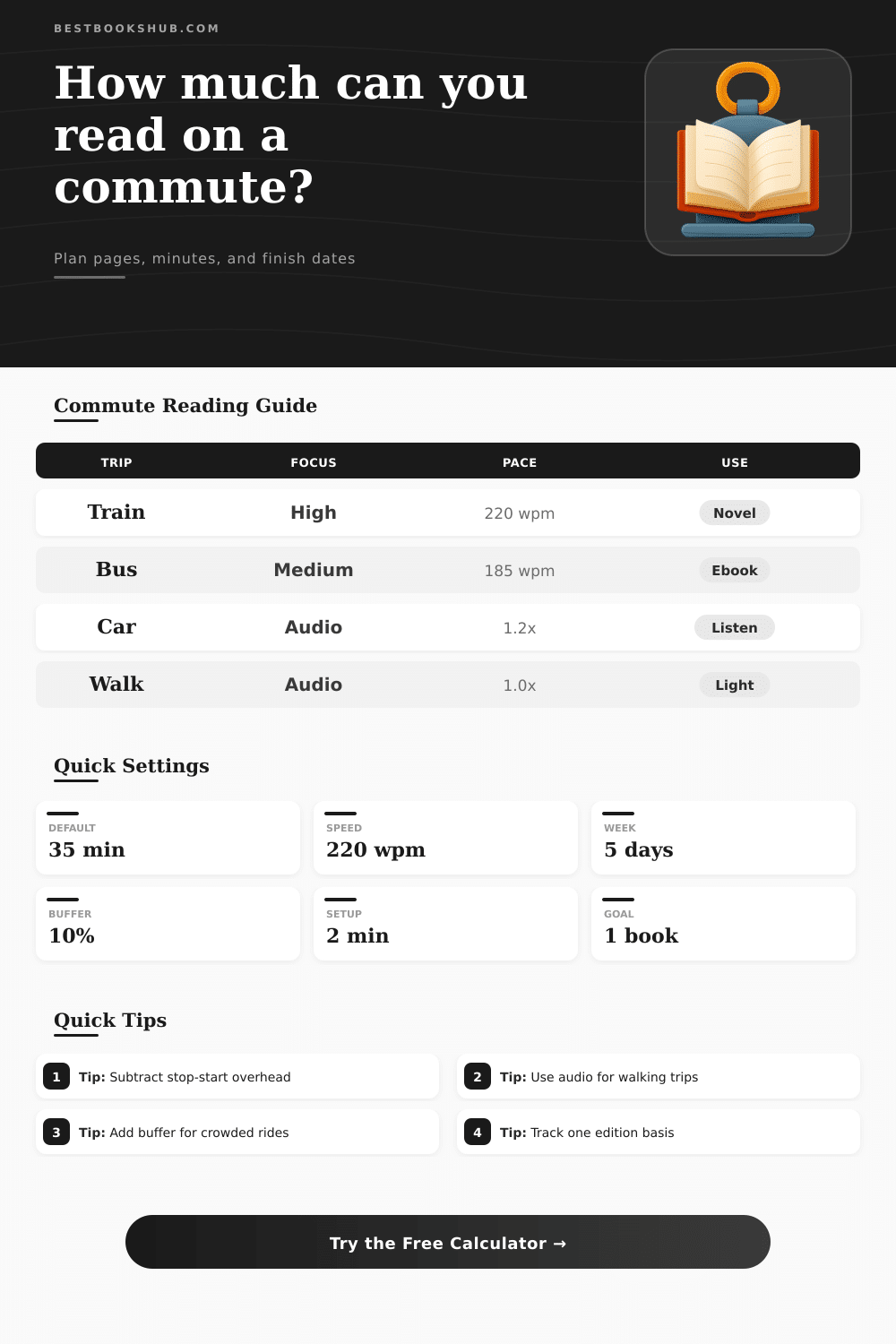
Estimate how much real reading your commute can hold after ride type, crowding, stops, setup time, delays, rereading, buffer, and book difficulty are included.
| Commute condition | Usable text factor | Best format | Planning note |
|---|---|---|---|
| Seated train or subway | 0.92 | Ereader, paperback, phone | Good for sustained chapters and dense fiction. |
| Bus or tram | 0.78 | Phone ebook or audio backup | Motion and frequent stops reduce line retention. |
| Standing transit | 0.62 | Phone ebook | Short chapters, essays, and rereads fit best. |
| Driving or cycling | 0.00 text | Audiobook | Calculator shifts capacity to audio when selected. |
| Walking commute | 0.18 text | Audiobook | Use text only for safe waiting windows. |
| Book profile | Time load | Typical material | Commute fit |
|---|---|---|---|
| Light fiction | 0.86x | Fast novels, familiar series | Works well in shorter ride blocks. |
| Standard novel or memoir | 1.00x | Most fiction and narrative nonfiction | Use as the default planning profile. |
| Dense nonfiction | 1.28x | Argument-heavy books | Needs calmer seats or longer sessions. |
| Textbook or academic | 1.55x | Technical, study, or citation-heavy text | Add extra review time outside the commute. |
| Annotation-heavy read | 1.75x | Book club notes, editing, study | Progress is slower but more deliberate. |
| Daily usable minutes | Standard pages/day | Weekly pages | Book finish signal |
|---|---|---|---|
| 10 minutes | 8 pages | 40 pages | Short stories, essays, rereads. |
| 20 minutes | 16 pages | 80 pages | One moderate book per month. |
| 35 minutes | 28 pages | 140 pages | Two regular novels over a month. |
| 50 minutes | 40 pages | 200 pages | Most paperbacks in two commute weeks. |
| 75 minutes | 60 pages | 300 pages | Strong finish pace for book clubs. |
| Friction source | Typical deduction | Why it matters | Calculator input |
|---|---|---|---|
| Setup and put-away | 1-3 min per trip | Short rides lose a large share to opening and stopping. | Setup minutes |
| Transfers | 0.6-1.4 min each | Stops break attention and add recovery time. | Transfers |
| Crowding | 4-22% time loss | Hands, noise, and motion lower usable focus. | Crowding selector |
| Rereading | 3-20% time load | Missed lines and plot checks slow completion. | Reread rate |
| Planning buffer | 5-20% time load | Protects against delays and uneven chapters. | Buffer selector |
DISCLOSURE: This post may contain affiliate links, meaning when you click the links and make a purchase, I receive a commission. As an Amazon Associate I earn from qualifying purchases.
A 40-minute train ride, to most, is like a 40-minute reading block. That doesn’t work out well. In real life, there’s friction. It takes two minutes to unlock your phone. One minute to find your last page. The conductor calls for platform change. Before long, it’s ten minutes.
That wasn’t your lack of discipline. That was the math. The issue isn’t that you lack focus. It’s that you overlook cost of getting started and stopped.
A Tool for Better Reading Habits
A calculator solves this challenge. It strips away optimistic self-deception. It reveals the impact of transit on text. The math assume the removal of real world distractions before calculating forward progress. That means taking into consideration set up time; finding your way around inside your app / book. It also takes into consideration transfers, since every transfer interrupt your flow and shatters your attention span.
Plugging in your trip details will adjust for these factors in calculator. So now you can stop guessing at how much time is realy left over for reading.
Another issue that hurts efficiency are crowding. Sitting next to a pole while there are three person crowded all around you makes holding your concentration for an extended period almost impossible. The calculator accounts for that, applying friction factors that represent the reduction of attention due to noise and motion.
Time isn’t everything. It’s about having enough headspace to put the time to good use. The nature of the book matters: Some books don’t play well in transit. Light fiction is easier to plow through than dense nonfiction. Academic texts will slow you down if you use them. To deal with this, the calculator give you options for the type of book you’re reading; it will adjust your speed based off its profile.
For example, it might take you twenty-two minutes to read fifty pages of a standard novel. With a text full of notes, you may need almost forty minutes to reach same point. Knowing this can save you from getting frustrated when you pick something challenging for a bumpy trip. Half the battle is matching the ride quality with the difficulty of book.
But with audiobooks it’s totally different. If one leg of your journey is by car, bike, or on foot, then carrying text around with you is neither practical nor safe. You can combine and switch between formats. It measures how much you can fit in depending on speed you listen, not the number of pages turned. Once people get accustomed to listening at 1.2x speed (which many commuters do), they realize they can absorbs audio more quickly then they can read text. This unlocks time that otherwise goes out window staring at a blank wall. Use the medium that works for the movement.
Check the reference table. The tool comes with a reference table that explains which text factors work during different types of commutes. Standing room have the biggest drop; seated transit keeps most of your attention. Use these coefficients to determine if now’s the right moment to attempt a challenging narrative or if you should of save it for a calmer evening session. Reading essays on the subway? Nothing to be ashamed about there. Saving the memoir for couch time? Nothing wrong with that either. Strategy will always defeat stubbornness.
Second, take into account how much time pressure you’re under. Does your club meet in two weeks and you want to read book for it? The calculator tells you if you can keep pace. If not, it will tell you if you have time to squeeze in some additional session after or before work. Based off how many hours per week you’ve got, it estimates when you’ll be done, so you can catch any holes right now.
Maybe you see that you’re just twenty pages per week from where you should of being. That could inspire you to get up a few minutes earlier Saturday morning. Little tweaks snowball. It’s about reading smarter, not faster. By matching our expectations against reality, we can do better at both. Reading isn’t just a habit we can count on, but also less of a chore. We don’t fight the train schedule anymore; instead, we plan around it. Reading becomes a dependable habit that gives us back dead time, all while keeping burnout at bay.
Most of the trick is realizing what we’re realy measuring. Once you have clarity on the numbers, you usually know next step.