📖 Reading efficiency lab
Comprehension time tradeoff calculator
Compare reading speed, available time, expected comprehension, reread load, note-taking overhead, fatigue, and delayed recall before choosing a pace for a book, chapter, article, or study session.
Use fixed-time mode to see how much quality comprehension fits in a session, or target-comprehension mode to estimate the time needed for a desired understanding level.
| Mode | Speed multiplier | Comprehension effect | Best use | Main risk |
|---|---|---|---|---|
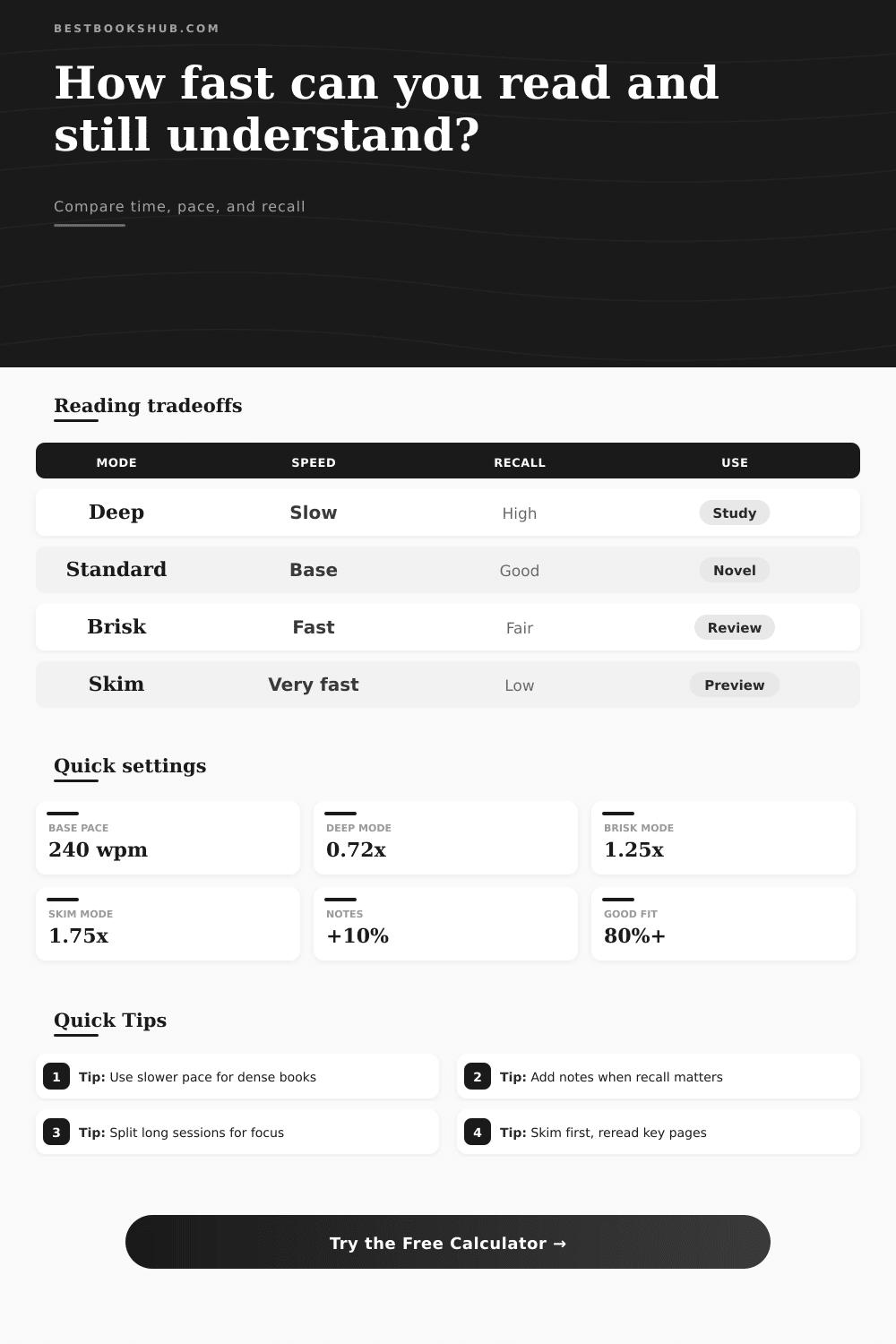
| Deep study | 0.72x base pace | About +10 points | Tests, dense chapters, unfamiliar theories | May overuse time on easy pages |
| Standard attentive | 1.00x base pace | Neutral baseline | Novels, nonfiction, general learning | Can fade in long sessions |
| Brisk read | 1.25x base pace | About -8 points | Review, familiar topics, second pass | Details and examples may blur |
| Skim for structure | 1.75x base pace | About -24 points | Previewing headings, argument maps | Poor standalone comprehension |
| Scan for facts | 2.35x base pace | About -38 points | Finding dates, terms, names, citations | Context is often missed |
| Material | Words per page | Difficulty factor | Suggested mode | Notes overhead |
|---|---|---|---|---|
| Fiction or memoir | 250-320 | 0.85-1.00x | Standard or brisk | 0-8% |
| General nonfiction | 280-380 | 1.00-1.18x | Standard attentive | 8-16% |
| Classic or literary prose | 260-360 | 1.18-1.38x | Standard or deep | 8-20% |
| Textbook chapter | 420-650 | 1.38-1.62x | Deep study | 16-42% |
| Research article | 500-750 | 1.38-1.62x | Deep plus review | 28-42% |
| Technical manual | 350-650 | 1.18-1.62x | Scan then reread | 8-28% |
| Session length | Best structure | Fatigue risk | Review idea |
|---|---|---|---|
| 15-25 minutes | One focused block | Low | One-sentence summary |
| 30-50 minutes | One block plus quick review | Low to medium | List 3 takeaways |
| 55-90 minutes | Two blocks with a break | Medium | Mark unclear pages |
| 95-150 minutes | Three blocks or split day | High | Reread core sections |
| 150+ minutes | Split across sessions | Very high | Use spaced review |
DISCLOSURE: This post may contain affiliate links, meaning when you click the links and make a purchase, I receive a commission. As an Amazon Associate I earn from qualifying purchases.
Skim headings and structure first, then reread only the pages that carry the argument, examples, formulas, or plot turns you need to retain.
When a single block runs past your focus cap, split the reading plan. The small break cost usually beats the comprehension lost to fatigue.
The clock is ticking as you sit in front of a thick textbook chapter. You have only so many hours left in the day, and you don’t just want to read. You want to understand what you read so you can recall it on Tuesday’s test. There’s a tradeoff here, the faster you go, the less you retain; the slower you go, the fewer hours you have. That tension between speed versus retention are the central challenge in studying planning.
Most people guesses at the right answer, reading as fast or slow as they go until they run out of time or get to confused. The key is a process. You remove guesswork and turn subjective anxiety into real variables you can change.
How to Plan Your Study Time
After plugging in your baseline focus and page count, the calculator (above) do the math for you, removing any extra work required to estimate delays based off taking notes or tired reading. It makes you recognize that reading isn’t a single activity, it’s a spectrum of modes with varying costs. Maybe deep study requires reading at only 72% of your usual rate to ensure a good chance at recalling the difficult-to-understand bits. Or maybe skimming means moving at 175% speed as you scan the structure; this helps you pick up the overall picture, but it’ll catch you flat-footed if someone asks you specifics later. The calculator models those tradeoffs: you can see precisely how much understanding you’re giving up in exchange for saving time.
This brings us to material density. While a research paper filled with citations and methodology will not flow the same as fiction. A technical manual would also not work without pausing to trace logic steps or using prose to visualize diagrams. You could try as hard as possible but if you approach a dense academic article as though it were a light novel, your comprehension will plummet. This is what the difficulty multipliers are capturing about the nature of the input. Even given an equal number of words on a page, a poem will pack a greater amount of cognitive weight than a page of simple narrative. Understanding this avoids underestimating the time required for complex subjects.
Add friction: Notes and rereading are great ways to add some friction to the process. I see this a lot with students who think that taking extensive notes is efficient, and it’s true, in theory. But sometimes it’s too slow, and then they don’t even get through the chapter. That’s where the calculator comes into play. It helps you balance out the extra cost of detailed outlines with the extra benefit of improved recall. Maybe you’ll realize that a thin film of margin notes provides most of the benefit without consuming half your study session.
Another popular tactic is rereading difficult passages, which seems productive, but again, can turn into a time suck if not properly controlled. If you plan ahead which parts you want to revisit before diving in, you won’t waste time getting hung up on little details while you miss the larger argument.
Planning also tends to neglect breaks, until we’re too tired to ignore them anymore. After about an hour (for most people), the brain tire out and stops focusing. When you keep going past this point, you’ll read page after page without taking in a word. Breaking up a large period of study with brief breaks maintains concentration far more effectively than powering through an entire chapter at once. Because these breaks are actual costs, not unproductive periods of time, I include them in my overall time estimates. Time spent reading should be time well-spent, protect your attention so every minute counts.
The final test of any learning (the ultimate test of whether you understood anything) is delayed recall. If you didn’t process it deeply enough on first reading, then you’ll lose that instant confidence in days. The tool shows how much of your current understanding will likely remain after a week or two. The tool accounts for that decay, and tells you what percentage of what you understand today will probably still be with you in a week or two. This helps you decide if you should review now. Or, are you pacing yourself well enough so that the information sticks?
It changes your goal from finishing the book to knowing the material when you need it. Speed-reading isn’t something you get through willpower; it’s strategic. You either have time to read fast or time to understand well, but you rarely do both well in a single sitting. It’s really just learning what you’re measuring in each session. Then you can set realistic goals for your reading speed. These goals should match how difficult the material is and the specific information you want to remember. This way, you work with your brain’s attention span rather than fighting against it. And when you make that switch from brute force to careful planning, you begin to see how much you can accomplish during one late-night session.