📝 Grammar analysis tool
Conditional sentence counter
Paste prose, lesson copy, policy text, or manuscript notes to count conditional sentences, identify marker patterns, and estimate the type mix.
| # | Type | Marker | Confidence | Sentence sample |
|---|---|---|---|---|
| Run the calculator to list matched conditional sentences. | ||||
| Type | Common structure | Example cue | Calculator signal |
|---|---|---|---|
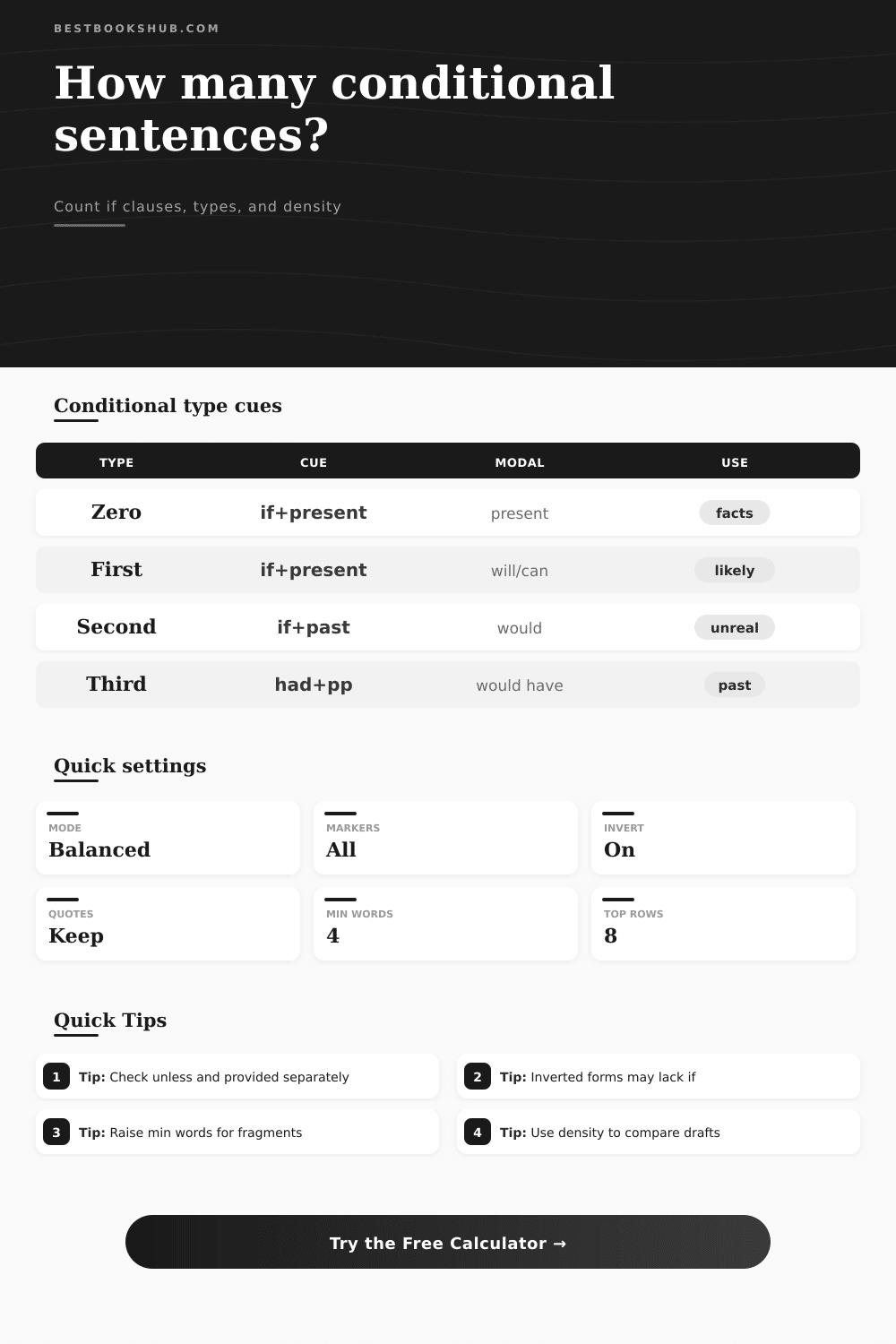
| Zero | If plus present, present | If water freezes, it expands. | Present verb cue without future modal. |
| First | If plus present, will or can | If you revise, the draft will improve. | Conditional marker plus future or ability modal. |
| Second | If plus past, would or could | If I knew, I would answer. | Past-form cue plus would, could, or might. |
| Third | If plus past perfect, would have | If she had called, we would have waited. | Had plus past participle and perfect modal. |
| Mixed | Past condition, present result | If he had studied, he would know. | Past perfect condition with present modal result. |
| Marker family | Triggers counted | Best mode | Possible false positive |
|---|---|---|---|
| Core if | if, even if, only if | Strict | Indirect questions using if. |
| Alternative markers | unless, in case, provided that | Balanced | Fixed phrases without a condition. |
| Expanded phrases | as long as, on condition that, assuming | Balanced | Literal time or place meanings. |
| Inversion | had I, were we, should they | Broad | Questions at the start of a sentence. |
| Modal-only clues | would, could, might with condition language | Broad | Polite requests and speculation. |
| Density band | Conditional share | Typical text | Reading effect |
|---|---|---|---|
| Light | Under 10% | Narrative prose, reviews | Conditions feel occasional. |
| Balanced | 10% to 25% | Explanatory notes, essays | Clear logic without overload. |
| Dense | 25% to 40% | Grammar drills, policy copy | Many dependencies per paragraph. |
| Lesson-heavy | 40% plus | Exercises, examples, quizzes | Conditional pattern is the focus. |
| Check | Why it matters | Input to adjust | Expected change |
|---|---|---|---|
| Fragment control | Short headings can mimic sentences. | Minimum words | Cleaner sentence total. |
| Quoted dialogue | Dialogue may skew fiction samples. | Quoted text handling | Separate narrator from speech. |
| Semicolon clauses | Academic prose packs logic into clauses. | Boundary mode | More granular matches. |
| Inverted grammar | Formal conditionals often omit if. | Inverted conditionals | Higher recall for formal text. |
DISCLOSURE: This post may contain affiliate links, meaning when you click the links and make a purchase, I receive a commission. As an Amazon Associate I earn from qualifying purchases.
Conditional clauses distinguishes the possible from the fact. They split straightforward sentences, making multiple options available. The problem is that excessive conditions can clutter a document, such a manuscript or policy could feel burdensome.
Conditional density offer a way to measure readability and assess probability of an idea landing with readers. This can be valuable when you want something written in plain English.
Why Conditional Clauses Matter
Sometimes writers can tell when a paragraph are too heavy. Often they don’t know why. Is it the choice of words? Is it sentences’ lengths? Or perhaps it’s just too many dependency. Does the text contain lots of unless? Lots of if? Did you write a string of inverted phrases, which look like this: “Were I to choose” or “had she known.” Easy to miss but easily spotted by the calculator.
How does it break it down? You can break it down by type, such as second conditional. Is it a first conditional? Is it zero conditional for fact? Is it hypothetical? Because here’s the difference: A text written with hypotheticals reads different than one written using likely outcomes. You’re running a test on how realistic your writing is.
Which mode of detective work is best? Creative fiction may have subtle conditional tones that is missed by strict mode. Tone may be carried by modal verbs only. Broad mode will alert you to polite requests which can be conditionals. That could cause it to over-inflate the number. Run both modes and see how many differ.
If broad’s higher, it suggests your text has used mood to indicate uncertainty, which makes sense. It’s a stylistic decision; it’s not wrong. Understanding that lets you choose whether to clarify or let the ambiguity stand.
Technical or legal prose demand clarity. Precision means using explicit, strict markers so there are no false positives. As an editor, it’s a handy metric. Ten-25% is about right; it is dense enough with a balance of direct statements and qualifying claims. That amount lets you express logic without overtaxing the reader working memory.
When you go over 40%, it starts feeling like a textbook. Maybe that’s fine for a textbook chapter. Probably not so great for marketing email, blog post, etc.
Cognitive load come from using conditions too often. You’re forcing readers to keep condition in mind as they digest the resulting statement. Do that too much and it slows down their reading. Stack those up and it becomes mentally fatiguing.
Automated tools has trouble with inverted conditionals. The phrase “were I to choose” is important in logic. It has no standard signal word. And it completely escapes most simple counters. Formal text is more complex than that. It is more accurately represented by inversion detection, this indicates just how reliant your text is on subordinate logic. It also flags areas that may sound too formal. Lots of inversions can sound stiff if aiming for a conversational tone.
Understanding is the point of counting conditionals. It is not just about getting some numerical target. Do you hedge enough? Are there things you should of qualify more? That’s where the tool come in. You still have to go there. Look at matched sentences. Does it fit the logic?
Sometimes high density isn’t a bug. It’s a feature. This is for genres that deal with speculation or risk. Use data to refine your voice. Make sure each if goes somewhere worth going.