📝 Grammar frequency scan
Conjunction Frequency Calculator
Paste a passage to count coordinating, subordinating, correlative, and conjunctive adverb links while checking density, sentence spread, pair balance, and repeated connector patterns.
Load realistic passages with different conjunction habits, then adjust the scan settings or paste your own manuscript, essay, worksheet, or review text.
DISCLOSURE: This post may contain affiliate links, meaning when you click the links and make a purchase, I receive a commission. As an Amazon Associate I earn from qualifying purchases.
The calculator tokenizes the text, counts single-word and multi-word conjunctions, estimates sentence load, and highlights clusters that may make prose feel joined too tightly.
| Conjunction | Family | Count | Share | Density |
|---|---|---|---|---|
| Run the calculator to list the most frequent conjunctions. | ||||
| # | Words | Hits | Family mix | Context |
|---|---|---|---|---|
| Sentences with conjunction detail appear after scanning. | ||||
| Band | Per 100 words | Sentence spread | Typical reading effect |
|---|---|---|---|
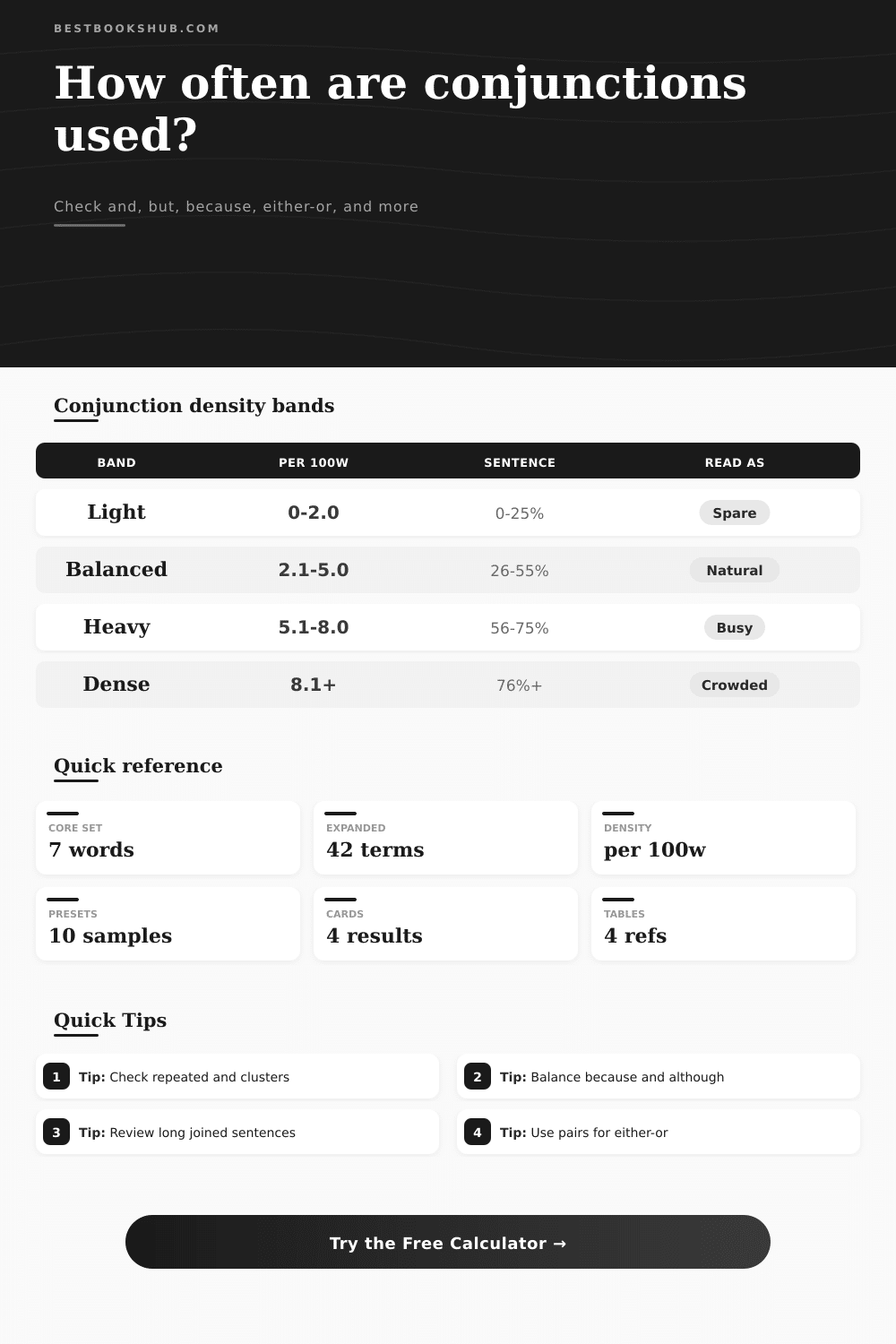
| Light | 0 to 2.0 | 0% to 25% | Spare connectors; clipped or simple sentence flow. |
| Balanced | 2.1 to 5.0 | 26% to 55% | Natural joining for essays, stories, and commentary. |
| Heavy | 5.1 to 8.0 | 56% to 75% | Many linked ideas; check repeated and, but, and because. |
| Dense | 8.1 or more | 76% or more | Potentially crowded syntax; split or vary high-load sentences. |
| Family | Main role | Common examples | Review cue |
|---|---|---|---|
| Coordinating | Joins equal words, phrases, or clauses. | and, but, or, so, yet | Too many can create chain-like sentences. |
| Subordinating | Introduces dependent clauses and logic. | because, although, if, when, while | Heavy use can bury the main action. |
| Correlative | Links two matching grammatical parts. | either-or, neither-nor, both-and | Unmatched halves need close editing. |
| Conjunctive adverb | Signals transition between ideas. | however, therefore, meanwhile | Punctuation and repetition often need review. |
Coordination load
High coordinating density often means ideas are stacked side by side. Check whether a sentence needs a period, semicolon, or clearer hierarchy.
Subordination load
High subordinating density often means cause, condition, and time clauses are doing heavy work. Watch for delayed main clauses.
Pair balance
Correlative pairs need both halves in a matching structure. The calculator flags likely missing partners for quick grammar review.
Transition habits
Frequent however, therefore, and meanwhile can make prose feel signposted. Use the top-match table to spot repeated transitions.
This grammar calculator uses pattern matching and sentence heuristics. Treat the results as a close editing guide, especially when words like as, since, and that can work in more than one grammatical role.
It is an endless sentence. You know what I’m talking about. It goes on, connected by words such as because, and, but, the connectives (until it loses its point).
Language teachers tells us that these connectives are the glue of language; without them our ideas would splinter and fall away. But there’s such a thing as excessive amount of glue. It doesn’t hold up construction; it just makes it all sticky.
How to Use Connectors Better
Too often, the trouble isn’t that there aren’t enough connectors. Instead, there is too many, or we use wrong ones in a repetitive pattern that weighs down the writing.
Writers generally think there’s one class of connectors: conjunctions. Because it does the same thing as although. Or and. Wrong! Connectors has different rhythmic and grammatical weight.
Coordinating conjunctions such as or, but, and and connect equal parts side by side. They are an easy habit to overuse. They feel comfortabley, so you can pile them up as high as you want and your writing will just keep going in a straight line.
Subordinating conjunctions such as while, although, and because burrow deeper. They create hierarchy, tell the reader what the main idea is and what is simply background information. Overdo ’em, and you end up burying the main action beneath conditional logic.
That’s what the above calculator does. It crunches those numbers for you. And then breaks them out by those groups. Take a glance at its density bands.
Typically speaking, a good balance lands somewhere in the middle, between two and five connectors per hundred words. This feels naturaly because it allows for connection without crowding. The closer to the dense end of the spectrum (between two and five) you get, the less it means you have to excise words, necessarily, and more it means you have to mix up your sentence structures.
If your high density come via coordinating conjunctions, you might consider splitting longer sentences into shorter ones. If it comes via subordinating conjunctions, you may want to clarify your logic or move some of your dependent clause to their own sentences.
But there’s also balance. Not only-but also, either-or, correlative pairs like these need exact symmetry that’s hard to get right. You might start a sentence with one side of the pair, but then you forget to end with the other. Leave the reader hanging, thinking: Wait a minute! What about …?
The tool spots these matches. It flags cases where the pair don’t quite close out cleanly. Sure, it’s a little thing, but it counts. These unmatched pairs break pattern far more subtly than they break meaning. It create a tiny hitch in the rhythm that makes professional copy sound amateurish. You won’t notice the hitch as you’re writing, but your reader will feel it.
The rules change, too, in context. In dialogue, for example, you’ll often need to increase your connector usage to match how human beings talk. And human beings don’t usually talk efficienty. When you write academic prose, you are likely to use more subordinating conjunctions to build complex arguments.
The scope lets you dial this in. It lets you exclude quoted speech that throws off your numbers. This matters because when you measure a realistic conversation based off the standards of formal writing, it is going to appear as grammar disaster. Your goal isn’t to have your characters sound like textbooks; it’s to have them sound real.
But how many?
In the end, it isn’t about how many conjunctions there is. This is about noticing. You’re searching for the places where you can spot the glue. If there’s a single kind of connector used over and over again in your piece, feel free to replace it. Use a period instead of an and. Make “because” its own sentence. Mix things up.
The aim isn’t to remove conjunctions. The aim is to use them consciously, to make sure they work as part of meaning rather than merely filling space.
Writing is a process of connecting ideas. And it’s a process of separating them. Your writing takes its form from knowing how, when, where to connect and when to disconnect. And it’s also an act of separating ideas. Your writing take its form from knowing how, when, where to connect and when to disconnect.
You don’t want your reader to become snagged at points between ideas. You want them flowing smoothly through your thoughts.
Read your draft aloud. Run your fingers across the page. Feel the space between words and sentences. Roughen up those spots that aren’t smooth.
It should of let the glue hold the structure together. It shouldn’t ooze off the edges.