📖 Lexical balance analyzer
Content word ratio calculator
Paste text to separate content words from function words, compare stopword list modes, force custom content terms, inspect lexical density, and rank sentence-level ratio outliers.
Load a sample, then change the function-word list, custom content words, token rules, and sentence mode to see how lexical density shifts.
| Rank | Content term | Count | Content share | Total density | Source |
|---|---|---|---|---|---|
| Run the calculator to rank content words. | |||||
| Segment | Words | Content | Function | Content ratio | Preview |
|---|---|---|---|---|---|
| Sentence or segment ratios will appear here. | |||||
| Density band | Content share | Content:function | Common use |
|---|---|---|---|
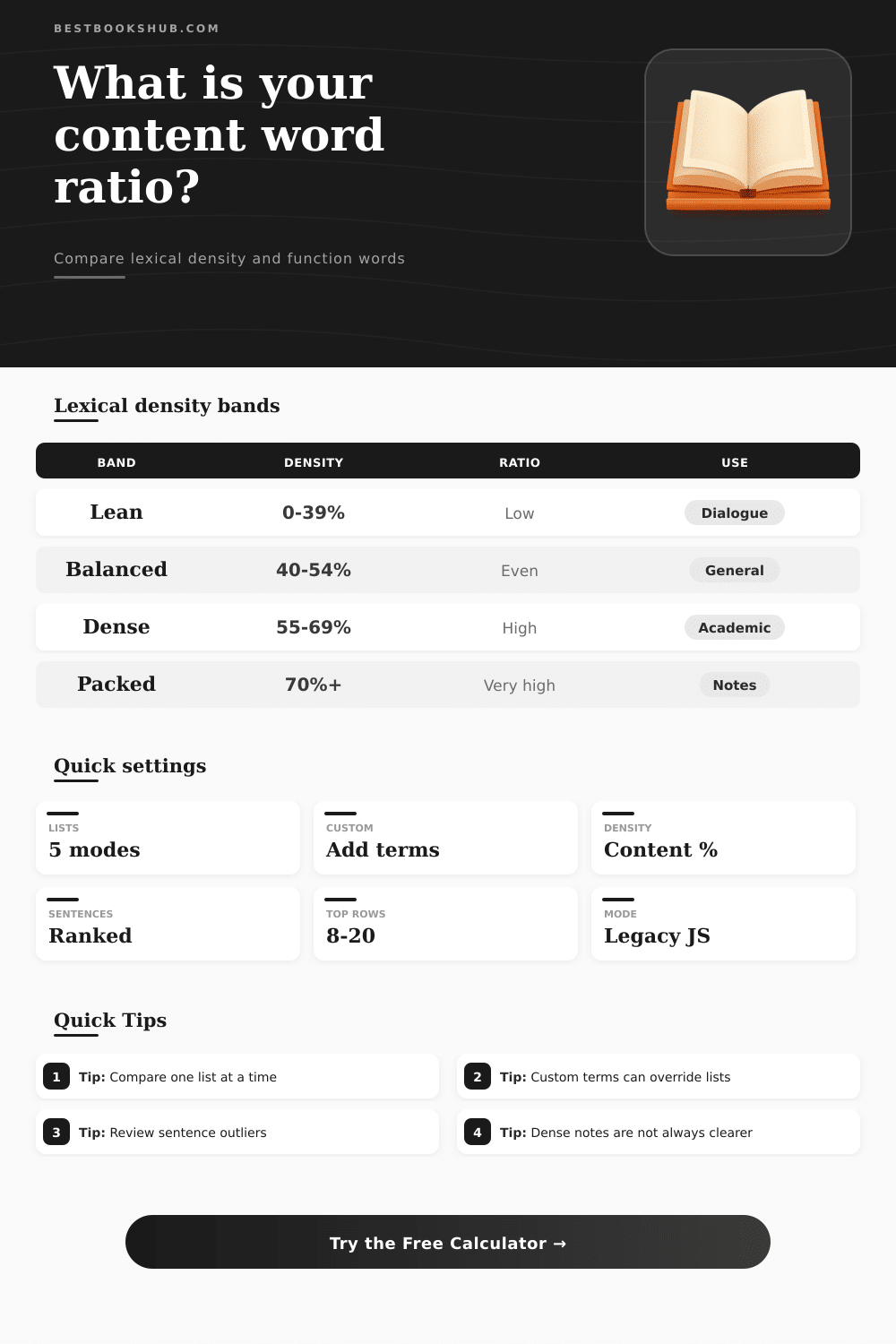
| Lean | 0-39% | Below 0.7:1 | Dialogue, simple readers, conversational drafts |
| Balanced | 40-54% | 0.7-1.2:1 | General prose, reviews, explanatory web copy |
| Dense | 55-69% | 1.2-2.2:1 | Academic prose, summaries, technical explanation |
| Packed | 70%+ | Above 2.2:1 | Study notes, headings, metadata, compressed outlines |
| Function list mode | Best for | Typical effect | Watch point |
|---|---|---|---|
| Core English | General drafts | Stable baseline | May leave bookish filler as content |
| Strict prose | Editing passes | Lowers content share | Can over-filter short passages |
| Academic connectors | Abstracts and essays | Marks linking words | Custom key terms may be needed |
| Fiction dialogue | Scenes and scripts | Handles pronouns and speech helpers | Character names stay content |
| Web copy helpers | Pages and blurbs | Filters CTA-style words | Brand or tool names need custom terms |
| Custom mode | What it does | Use when | Result impact |
|---|---|---|---|
| Force content | Overrides function matches | House terms matter | Raises content ratio |
| Only custom | Counts custom terms as content | Tracking vocabulary targets | Creates narrow density |
| Remove custom | Excludes terms from content | Names or repeated labels skew counts | Lowers content ratio |
| Ignore custom | Uses only selected list mode | Need a baseline run | Keeps comparison clean |
| Text type | Likely range | Ratio signal | Editing cue |
|---|---|---|---|
| Dialogue page | 32-48% | Function heavy | Natural speech can run low |
| Book review | 42-58% | Balanced | Check repeated nouns |
| Academic abstract | 50-68% | Dense | Connector choice matters |
| Study notes | 58-78% | Packed | Add context if too compressed |
DISCLOSURE: This post may contain affiliate links, meaning when you click the links and make a purchase, I receive a commission. As an Amazon Associate I earn from qualifying purchases.
To determine your lexical density, try this content word ratio calculator. It will show how many function-words there is compared to content words. It will let you override your own list of content words to test for sentence-level balance.
If your draft sounds off in ways you can’t put your finger on, despite proper grammar and punctuation, it is probly because of an imbalance between structural and meaning-carrying words. That’s where the content word ratio come in.
What Is Content Word Ratio?
For example, content words are those that express your ideas: nouns, adverbs, adjectives, and main verbs. Function words include conjunctions that connect sentences, pronouns that stand in for other words, prepositions that shows relationships between words, and articles that connects to a following word. Think about it this way: function words sticks the sentence together; content words carry your ideas. You’ll know what I mean when you look at your own writing.
Dialogue uses many short connectors while a novel scene use fewer. An academic abstract need to be dense, so each sentence carries as much information as possible.
After choosing your settings and selecting some text, the words is counted for you. You don’t have to guess; you can see pattern. Selecting a different list of function words have a dramatic impact. Strict lists capture more linking words and tend to depress your content score. Fiction-friendly lists ignores common speech tags. That way, dialogue remains naturaly and isn’t artificially sparse.
You may want to add custom terms that safeguard brand language and/or proper names. Otherwise they might be flagged as function words. One override term can swing a passage from balanced to dense even if the sentences stays the same. It’s subtle until you notice how readers react to the change.
You don’t want to aim for a high word density as an end in itself. Three paragraph of packed prose wears out its welcome. It may impress upon initial reading, but it exhausts instead of energize. On the other hand, lean text reads slickly. It can also require too much work from the reader (filling in the blanks).
The right density depend on the context. Younger readers requires some breathing room and thus early-reader books live at lower end. Students studying for tests want to cram facts and notes can be up to seventy percent dense. Where your lexical density should land requires knowing where you’re aiming.
There’s also another layer of sentence level ratios that most writers will ignore. It works great to have one dense paragraph surrounded by lighter paragraphs, used for emphasis. Five dense paragraphs in a row are usually a sign of too compressed prose. With this tool, it’ll break up your text into segments, allowing you to scan for these outliers. Soon, you’ll find out what needs some air and what’s got the right load.
Function words is frequently used by writers without thinking about them at all. Inflating your function word count is easy: Just say “really” or “very” too many times. You can also use words like “that” or “just.” Then the function count goes up and down, so does the impact. Deleting those words increases density while making the writing seem more abrupt.
You’ll see the tradeoff live on the screen, and won’t have to guess anymore.
And remember: Numbers don’t determine quality. A beautifully balanced ratio cannot rescue a weak argument. You can’t save a bad story with a good one. Conscious choice is what counts. If you know that half of your words are about meaning and half are about structure, you start consciously adjusting instead of feeling your way in.
Do you want this piece of writing to sound as if you’re having a quiet conversation? Or do you want it to land with a thud? That’s what the ratio shows you: whether you have the tool you want in your hand. This isn’t a sentence-writer. This is a sentence-calculator that shows the shadowy structure beneath your words.
Everything else is up to you, if you’re willing to look.