✍ Editorial schedule lab
Copyedit time calculator
Estimate copyediting hours, working days, pass allocation, query time, APA reference cleanup, and deadline fit from manuscript length and editorial complexity.
Choose a length source, then add editorial complexity. References, tables, figures, author queries, and second-pass review are calculated separately from base word-rate editing.
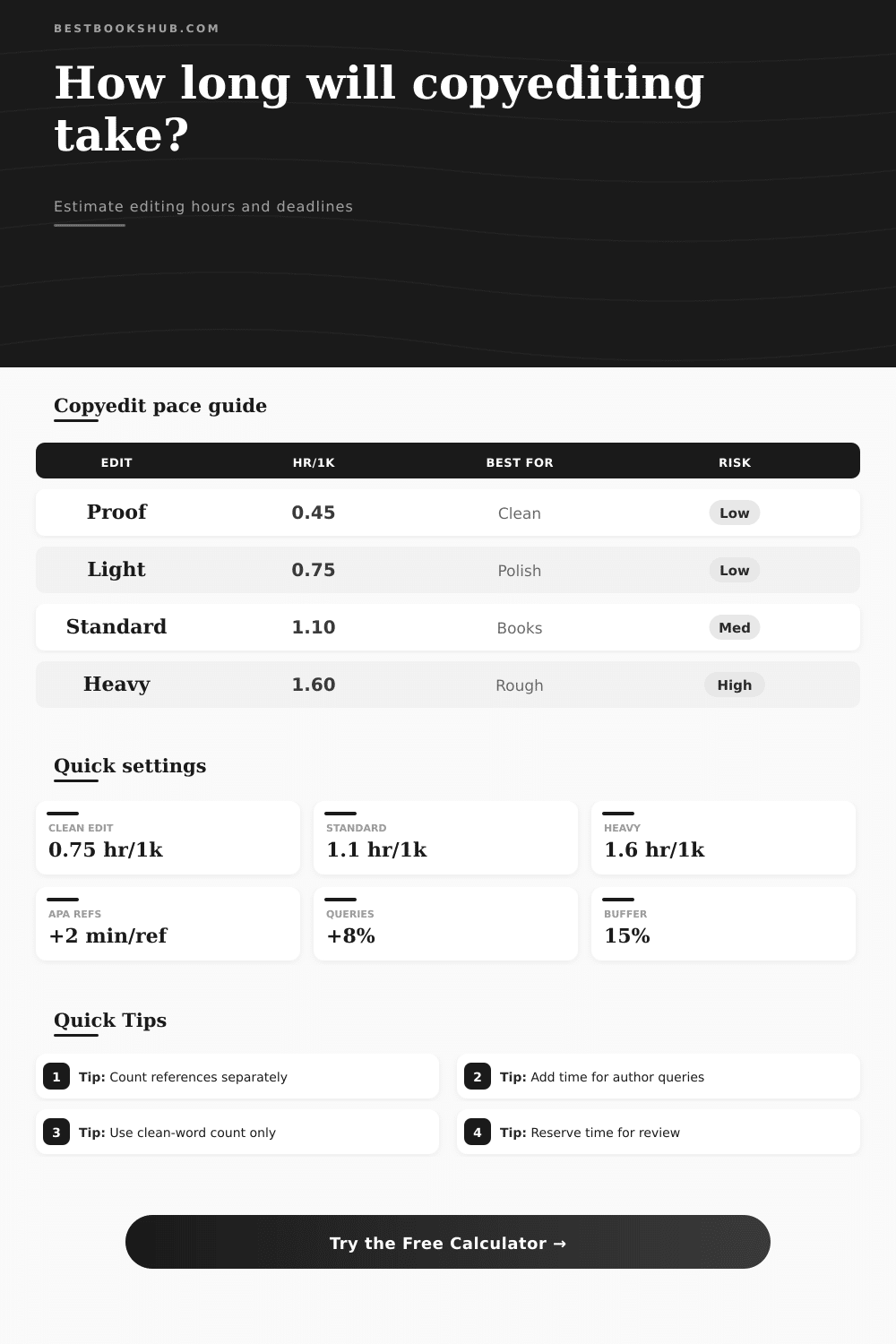
| Edit level | Working hours per 1,000 words | Typical manuscript condition | What the time covers |
|---|---|---|---|
| Proofread pass | 0.35 to 0.60 hr | Typeset, clean, already edited | Typos, punctuation, minor consistency, obvious grammar fixes |
| Light copyedit | 0.60 to 0.90 hr | Clean prose with few style problems | Grammar, spelling, style sheet updates, light fact flags |
| Standard copyedit | 0.90 to 1.30 hr | Typical book or thesis draft | Sentence cleanup, consistency, usage, citations in text, author queries |
| Academic copyedit | 1.15 to 1.70 hr | Research prose with citations | APA/MLA/Chicago style points, headings, tables, reference coordination |
| Heavy copyedit | 1.40 to 2.10 hr | Rough, translated, or inconsistent draft | Substantial sentence repair, repetition control, query-rich editing |
| Line copyedit | 1.90 to 3.00 hr | Style-sensitive fiction or nonfiction | Rhythm, clarity, voice, paragraph movement, line-level polish |
| Reference task | Typical time | Use when | Schedule note |
|---|---|---|---|
| Reference list scan | 1 minute per entry | Only punctuation, italics, capitalization, and hanging-indent style need review | Works for clean bibliographies with few missing fields. |
| APA cleanup | 2 minutes per entry | Titles, DOI forms, author initials, date placement, and journal formatting need attention | Good default for theses and journal articles. |
| Detailed style pass | 3 to 4 minutes per entry | Mixed source types, inconsistent capitalization, and incomplete entries appear often | Budget separately from main prose editing. |
| Source-by-source check | 5+ minutes per entry | Entries must be verified against PDFs, URLs, databases, or author files | Can dominate the project if sources are messy. |
| Project | Length | Likely edit time | Planning note |
|---|---|---|---|
| Journal article | 6,000 to 9,000 words | 8 to 18 hours | References, tables, and journal style often add visible overhead. |
| Thesis chapter | 10,000 to 18,000 words | 16 to 36 hours | Plan time for citations, headings, tables, and supervisor-driven changes. |
| Trade nonfiction | 55,000 to 85,000 words | 65 to 130 hours | Fact flags, repeated terms, and notes can slow the middle chapters. |
| Commercial novel | 70,000 to 100,000 words | 70 to 150 hours | Continuity, style sheet work, dialogue consistency, and second pass matter. |
| Dissertation | 60,000 to 100,000 words | 95 to 210 hours | Academic apparatus and reference cleanup can add multiple workweeks. |
| Load percentage | Status | Meaning | Adjustment |
|---|---|---|---|
| Under 70% | Roomy | Deadline has extra room for queries, author replies, and review | Keep the buffer or use it for a calmer final pass. |
| 70% to 90% | Workable | Schedule is realistic if the draft condition is entered honestly | Protect daily editing hours and avoid adding tasks. |
| 90% to 110% | Tight | The project may fit, but one delay can affect delivery | Add hours per day, extend the deadline, or reduce scope. |
| Over 110% | Overloaded | Required hours exceed the available schedule | Split the project, remove reference checks, or move the deadline. |
DISCLOSURE: This post may contain affiliate links, meaning when you click the links and make a purchase, I receive a commission. As an Amazon Associate I earn from qualifying purchases.
Maybe it’s three weeks before your manuscript is due and you haven’t even looked at the bibliography yet. What? That’s how we often react to that situation. You signed a contract, you promised to deliver. Now you’re panicking.
The 80,000-word problem feels like it will take as long to fix than it did to write. It almost never does. Writing is about generating ideas; editing is about managing them. Editing polishes up the surface and keeps sentence from fighting each other on page. Both are skills and so both use different amount of time.
How to Plan Your Editing Time
Copyediting time is not about predicting the future; it’s about estimating the amount of friction your draft contains. With a clean draft, a proofread pass zips along: there are no tangled-up bits of logic to untie, no sentences to be rewritten. You’re looking for punctuation problems, typos, that kind of thing. But with an inconsistent/rough draft, the pace will slow down.
The editor calculator (above) does this math for you when you input word count and choose your level of edit. Guessing between “light” and “heavy” doesn’t require guessing whether heavier version will take more time or less. Chances are, yes, it will, heavy edits requires structural decisions that use up your brainpower.
Know what is getting counted. Rates are usually quoted in terms of “per thousand words.” The thing to know is what that means in its base case. For instance, if you hire a standard copyeditor, the per-thousand rate includes checking the manuscript for grammar, usage, consistency, and flow. For most book manuscripts, this is the way to go. However, if the manuscript has lots of references, tables, or other author queries, the base rate isn’t meaningful and needs overhead added. A big part of one’s schedule can be spent on references alone.
Verifying these against their sources are time-consuming and doesn’t scale linearly with word count. It takes twenty minutes on ten references and four hours on two hundred. This is how folks get tripped up: they budgeted for the text and forgot about supporting material.
One more thing: build in a second pass. I almost never complete an edit on first run-through. The first pass corrects mistakes, the second catches mistakes that the editor made correcting them in the first. Sounds like duplication but skipping this step will mean there will be new mistakes. To accommodate this editing process, the tool lets you include a buffer.
This is smart because our attention span plummets after several hours of concentrated effort. Edit four or five hours straight and the quality will drop as does your error-rate. Break the work down into chunks and it stay accurate.
Read the deadline fit carefully. The “estimated completion” date must fall before your hard deadline. There are only two options: either adjust time or adjust the scope. Speeding up won’t get you there; it’s impossible to just edit faster while maintaining quality. A rushed heavy edit becomes a light edit by definition. You won’t be able to make deep structural changes in a tight timeframe.
Be honest: it’s more productive to aim low with a tighter deadline than aim high with more stress. Look at the page’s reference tables to see what I mean. These charts show the fixed block of time added by citation density and table complexity… These don’t scale with word count.
The point of planning an editorial calendar is to manage reality, not wish it goes faster. You have a working pace, and you know how many hours you can devote to this project each day. If you work 10 hours one day, you’ll still have as much to do in the end than if you only worked five hours. That’s why the calendar changes: that’s what will keep you sane, and keep your reputation intact.
Because you’ve estimated accuratley, when you turn in that final manuscript, it will shine; you’ve had time to take care. And care takes more time than it seems at first glance.