📖 Reading value lab
Cost per page read calculator
Measure a book by the pages you actually read, including rereads, shared readers, credits, fees, and format expectations.
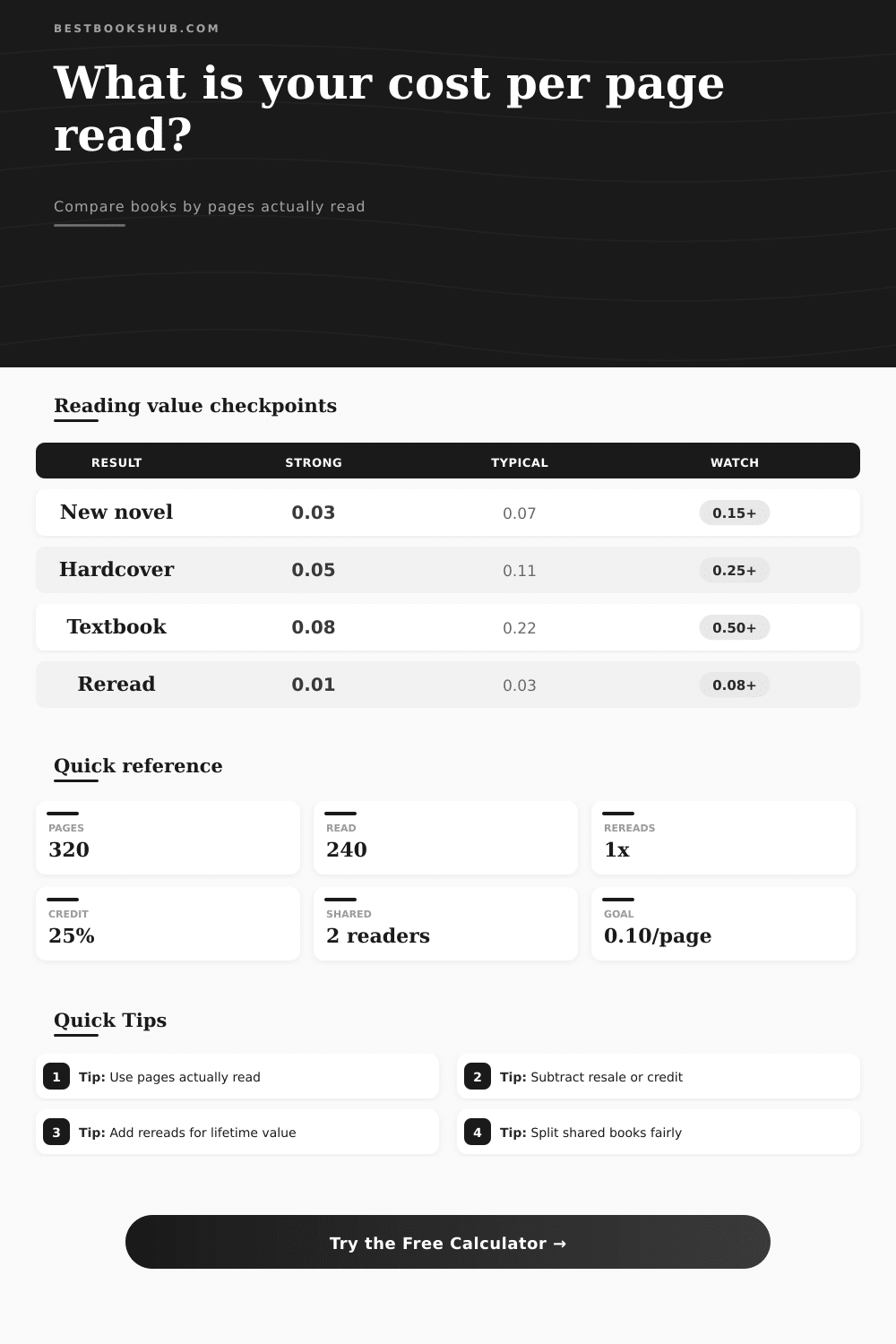
| Book situation | Strong value | Typical range | Review if above |
|---|---|---|---|
| New paperback read once | Under $0.04/page | $0.04 to $0.09/page | $0.15/page |
| Hardcover read once | Under $0.06/page | $0.06 to $0.14/page | $0.25/page |
| Ebook sale or bundle | Under $0.02/page | $0.02 to $0.06/page | $0.10/page |
| Textbook or course book | Under $0.12/page | $0.12 to $0.35/page | $0.60/page |
| Borrowed book with fees | Under $0.01/page | $0.01 to $0.04/page | $0.08/page |
| Format | Typical pages | Best adjustment | Useful output to watch |
|---|---|---|---|
| Trade paperback | 280 to 420 | Completion percentage | Cost per finished page |
| Hardcover | 320 to 520 | Resale or sharing credit | Net spend after credit |
| Ebook | 180 to 550 | Sale bundle allocation | Pages per dollar |
| Audiobook with companion text | 250 to 480 | Pages completed from listening | Effective pages |
| Textbook | 500 to 900 | Reference page value | Quality-adjusted value |
| Graphic novel | 120 to 240 | Repeat reads | Reread-adjusted pages |
| Common scenario | Inputs to include | Pages counted | Fair comparison note |
|---|---|---|---|
| Finished novel | Paid amount plus fees | All pages read | Compare against similar fiction length. |
| Did not finish | Paid amount minus credit | Only pages read | Do not count unread pages as value. |
| Shared copy | Total spend and readers | Read pages per reader | Split net spend by reader count. |
| Course book | Purchase, resale, fees | Assigned and referenced pages | Use the research or course multiplier. |
| Reference title | Purchase and long-term credit | Read plus kept reference pages | Lifetime use can justify higher spend. |
DISCLOSURE: This post may contain affiliate links, meaning when you click the links and make a purchase, I receive a commission. As an Amazon Associate I earn from qualifying purchases.
Eighteen dollar for a hardcover novel. I read halfway through it. I set it down because the plot dragged. Was that money wasted? Or did you get eight dollars worth of entertainment? Most people think the former. The price tag is the indicator of value. More often than not, it isn’t. How many pages did you have open? That’s the true cost.
This change of thinking make buying books more of an investment. Plug in your reading habits into calculator above, and it’ll do the math for you. No more guesswork on whether a cheap paperback saved money over an expensive hardcover. It begins simply: pages read vs. Total pages.
How to Calculate the Real Cost of Books
You paid for all 400 pages of a book, but used just 150 of them before giving up? Suddenly your cost per page triple. Most readers overlook this. They see the cover price and they forget that books left unread is costly mistakes.
But the bottom line is that it really depends off the format (hence the name!). For example, hardcover books is expensive but require deeper reading; paperbacks are inexpensive yet can be quickly skimmed through. Textbooks exist somewhere in-between: they’re very expensive, but their usefulness as a reference justifies those costs instead of their linear reading speed. This is where the tool comes into play, you can account for these format-based norms.
If you buy a textbook and only use it once, then maybe its cost-per-page are high… but if you leave it on shelf for future reference, then its value becomes entirely different. You must take that longevity into consideration.
And of course there’s also this: the part where we share things with other humans. That is, the cost of one copy get split up when it’s shared between two adult-sized sofa. Though, if one reads half and the other reads the rest, they’ve got leftover pages to pay for. Those don’t go away because someone else read a bit too. The input fields for shared readers require you to be upfront as to who really read what. No more pretending that buying a single copy for entire book club covers the cost for everyone. Usually you end up splitting the cost by half. Perfectly OK, but nothing magical.
Resale value is like an after-the-fact discount: “I bought this used book, and sold it back to them when I was done.” Or: “I returned this book to the store, which gave me credit towards another purchase.” The calculator divide by your effective number of pages (subtracting the credit from your total). That way we have a more accurate picture of how much you really paid.
Example: You borrow a book from the library, and don’t incur any monetary costs. But if there are late fees, those fees becomes the price. Either way, it’s something you paid in time OR money, and they’re both counted against the final ratio.
The math gets interesting when it comes to rereading your favorite books. Reading a favorite novel three times will triple your consumption at no cost of tripling. You can even tack on additional reads to increase your effective page count. This is how classics seem like such a deal over time. You spread that first spend over many emotional payoffs.
It is a little thing, sure, but it counts up when considering whether to buy something new or give in and re-read. It creates a goal metric. Do you want to read at one cent per page? Then anything over one cent per page has to be an exception, either because of its quality, or because it’s something you know will get heavy use (a.k.a. Reread value).
It makes budgeting concrete. Instead of wondering whether a book is expensive, you wonder whether it fits within your efficiency standard. At the end of the day, though, all of this alters your behavior toward unread pages. You no longer view them as empty white space, no, if you’re not engaging with them, then you’re wasting money on them.
You cease to feel guilty about neglected books, and instead begin aiming for dollars-per-unit-of-enjoyment. In your world of reading, your currency is the page. You should of spend it well.