📄 Application draft audit
Cover letter length checker
Check whether a cover letter is concise enough for recruiters, detailed enough for the role, and formatted to stay near one readable page.
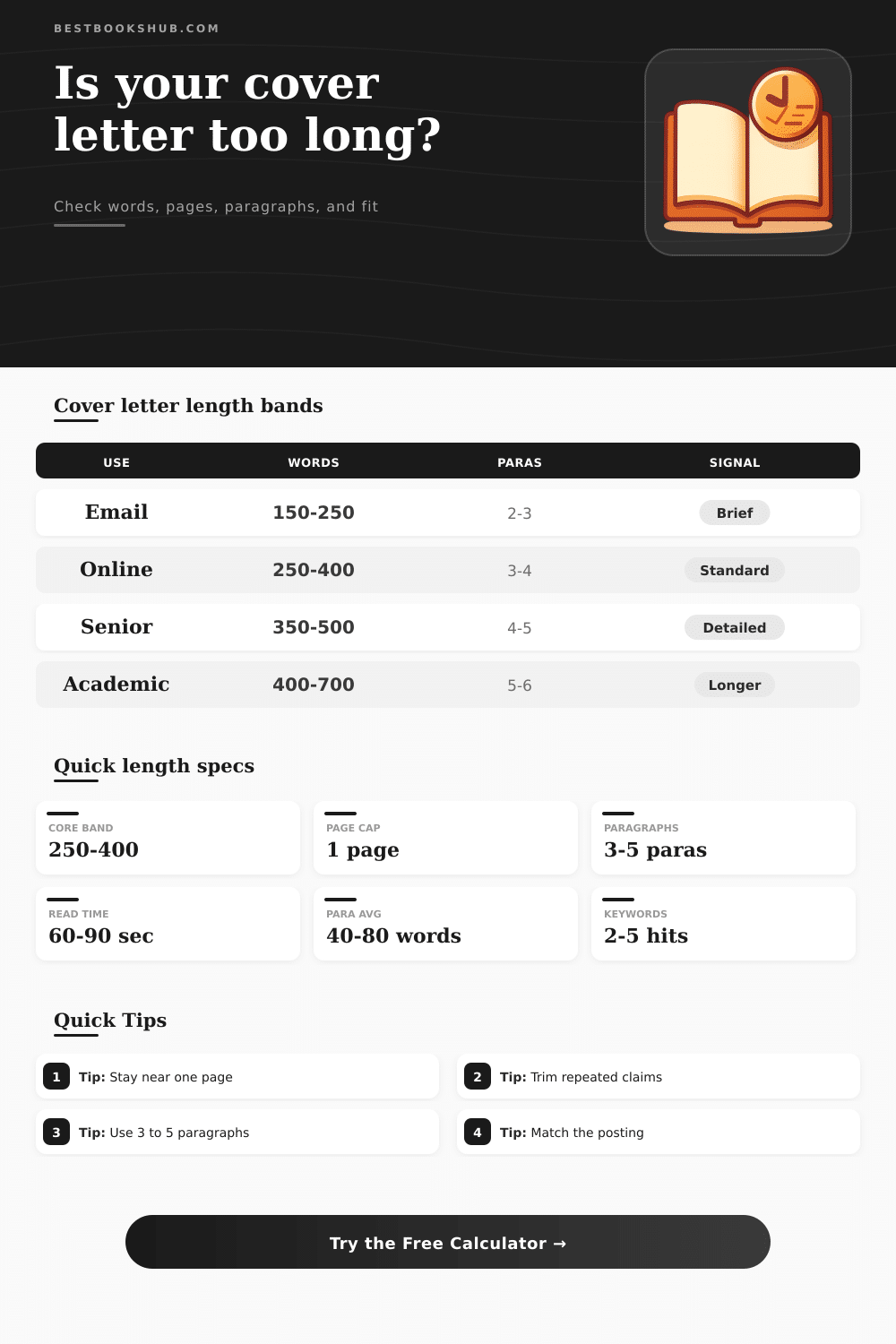
| Submission context | Target words | Paragraphs | Best use |
|---|---|---|---|
| Short recruiter email | 150-250 | 2-3 | Fast introduction, referral note, or warm follow-up. |
| Online application | 250-400 | 3-4 | Standard job application where the resume carries most detail. |
| Referral introduction | 200-350 | 3-4 | Concise link between mutual contact, role fit, and next step. |
| Executive search letter | 350-550 | 4-5 | Senior narrative with scope, leadership proof, and business impact. |
| Academic or staff application | 400-700 | 5-6 | Committee-style review where fit, service, and evidence need room. |
| Speculative outreach | 200-325 | 3 | Cold introduction that earns a reply without overexplaining. |
| Role level | Useful range | Detail level | Length risk |
|---|---|---|---|
| Internship or student role | 180-300 words | Motivation, coursework, one proof point | Too many unrelated activities |
| Early career role | 225-350 words | Transferable skills and one or two examples | Repeating every resume bullet |
| Mid-career professional | 275-425 words | Selected outcomes and direct role match | Broad career summary with no focus |
| Senior manager or lead | 325-500 words | Leadership scale, team scope, and measurable impact | Long biography instead of job-specific fit |
| Director, VP, or executive | 400-600 words | Strategic scope, operating context, and transformation proof | Abstract leadership language without evidence |
| Academic, research, or staff | 400-700 words | Fit with department, teaching, service, or research needs | Dense paragraphs with no skimmable structure |
| Format setting | Approx words/page | Good target | Layout note |
|---|---|---|---|
| Compact, 10.5 pt, 0.75 in margins | 520-590 | 350-475 words | Works only if spacing still looks readable. |
| Standard, 11 pt, 1.0 in margins | 430-500 | 275-425 words | Balanced for most one-page applications. |
| Spacious, 12 pt, 1.25 in margins | 330-405 | 240-350 words | Longer letters can spill onto a second page. |
| Plain email message | Screen based | 150-300 words | Short paragraphs matter more than page count. |
| Structure | Word split | Best for | Checker signal |
|---|---|---|---|
| 2-paragraph email note | 75-125 each | Recruiter follow-up or warm intro | Good when total stays below 250 words. |
| 3-paragraph concise letter | 70-115 each | Online applications and cold outreach | Strong when every paragraph has a clear job. |
| 4-paragraph standard letter | 60-100 each | Most professional cover letters | Ideal when proof and company fit are separate. |
| 5-paragraph detailed letter | 55-90 each | Senior, nonprofit, academic, or career change | Useful if headings are absent but scanning is easy. |
DISCLOSURE: This post may contain affiliate links, meaning when you click the links and make a purchase, I receive a commission. As an Amazon Associate I earn from qualifying purchases.
Hiring managers reads your cover letter in six to ten seconds and decide. Do you really want them spending that long on your document just trying to figure out what main point is? If so, congratulations, you’ve already lost them.
This is like comparing the attention span of the reader with the physical footprint of application. It doesn’t critique your grammar, nor does it judge your writing style. Rather, it measures how many word you used and what paragraph structure you took. It also looks at how this matches industry norms across different types of submission and seniority levels.
Why Short Cover Letters Work Best
While excessive length may make you appear passionate about something, hiring managers frequent see it as an inability to prioritize their information. Does your document fit into one page when formatted under standard conditions? It depends on the reader: what they read it on, and who they are.
A senior cover letter have room to describe measurable impact and scope of leadership; an email intro needs to be punchy. Those variables adjust the calculator. Pick “executive search” and target band expands higher (with more room for narrative). Pick “speculative outreach” and the targets narrows dramatically (a cold email must catch someone’s eye with no relationship).
That nuance will save you from shooting a three-page manifesto at the inbox of a busy startup founder seeking only to know if you can code. Paragraph structure is almost as important than word count. It’s more difficult for someone to skim through a wall of text with 40 words in every sentence then it is for them to read four distinctly different paragraphs of equal length.
Beyond counting paragraphs, the checker takes into account their order and how logically they flow from an opening hook to evidence and finally to a closing call to action. Even though five awesome key achievements might be jammed together in one dense block, the system flags it as poor structure because it knows people has a better chance of remembering at least two point if they’re broken up into individual paragraph.
Another factor that works behind the scenes but still matters is formatting decisions. If you use 12-point type instead of 11, or if you expand your margins from an inch to one and a quarter inches, you’ll get fewer word per page, even though you haven’t altered what’s being said inside the letter. The calculator takes those physical factor into account, allowing you to guess at whether your document will stretch past a single page.
Unless you’re writing for a very technical audience (in which case, expect a lot of detail) or you’re in academia, where lengthy evidence is required, going beyond one page is considered excess filler in most corporate hiring situations. Even better, keeping it to one page makes you ruthless about editing, something that usually enhances quality of your argument.
Don’t obsess with meeting an exact target, treat the limits as guard rails. When the tool says your draft is too long, don’t cut unique insights; trim duplicate fact from your resume. Never cut proof of how you match the job description just to make your resume shorter.
You should of concentrated on proving you’re a good fit through specific projects and measurable outcomes. Cut the fluff. Get rid of generic descriptions like “enthusiastic team player” or “hard worker”. Those are meaningless unless you give examples. Concentrate on proving you’re a good fit through specific project and measurable outcomes.
Your cover letter should serve as the bridge connecting your resume with the job description. It should be short enough to cross quickly, yet strong enough to hold its own weight. If you sync up the length with what the hiring team expects, then you’re taking the friction out of their review process. You’re giving them precisely what they want… When they want it. That’s some serious professional courtesy in a world of a crowded inbox, where attention is the most limited resource of all.
Actualy, you would of seen this with more moddern tools.