📚 Reading deadline planner
Daily page quota calculator
Set a book deadline, subtract pages already read, add a realistic buffer, and turn the remaining pages into a daily reading plan.
| Reading goal | Pages remaining | Deadline | Active days | Quota with 10% buffer |
|---|---|---|---|---|
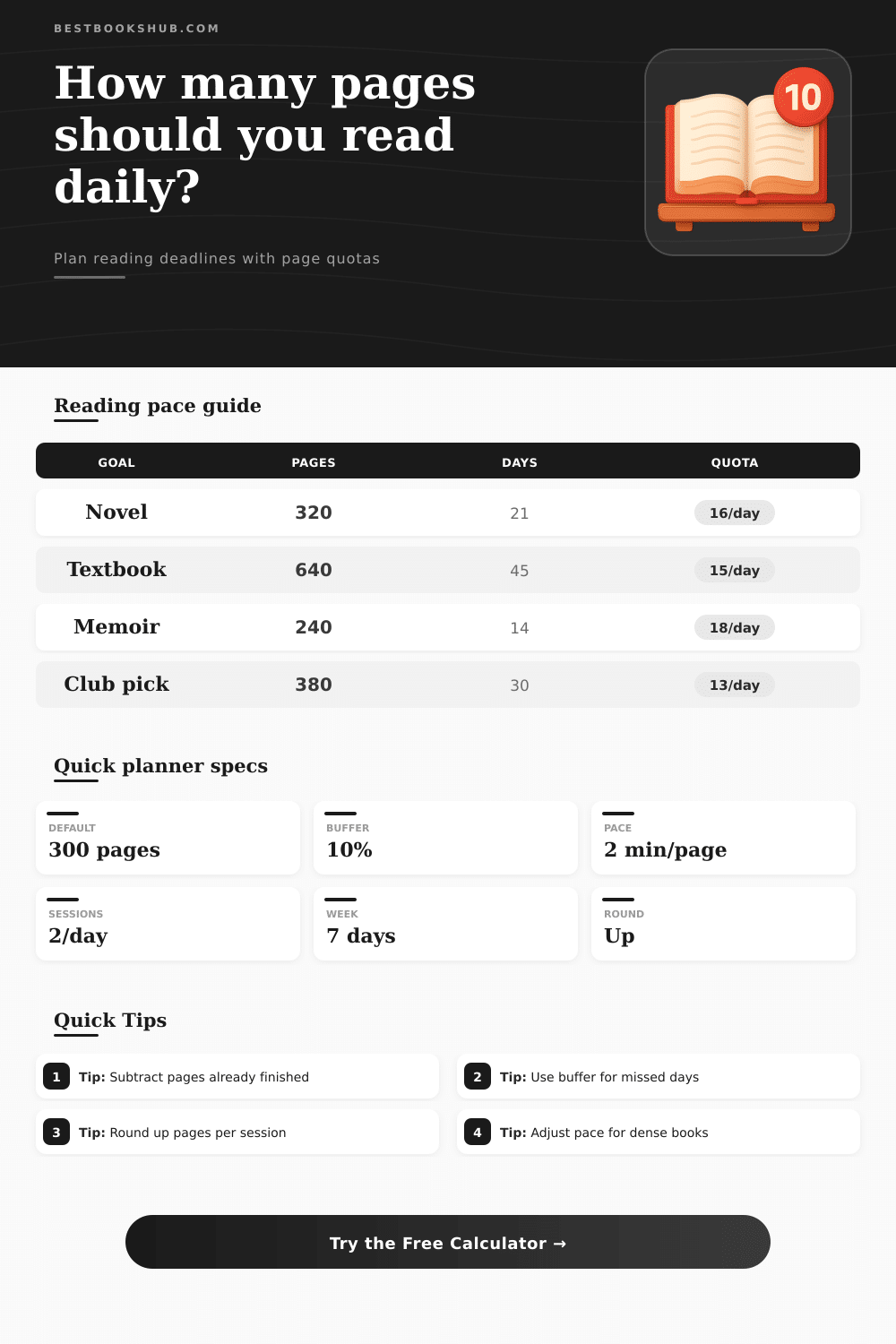
| Book club novel | 320 pages | 21 calendar days | 21 days | 17 pages per day |
| Weekend finish | 180 pages | 3 calendar days | 3 days | 66 pages per day |
| Textbook unit | 140 pages | 14 calendar days | 10 days | 16 pages per active day |
| Library return | 260 pages | 10 calendar days | 9 days | 32 pages per active day |
| Long novel plan | 720 pages | 60 calendar days | 52 days | 16 pages per active day |
| Pages per day | Fast pace | Normal pace | Dense pace | Suggested sessions |
|---|---|---|---|---|
| 10 pages | 12-16 minutes | 20-25 minutes | 40-60 minutes | 1 short session |
| 20 pages | 24-32 minutes | 40-50 minutes | 80-120 minutes | 2 moderate sessions |
| 35 pages | 42-56 minutes | 70-88 minutes | 140-210 minutes | 3 split sessions |
| 50 pages | 60-80 minutes | 100-125 minutes | 200-300 minutes | 3 or 4 sessions |
| 75 pages | 90-120 minutes | 150-188 minutes | 300-450 minutes | 4 focused blocks |
| Schedule type | Reading days | Best for | Quota effect | Planner note |
|---|---|---|---|---|
| Daily reading | 7 per week | Book clubs and deadlines | Lowest daily page count | Use a small buffer |
| Weekday reading | 5 per week | Study routines | Higher weekday quota | Add weekend catch-up if needed |
| Alternate days | 3 or 4 per week | Dense nonfiction | Moderate to high quota | Split into more sessions |
| Weekend only | 2 per week | Casual reading blocks | High quota per day | Use longer sessions |
| Catch-up sprint | Custom | Missed deadlines | Highest quota | Reduce buffer if deadline is fixed |
DISCLOSURE: This post may contain affiliate links, meaning when you click the links and make a purchase, I receive a commission. As an Amazon Associate I earn from qualifying purchases.
The covers look nice. The reviews sound promising. With good intentions, you purchase a book. “This time,” you think, “I’m going to read.” Three weeks later, your book remain untouched on your nightstand and your ambition has been replaced by guilt. Why does it keep happening?
Most readers don’t approach books as a practical project; they view them as general intention. Your problem isn’t a lack of desire. You haven’t figured out how much each day cost in order to complete the story.
How to Read More Books Every Day
This shift in mindset make all the difference when it comes to thinking in terms of page quotas. When you assign pages to time slots, you aren’t challenging yourself to read more. Instead, you have gave each day a set number of pages. This number does not account for how hard the text is to read. Once you input how fast you want to go and how much time you have until your deadline, the rest is just math. There’s no commitment to reading a huge book today, only the commitment to getting through ten pages before dinner. And that’s enough to maintain momentum month after month.
The biggest variable left out of all reading plans are the buffer. We base our quota on ideal circumstances. We think, “Oh sure! Every night I’ll be able to read for two hours.” But in reality, life doesn’t accommodates this kind of rosy thinking. There’s going to be one night when you’re up late trying to follow a tricky chapter, forcing you to reread it just to understand the argument. Or maybe you got stuck at work; you missed an evening here or there. That’s why adding a 10% buffer helps: it accounts for these naturaly friction points without throwing off rest of your schedule.
The key is to understand what it is we’re measuring here. A buffer isn’t laziness written into the plan. It’s insurance to close the distance between ideal planning and messy execution.
This is also true for how often you read. You’re more likely to stick with it if you break up your reading session into smaller chunks, say, 2-3 times instead of trying to plow through 50 pages at once. It’s hard to retain much information that way (plus, it’ll make your brain tired). As you can see from the chart on the page, session length impact your total time commitment. For example, are you low on energy after work? Rather than forcing yourself to sit down for an entire hour and then feeling resentful towards the book, you’d be better off carving out 20 minutes here and there. Intensity does not trump consistency, which apply to all long-term habits.
The other thing is, the pace make a difference, too. Heavy historical nonfiction doesn’t read the same way than a technical manual, which doesn’t read the same way as light fiction. Your minutes-per-page adjustment will show how much mental effort you are using, and your daily target is adjusted to match. Underestimate how many words you need to absorb in order to understand difficult argument, and by next week, your daily number is going to look unachievable. You’ll give up, feeling frustrated and angry with yourself for not sticking to “the plan.” This is where honest self-assessment come into play: you can always speed things up later if you realize that you’re able to plow through pages at a rate higher than you anticipated. Burnout happens when you start too hot and you haven’t even made it half-way yet.
For those of you who think in terms of output instead of physical pages, word count estimates also provides an additional layer of clarity. For example, a typical trade book will contain two hundred seventy-five words per page while a dense academic text may pack six hundred words into the same space. That’s what explains why some books with fewer pages still feel heavier. If you know that, then you can calibrate your expectations before ever opening up the cover.
In the end, willpower isn’t the main issue. The key is architecture: building a system that fit with your own life (energy levels, time crunches, etc.) to support your reading. The whole process doesn’t have to feel like a slog. Don’t try to force-feed yourself pages of text you don’t love! Just come up with a system that can withstand contact with reality.
When you buy a book, you are making a promise to yourself that is more than just wishful thinking. Give it a daily quota that reflects how much time you realy have.