📖 Dale-Chall Readability Calculator
Paste your text or enter counts manually — get grade level, difficulty rating, and hard word analysis
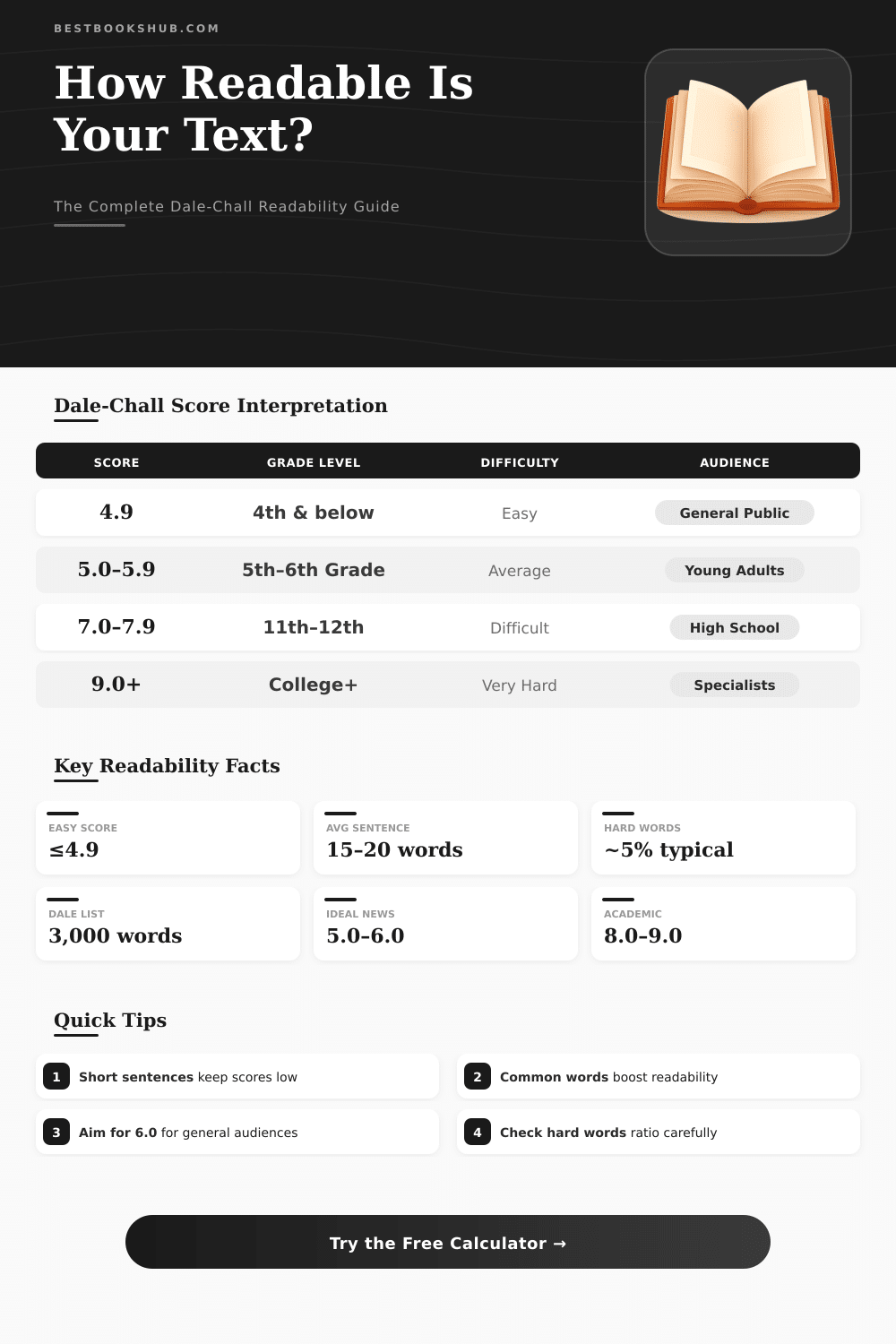
| Raw Score | Adjusted Score | Grade Level | Difficulty | Typical Audience |
|---|---|---|---|---|
| 4.9 or below | 4.9 or below | Grade 4 & below | Very Easy | Elementary school readers |
| 5.0 – 5.9 | 5.0 – 5.9 | Grades 5 – 6 | Easy | Middle-grade readers |
| 6.0 – 6.9 | 6.0 – 6.9 | Grades 7 – 8 | Average | Young adult readers |
| 7.0 – 7.9 | 7.0 – 7.9 | Grades 9 – 10 | Moderately Difficult | High school students |
| 8.0 – 8.9 | 8.0 – 8.9 | Grades 11 – 12 | Difficult | Advanced high schoolers |
| 9.0 – 9.9 | 9.0 – 9.9 | College level | Very Difficult | College students |
| 10.0+ | 10.0+ | College graduate | Extremely Difficult | Specialists / Experts |
| Avg Words/Sentence | Score Impact | Recommended For | Example Genre |
|---|---|---|---|
| 1 – 8 | Reduces score by ~1.0 | Children grade 1–3 | Beginning readers |
| 9 – 14 | Neutral / low impact | Grades 4–6 | Middle grade fiction |
| 15 – 20 | +0.3 to +0.6 | General adults | Newspapers, blogs |
| 21 – 25 | +0.7 to +1.0 | High school+ | Academic essays |
| 26 – 30 | +1.0 to +1.5 | College level | Research papers |
| 30+ | +1.5 or more | Graduate / Expert | Legal, scientific texts |
| Unfamiliar Word % | Dale-Chall Category | Readability Level | Action Needed |
|---|---|---|---|
| 0% – 3% | Very Familiar | Very Easy (≤5.0) | Ideal for wide audiences |
| 3% – 5% | Familiar | Easy (5.0–6.0) | Good for general readers |
| 5% – 8% | Moderate | Average (6.0–7.0) | Consider simplifying some words |
| 8% – 12% | Unfamiliar | Difficult (7.0–8.0) | Revise for broader audiences |
| 12%+ | Very Unfamiliar | Very Difficult (8.0+) | Significant revision required |
| Text Type | Typical Score | Grade Level | Avg Sentence Length |
|---|---|---|---|
| Children's Picturebook | 1.0 – 3.0 | K – 2nd | 5 – 8 words |
| Elementary Reader | 3.5 – 5.0 | 3rd – 5th | 8 – 12 words |
| Newspaper / Blog | 5.0 – 6.5 | 5th – 7th | 14 – 18 words |
| Literary Fiction | 6.0 – 7.5 | 7th – 10th | 15 – 22 words |
| Business Writing | 6.0 – 7.0 | 7th – 9th | 15 – 20 words |
| High School Textbook | 7.0 – 8.0 | 9th – 11th | 18 – 25 words |
| Academic / Research | 8.0 – 9.5 | College | 22 – 30 words |
| Legal / Medical | 9.0 – 12.0 | Graduate+ | 25 – 40 words |
Readability deals with how easily one can read text. Complexity, needed knowledge, visibility and typography all affect how well one understands the material. Simply said, it measures how quickly readers manage to finish the writing.
DISCLOSURE: This post may contain affiliate links, meaning when you click the links and make a purchase, I receive a commission. As an Amazon Associate I earn from qualifying purchases.
One can estimate readability by means of separate tools. Elements like syllables per phrase, range of words, average word length, total word count and sentence length help to make the score. They give a rough idea about the school level that is needed to easily scan a piece of text.
How Easy Text Is to Read
There are several well known tests for readability. The Flesch score for reading ease estimates how simple the text is, where bigger values show more accessible content. The Flesch-Kincaid score for grade level links the difficulty to American public schools.
Other methods include the Gunning fog index, the SMOG index and the Coleman-Liau index. The Flesch-Kincaid points grow for scripts with long phrases and difficult words, compared to simple styles. Also the share of passive sentences deserves attention.
A high point for readability does not always guarantee that the text truly is good to read. A person can write total nonsense and cheat the computers for high values. Also, readability does not care about logical flow and inner unity, which is part of good writing.
Certain special fields, like engineering or technology, naturally raise the difficulty of readability. The many technical terms push the points upward, even if the content is clear for the target group. It is seriously hard to no who is the perfect reader.
Only the age can greatly change how readable something is. Also font, typeface size, background color and text color affect the reading. Left-aligned texts help, because steady left-hand margins ease the reading.
Lyman Bryson from the School of Teaching at the University of Columbia found that many adults suffered because of weak literacy because of bad teaching. Although schools had long tried to teach clear and accessible writing style, Bryson found that that happened rarely. He called such writing an art and skill that few people with training would manage to reach.
There are free websites for checking readability, that right away show the school level of the text and the most difficult phrases. Those programs are useful for tasks like searching thousands of pages to find badly written parts or scanning a book to find hard places. If someone naturally writes with short phrases and clear style, the points do not matter that much.
Even so readability matters only in case the goal is that readersactually finish everything written.
There is also an app for reading, running by means of artificial intelligence, called Readability, made for children from kindergarten until the sixth grade. It helps to improve the flow of reading, word use and insight. The technology listens to the child reading, gives the right word and later lets them repeat the phrases.