📖 Familiar word readability lab
New Dale-Chall readability calculator
Paste a passage to estimate difficult word percentage, average sentence length, raw Dale-Chall score, adjusted grade band, and custom familiar-word exclusions.
This calculator uses the New Dale-Chall formula with an approximate familiar-word list, plus controls for names, hyphenated terms, custom easy words, and forced difficult words.
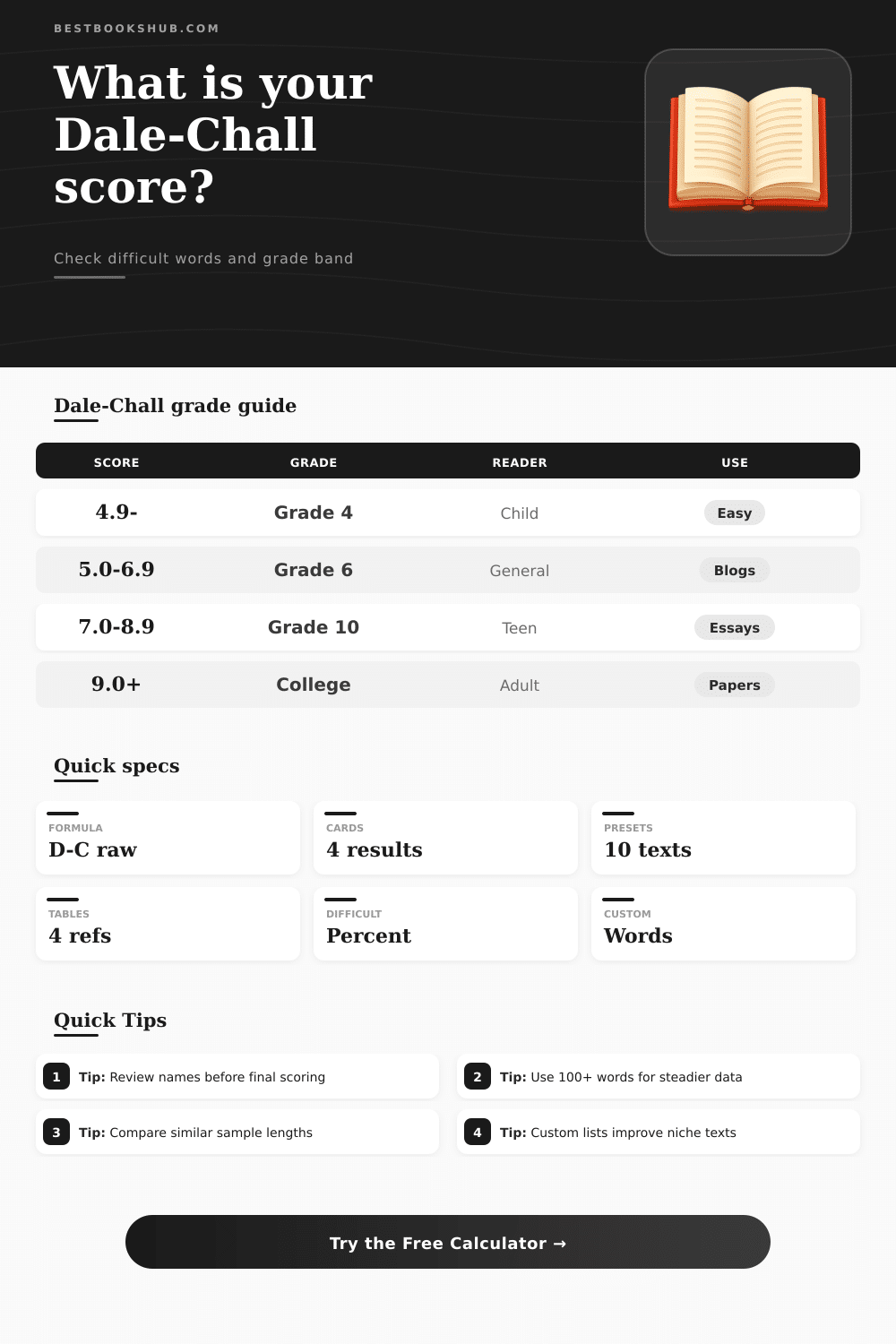
| Adjusted score | Estimated grade band | Reader description | Editorial signal |
|---|---|---|---|
| 4.9 or lower | Grade 4 and below | Very accessible school reading | Mostly familiar words and short sentences. |
| 5.0 to 5.9 | Grades 5 to 6 | Upper elementary to early middle | Good for broad explanation and simple chapters. |
| 6.0 to 6.9 | Grades 7 to 8 | Middle school to general readers | Usually clear when context supports harder terms. |
| 7.0 to 7.9 | Grades 9 to 10 | High school readers | Watch clusters of abstract vocabulary. |
| 8.0 to 8.9 | Grades 11 to 12 | Advanced high school | Definitions and sentence trimming may help. |
| 9.0 to 9.9 | Grades 13 to 15 | College readers | Likely dense for casual audiences. |
| 10.0 or higher | Grade 16 and above | Advanced college or specialist | Use only when technical precision is needed. |
| Step | Measurement | Formula role | What to check |
|---|---|---|---|
| 1 | Count total words | Denominator for difficult percent | Remove headings if they distort the sample. |
| 2 | Count unfamiliar words | Difficult percent = difficult / total x 100 | Review proper nouns and repeated domain terms. |
| 3 | Count sentences | Average sentence length = words / sentences | Fix fragments or list items before comparing drafts. |
| 4 | Apply raw formula | 0.1579 x difficult% + 0.0496 x ASL | Raw score is not the final grade band. |
| 5 | Add adjustment | Add 3.6365 when difficult% is above 5 | This is why word familiarity matters heavily. |
| Option | Effect | Best fit | Risk |
|---|---|---|---|
| Strict compact list | Counts fewer words as familiar | Conservative screening | May overstate difficulty. |
| Balanced approximation | Uses common roots and variants | Most classroom and web samples | Still not the full 3,000 word list. |
| Generous variants | Softens common suffixes and forms | Draft editing and quick comparison | May understate technical density. |
| Custom familiar words | Marks terms known to your audience | Series vocabulary, classroom units, niche brands | Only use when readers truly know them. |
| Custom difficult overrides | Forces terms to count as hard | Jargon audits and glossary planning | Can make a text look harder than average readers feel. |
| Sample length | Reliability | Use case | Notes |
|---|---|---|---|
| Under 100 words | Quick signal | Headlines, labels, blurbs | One difficult sentence can swing the result. |
| 100 to 200 words | Useful draft check | Article openings, pages, lesson excerpts | Good for comparing revisions. |
| 200 to 500 words | Stronger passage read | Chapters, policies, study materials | Recommended for steady editorial decisions. |
| 500+ words | Broad document view | Reports, manuscripts, guides | Review sections separately to find spikes. |
DISCLOSURE: This post may contain affiliate links, meaning when you click the links and make a purchase, I receive a commission. As an Amazon Associate I earn from qualifying purchases.
The New Dale-Chall approach will provide you with a way to calculate sentence lengths and word familiarity with easy. The New Dale-Chall approach will also help you to understand which audiences to target based off you’re writing. Many writers feels that their drafts are either too dense or too simple to be effective.
Yet, most writers is not aware of specific changes that they can make to their drafts to address these issue. The calculator will help you with the mathematical calculation required to determine writing readability. The New Dale-Chall formula require that you count the number of word in your passage that are not on a list of word that are consider familiar to readers.
How to Use the New Dale-Chall Readability Calculator
The formula will combine that percentage of unfamiliar word with the average length of the sentence in your passage. If the percentage of unfamiliar word is above five percent, the formula will adjust the score. A cluster of technical term will increase the score even if the sentence are short because the New Dale-Chall approach count the number of word that are familiar to readers.
Many people do not consider word familiarity when they are only calculate sentence length. By using the calculator, you can change word in your passage and see how this change your readability score. The New Dale-Chall approach is not based on the number of syllable in each word.
Instead, the approach measure how many word in your passage the reader have used before. Depending upon your audience, you may have to write for both expert and the general public. The calculator allow you to quickly compare readability score based on different list of familiar word.
Using the calculator, you can set the sample size that you use for your passage and how you calculate the number of sentence in your passage. Shorter passage may give wildly varying readability score. Longer passage will provide more even score.
You can analyze the middle portion of your draft. The calculator allow you to choose the portion of your draft that you wish to analyze. Different portion of your draft will produce different readability score.
A custom list allow you to specify that certain word are familiar to a particular audience. For instance, certain technical term may be specific to a certain group of individuals but may be unknown by other individual who are not expert in the specific field. The readability calculator will ignore words that you add to your custom list.
You can also force certain word to be considered as difficult word even if they are familiar word to your readers. The readability calculator will apply these change for you. The reference table will allow you to translate your readability score to a range of grade band.
The grade band will show you which education level of reader is most likely to understand your passage. However, changing a few word may create a new score that falls into a different grade band. This new score will help you to determine if your change have made your passage easier to read for an average reader.
Using the readability calculator regularly will eventually create a habit of considering which word that the readers of your passage should already be familiar with. Once you begin to form this habit, you can use the readability calculator as a tool that you reference often. The readability calculator will act as a mirror that allows you to understand the status of your draft while you are still write the draft itself.