📅 Reference audit tool
Date reference counter
Paste prose, notes, citations, schedules, or manuscript copy to count explicit dates, numeric dates, relative phrases, ranges, missing years, and ambiguous formats.
| # | Found text | Type | Flag | Context |
|---|---|---|---|---|
| Load a preset or paste text to see date references. | ||||
| Pattern family | Examples | Primary signal | Common flag |
|---|---|---|---|
| Month before day | March 4, 2026 | Month name | Missing year |
| Day before month | 4 March 2026 | Month name | Ordinal suffix |
| ISO numeric | 2026-03-04 | Year first | Rarely ambiguous |
| Short numeric | 03/04/26 | Separator | Order ambiguity |
| Numeric form | MDY read | DMY read | Ambiguity rule |
|---|---|---|---|
| 03/04/2026 | Mar 4 | 4 Mar | Flag if both fit |
| 13/04/2026 | Invalid | 13 Apr | DMY only |
| 04/27/2026 | Apr 27 | Invalid | MDY only |
| 2026-04-03 | ISO | ISO | Year first |
| Relative phrase | Anchor need | Typical scope | Flag reason |
|---|---|---|---|
| Today | Required | 0 days | Changes by date |
| Tomorrow | Required | 1 day | Changes by date |
| Next Friday | Required | 1-7 days | Week anchor |
| In 2 weeks | Required | 14 days | Unit conversion |
| Range connector | Example | What to count | Review point |
|---|---|---|---|
| to | May 1 to May 3 | Start and end | Both dates present |
| through | June 7 through 9 | Span marker | Shared month |
| from | from 2026-01-01 | Start marker | End nearby |
| hyphen | July 4-6 | Compact span | End day only |
DISCLOSURE: This post may contain affiliate links, meaning when you click the links and make a purchase, I receive a commission. As an Amazon Associate I earn from qualifying purchases.
Until you work with dates in different country you may not know: they’re fickle. On paper they appear rock solid, but their meaning change based off the context of when and who is viewing them. What happens depend entirely on how people interpret them.
Take 03/04/2026: That looks like a solid date, right? Half of the world interprets that as March 4th and the other half read it as April 3rd. This is just one example of problems ranging from data entry mistakes to lost meeting caused by a misunderstanding.
Why Clear Dates Matter
The calculator above will help quantify this risk for you. What’s it do? Well it doesn’t simply tell you how many date there are, instead it’ll scan through your text and let you know which ones is problematic.
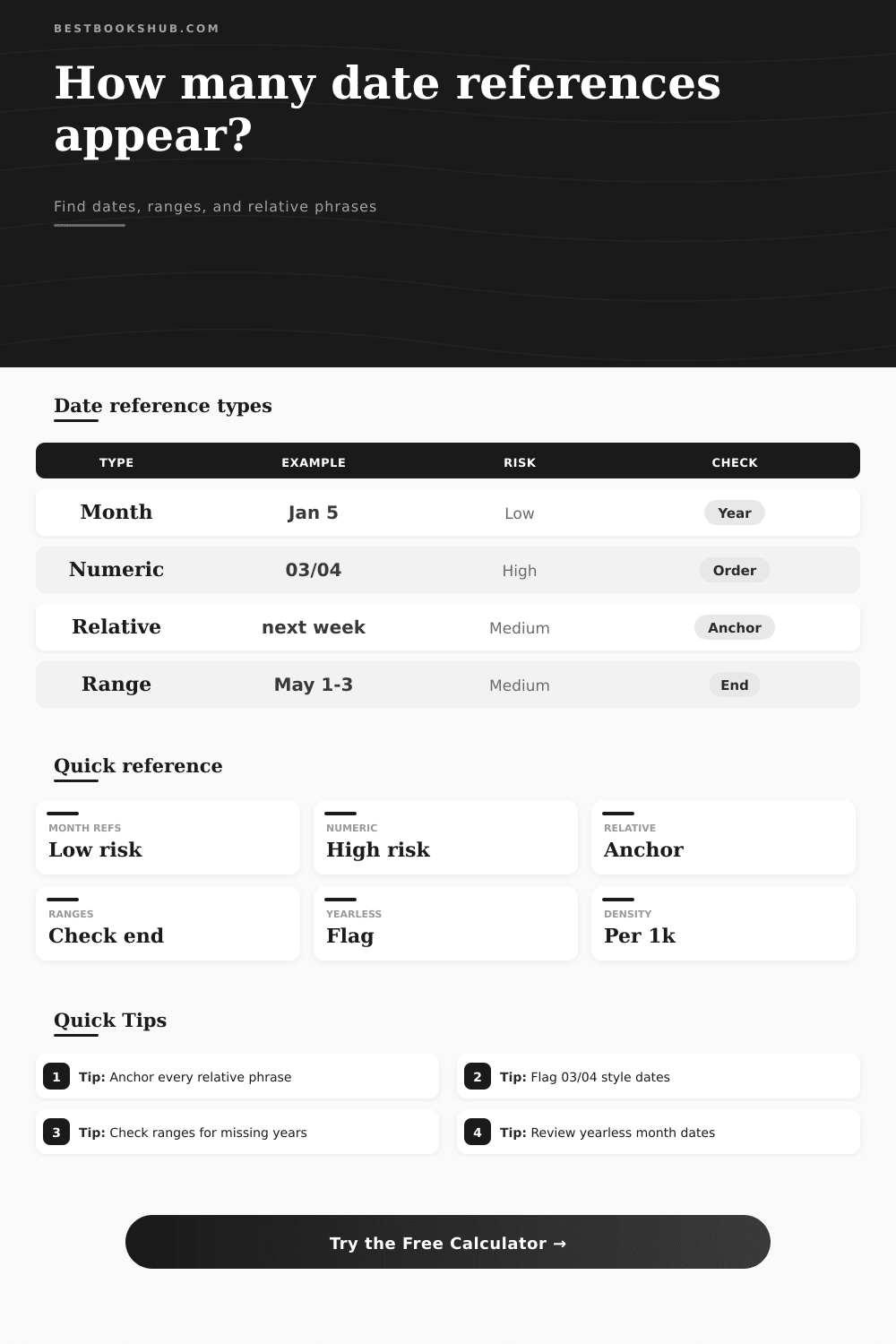
Here’s how it parses out your references. In general, numeric dates are risky; those anchored by month names (e.g., March 4) are fine, because most people knows which month March is. It flags these with a higher risk rating, since it isn’t universal… It vary depending on regional conventions.
You can also set the default ordering of dates so that it aligns with who you’re writing for, but the more ambiguous your date is (both day and month number are 12 or below), the higher the score. That’ll help you gauge just how much explanation you need in your piece.
The other type of challenging phrase is relative phrases. Phrases such as tomorrow or next week are all anchored to some other date. If there’s no anchor date, then those dates float away from you. You could create a guide now, save it, and post it in three months. By then, next week will have a completely different meaning.
With the calculator, you can anchor down any date and compare those types of phrase to it. This will help you see if what you are trying to publish is too specific to work as evergreen content. It also give you a snapshot of your document’s temporal health.
Another wrinkle involve ranges. On the surface, a range like “May 1-3” seems clear, but it’s got gaps behind it. Is the third day excluded? What about the year? The calculator splits apart ranges (or highlights the connectors) for you to check for completeness.
And a lot of times, folks log notes with just the month, leaving out the year. That makes sense at the time, but later on those become empty placeholders that don’t help anyone. The calculator flags dates without any year so you can choose to complete them or let it go because you’re OK with the shorthand.
To me, all of this sounds like a type of spell check for time: just like you wouldn’t send a document full of spelling errors, don’t release schedules that aren’t clear about their dates. Fixing a misunderstanding after it happen is always more expensive than auditing it ahead of time. It might take you ten minutes to scan through your newsletter draft to double-check every date is spelled out explicitly. Those ten minutes will prevent an hour of confused customer email later; being clear is worth the extra time.
What about the readers? Think about who’ll read this document. Are you writing for an international group? Numbers as dates will hurt you. Spelled-out dates or an ISO format are better in that case. And if you’re saving personal notes for yourself? As long as you remember what day you wrote that down, then relative dates may work just fine. Depending on the situation, the calculator make adjustments to match, allowing you to set how strict you want it to be.
Dates don’t have one right answer, but knowing which dates the reader will understand is important. Now let’s look at the breakdown table to see how healthy your document is at a specific point in time. If you have a lot of ambiguity, you should of rewrite. If you don’t have many relative phrases, maybe your content is timeless (good). These insights guide you on how to improve longevity and clarity. It takes fuzzy feelings of confusion and turn them into hard data that you can now do something with.
At its core, clarity eliminates friction. For example, dates can be a common cause for friction. And if you find the areas where your writing might break down, you make it stronger. You move from hope to knowledge. You shift from wondering “do I think they get this?” to knowing “I know they know.”
The calculator does all the boring arithmetic, leaving room for you to do what you do best: write. It helps you ensure that when you type March, the other person reads March. Precision is secondry to clarity, and that’s something many people forget.