📚 Reading deadline lab
Deadline book finish calculator
Turn a due date, current page, reading speed, and weekly availability into a practical finish plan with pages per day, sessions, buffer, and pace warnings.
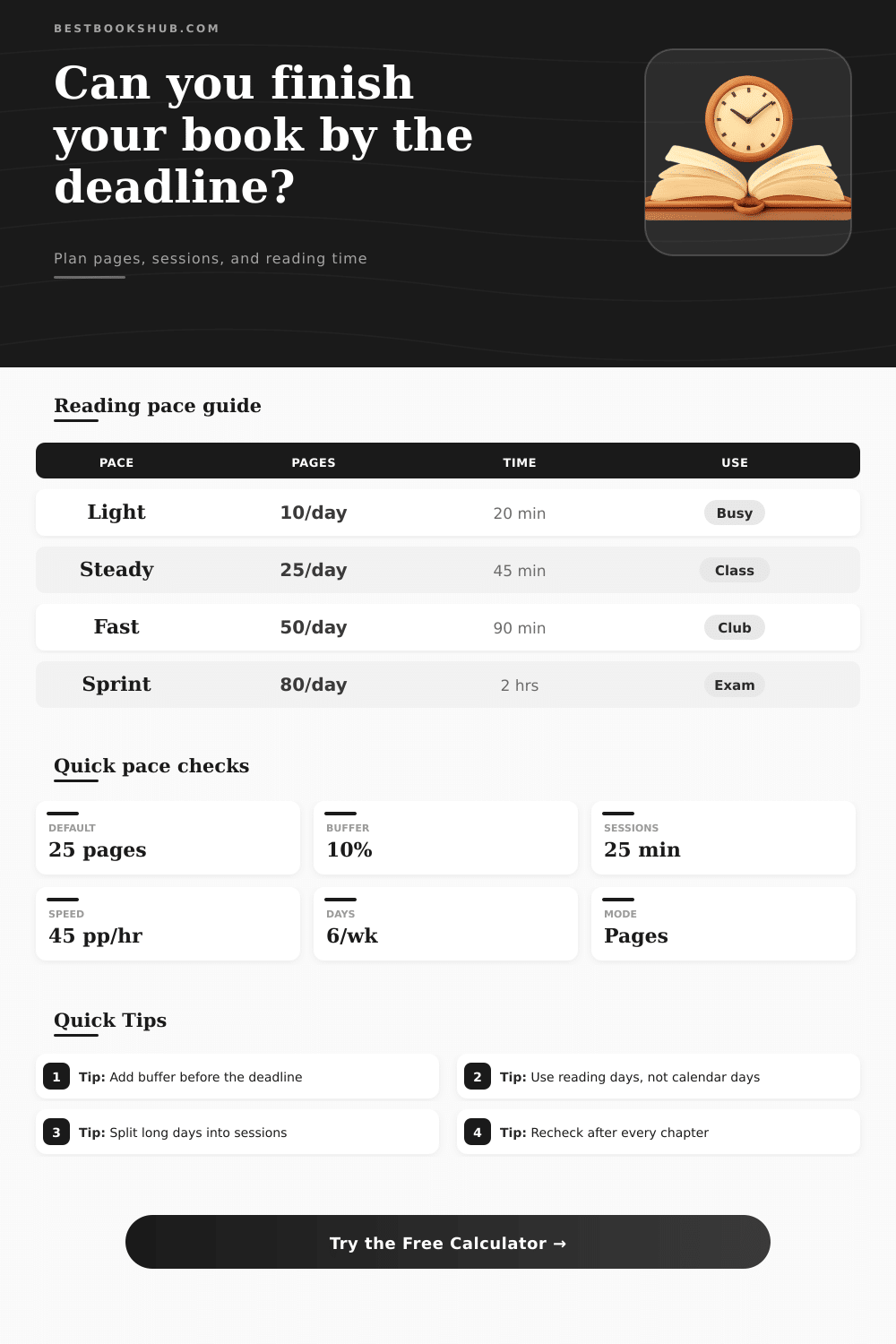
| Reading situation | Typical speed | Pages in 30 min | Best planning use |
|---|---|---|---|
| Light fiction or familiar reread | 55 to 75 pages per hour | 28 to 38 pages | Comfortable book club plans and travel reading. |
| Standard novel or general nonfiction | 35 to 55 pages per hour | 18 to 28 pages | Most deadline plans when no extra notes are needed. |
| Dense nonfiction or essay collection | 25 to 40 pages per hour | 13 to 20 pages | Use when passages need rereading or annotation. |
| Academic, technical, or translated text | 15 to 30 pages per hour | 8 to 15 pages | Best for study deadlines, exams, and research reading. |
| Audiobook at normal narration speed | 25 to 35 pages per hour equivalent | 13 to 18 pages | Useful when mixing listening with print reading. |
| Deadline pattern | Suggested buffer | Session size | Why it helps |
|---|---|---|---|
| Book club discussion | 10% time buffer | 25 to 45 minutes | Leaves a day to revisit notes before the meeting. |
| Class reading quiz | 15% time buffer | 30 to 60 minutes | Protects time for key terms, margin notes, and review. |
| Library return date | 5% time buffer | 20 to 30 minutes | Keeps the plan light while avoiding the final-day rush. |
| Exam or thesis source | 20% time buffer | 45 to 60 minutes | Accounts for dense chapters and slower note-taking. |
| Weekend sprint | No buffer | 45 to 60 minutes | Works only when the deadline is fixed and close. |
| Remaining pages | 7 days left | 14 days left | 21 days left |
|---|---|---|---|
| 150 pages | 22 pages/day | 11 pages/day | 8 pages/day |
| 250 pages | 36 pages/day | 18 pages/day | 12 pages/day |
| 400 pages | 58 pages/day | 29 pages/day | 20 pages/day |
| 600 pages | 86 pages/day | 43 pages/day | 29 pages/day |
DISCLOSURE: This post may contain affiliate links, meaning when you click the links and make a purchase, I receive a commission. As an Amazon Associate I earn from qualifying purchases.
This scenario probably sounds familiar: You’ve got a book club meeting coming up. Or maybe the book you checked out from the library needs to be returned soon. Or perhaps a friend ask you to read that biography and report back by Friday. Then comes the harsh truth: you are looking down at a pile of unturned pages and realizing that while your excitement was high, your hours were not.
The gap between our desires and our time leads us to abandon most reading goals. The intention was there but we reached the end without any hours left in the day, forcing us to skim through an online summary. What’s the issue? Not wanting it enough isn’t usually the problem. The issue is not accounting for friction. You get sick. You have to work late. A kid need help with his math homework. That’s all fine; life happens.
How to Plan Your Reading Time Better
But most people treat their reading list like they’re livig in a vacuum: every night is on lock-down to follow a rigid schedule. They count up how many pages they has left, divide by however many nights remain, then act surprised when that figure doesn’t pan out. That math rarely take into account the difference between different text densities, nor does it include a cushion for human error.
So what does it all mean? When you input your own constraints, the calculator figures out the math for you so you don’t have to guess at conversion rates and coefficients. But knowing what your inputs represent is where the magic happens.
First, get real about how many days per week you’re available for reading. Are you really going to be reading on Saturday night instead of hanging out with your friends? Unless you said six, I bet you are exaggerating your availability. It’s better to assume that you have five solid days rather then seven perfect ones.
Next up, think about your buffer. Ten percent doesn’t seem like much but in a three-week period, that’s another day of breathing room. And that one day can accommodates a crazy workweek or a really tough chapter that demands a rereading.
Book density matter more than page count. Two-hundred pages of technical manuals and academic theory don’t fly by as quickly than two-hundred pages of light fiction. To account for this, the tool adjust your reading speed based off the type of text you’re working with. The pace you use while plowing through a textbook for an exam won’t match the pace you read a thriller just before falling asleep. When you’re plugging away at something heavy, your brain is doing work: it’s retaining information and building arguments. It can’t follow along the narrative flow like it does with a thriller. Recognizing this difference stops the scary feeling of falling behind schedule.
The other factor that people don’t account for is session duration. Sure, reading for an hour seems like a solid chunk of time but in practice, the effectiveness begin to taper off. After half an hour, you find yourself mindlessly flipping through pages without actualy absorbing anything. Breaking up that hour into more manageable segments (e.g., 25-minute chunks) will result in greater understanding AND less brain fatigue.
The chart on the page link pace recommendations with practical application situations. It’ll tell you if your workload is doable, or if you’re pushing it to the burnout limit. Then use what you learn as a guide. Look at the numbers when you get them back, if they’re too many pages per day, don’t charge ahead blindly. Tweak the assumptions. Double down by starting two days early. Cut back on some smaller commitments so you have more time. Admit defeat and change your goal to getting certain chapters done instead.
The flexibility is part of the plan. A rigid plan shatters under pressure; a flexible plan changes with it. The key here: finishing on time is less about speed reading hacks and more about respectful planning. You’re negotiating with your future self. If you add realistic limits, if you put some buffers into place now, then your future self won’t be rushed and frantic when they has to get through those last hundred pages.
Begin with modest changes. Track what you do compared to the plan. Tweak along the way. Finish it. But also read along the way to truly engage with the book before the deadline hits. That buffer will help. Hold onto it. It’s the difference between a frenzied scramble and a calm conversation. You should of planned better.