💬 Dialogue rhythm
Dialogue exchange counter
Paste a scene, script page, interview, or transcript to count turn-taking pairs, speaker changes, quote blocks, average words per exchange, and monologue streaks.
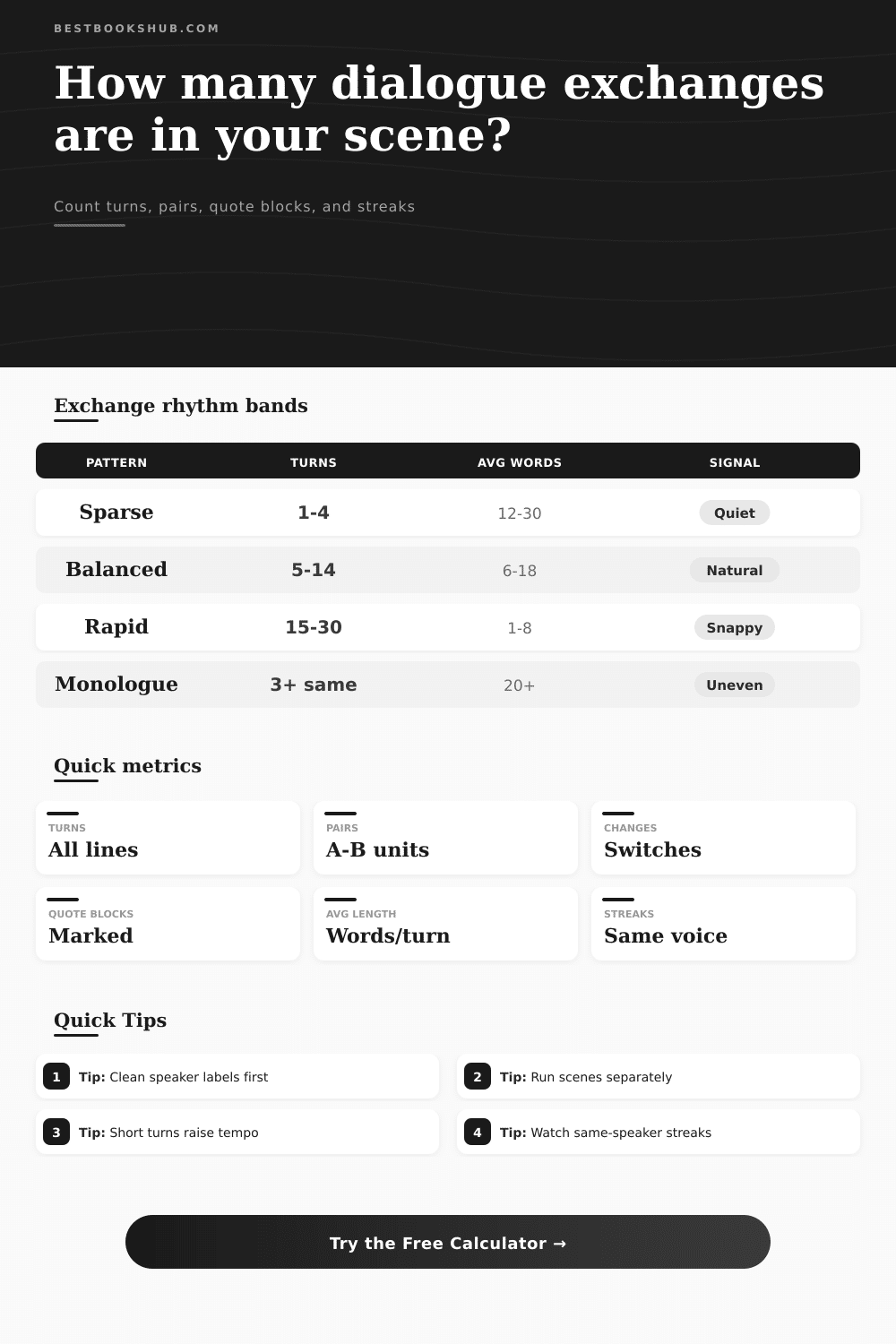
| Dialogue pattern | Typical turn count | Average words per turn | Common scene signal |
|---|---|---|---|
| Sparse exchange | 1 to 4 turns | 12 to 30 words | Quiet, withheld, or narration-led scene |
| Balanced scene | 5 to 14 turns | 6 to 18 words | Natural back-and-forth with room for action beats |
| Rapid banter | 15 to 30 turns | 1 to 8 words | Fast tempo, conflict, comedy, negotiation, or argument |
| Monologue-heavy exchange | 3 or more same-speaker turns | 20 or more words | Speech, explanation, interrogation answer, or imbalance |
| Input style | Best mode | What is counted | Watch for |
|---|---|---|---|
| Name: line | Speaker labels | Each labeled line becomes one turn | Names with colons inside quoted text |
| Name - line | Dash speaker pattern | Dash-labeled transcript lines become turns | Dashes used as punctuation in narration |
| Quoted prose | Quoted speech blocks | Each matched quote pair becomes a turn | Nested quotes and interrupted dialogue tags |
| Screenplay | Screenplay cue blocks | Uppercase cue followed by dialogue lines | Scene headings written in all caps |
| Metric | Low reading | High reading | Possible interpretation |
|---|---|---|---|
| Turn-taking pairs | Few replies | Many replies | Shows how much direct response exists in the passage |
| Speaker changes | One voice dominates | Frequent alternation | Highlights whether dialogue behaves like exchange or speech |
| Average words per exchange | Clipped lines | Long speeches | Suggests pace, pressure, exposition, or hesitation |
| Monologue streaks | Alternating voices | Repeated same speaker | Flags sections where one speaker holds the floor |
| Format | Clean example | Parsed speaker | Parsed turn text |
|---|---|---|---|
| Colon transcript | Ari: We have one minute. | Ari | We have one minute. |
| Dash transcript | Bo - Then stop explaining. | Bo | Then stop explaining. |
| Q and A | Q: Why now? | Q | Why now? |
| Quoted prose | "Stay close," Nia said. | Inferred A/B | Stay close, |
DISCLOSURE: This post may contain affiliate links, meaning when you click the links and make a purchase, I receive a commission. As an Amazon Associate I earn from qualifying purchases.
Good dialogue has a very specific rhythm. This mean turn-taking plays an important role in driving the scene forward. That’s why I recommend thinking about the pace of your dialogue… Specifically when the floor gets passed from one person to another.
The calculator highlights quote blocks and speaker labels (i.e., dialogue tags). Then it divide up the text into streaks, pairs, and turns, allowing you to visualize who is talking more and whether scene is a true give-and-take or more of a monologue.
How to Check Dialogue Rhythm
Why is that relevant? Because the feeling of speed has less to do with raw word count then you’d think. Two-thousand-word pages may be slow reading if they’re all big speeches, but they can be quick reading if they consist of short turns.
Clean your transcript or script by using clear speaker tags. Names preceded with colons are tracked automatically as well as quoted prose in novels. Ideally, typical turn size is about fifteen words long. That’s just long enough to think what to say next while not dragging out the reader too much. Anything under five spikes the tempo they are great for comedy or argument. It is not so great for emotional intimacy. Intimacy require time for silence and subtext; short turns has nowhere to breathe.
So, pay attention to those monologue streaks. The counter’s flag will go up whenever someone talk more than two times in a row. This is not necessarily a problem; sometimes you want someone dominating an interrogation scene. But it kills tension on something like a negotiation or a debate.
Dialogue becomes reporting. You see obvious bands for rapid, balanced, and sparse patterns, use that table to check your own writing. Maybe you wanted something with snappy banter, if the tool shows you’ve got sparse exchanges, you’re probably making your characters think out loud way too much. Cut the polite fillers and trim the exposition so they can cut each other off. That is how you counter the power dynamics in your scene.
It is not the content of those dynamics. It is the number of turns rather than the quality. Who’s doing most of the talking? Is one character taking ten to another’s two? That’s off-balance. Maybe that’s what you want, like a bossy manager steamrolling a subordinate. But the data show you what the interaction looks like. It removes your bias of being familiar with the story. All the reader know are the words on the page. Counter measures lets you know how much each person is talking.
And remember: this isn’t a sterile spreadsheet. Let it be messy like real conversation. People don’t always finish each other’s sentences; they change topics. You want the rhythm to fit the story, not the other way around. Read it out loud. Use the tool to help you diagnose rhythm problems, but then back off and let your ear find what the algorithm doesn’t see. It’s about giving dialogue the life, while the counter provides the structure. When the turns click when the scene breathes, that’s when the dialogue works.