💬 Manuscript balance lab
Dialogue-to-narration ratio calculator
Estimate how much of a scene, chapter, or draft is carried by quoted speech versus narration, then compare the result with genre-aware pacing ranges.
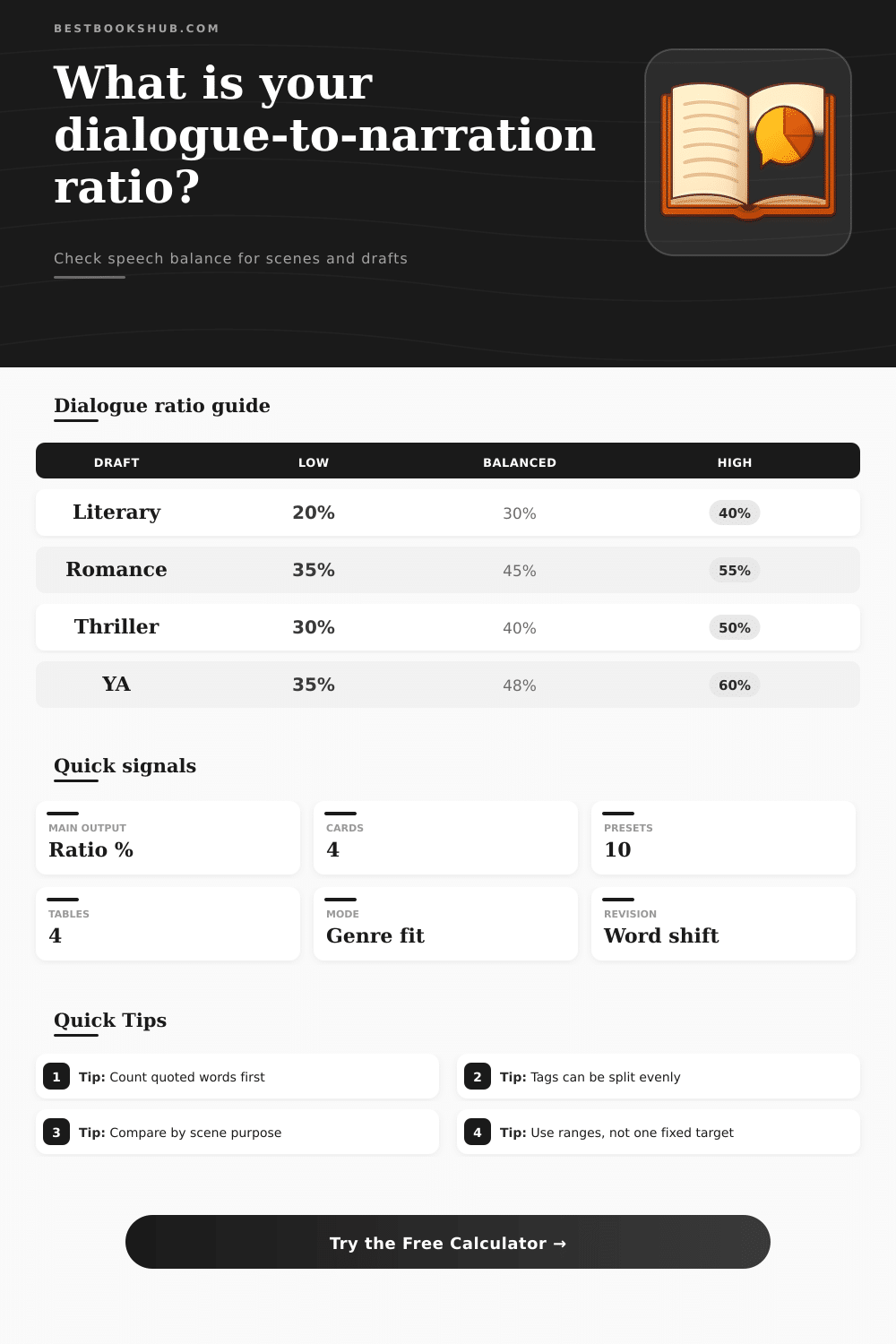
| Shelf | Typical dialogue range | Balanced midpoint | Ratio signal |
|---|---|---|---|
| Literary fiction | 20% to 40% | 30% | Voice, interiority, and image often carry more weight. |
| Romance | 35% to 55% | 45% | Dialogue often carries chemistry, conflict, and reveals. |
| Thriller | 30% to 50% | 40% | Short exchanges can keep pressure high between action beats. |
| Mystery | 30% to 50% | 40% | Interviews, clue reveals, and misdirection often raise speech share. |
| Young adult | 35% to 60% | 48% | Voice-led scenes commonly mix quick speech with close thought. |
| Fantasy epic | 20% to 40% | 30% | World detail and travel narration may lower dialogue share. |
| Memoir | 10% to 30% | 20% | Reflection and recollection often dominate quoted exchange. |
| Middle grade | 40% to 65% | 53% | Fast exchanges and clear scene goals can support younger pacing. |
Narration-led
Below 25% dialogue often reads reflective, descriptive, or summary-forward unless the scene goal is tightly active.
Balanced scene
DISCLOSURE: This post may contain affiliate links, meaning when you click the links and make a purchase, I receive a commission. As an Amazon Associate I earn from qualifying purchases.
About 30% to 50% dialogue usually gives speech room while preserving setting, thought, and movement.
Dialogue-led
Above 50% dialogue often feels fast and conversational, but may need beats to avoid floating voices.
Script-like
Above 65% dialogue can work for arguments or reveals, but prose scenes may need more texture.
| Text category | Default treatment | Use as dialogue when | Use as narration when |
|---|---|---|---|
| Quoted speech | Dialogue | Always, if it is spoken aloud. | Rarely, unless quoted inside exposition. |
| Dialogue tags | Split | Tags mainly clarify rapid exchanges. | Tags carry rhythm or viewpoint emphasis. |
| Action beats | Split | Beats replace tags inside spoken exchange. | Beats develop blocking, mood, or setting. |
| Interior monologue | Narration | Only if formatted as direct inner speech. | Most close-POV thought and reflection. |
| Summary exposition | Narration | Almost never for ratio work. | Scene setup, history, transitions, and context. |
| Ratio problem | Likely reader effect | Revision move | What to recheck |
|---|---|---|---|
| Dialogue below range | Scene may feel distant or summarized. | Convert key exposition into spoken conflict or discovery. | Speech should reveal pressure, not repeat facts. |
| Dialogue above range | Scene may feel under-staged or weightless. | Add beats, sensory grounding, and close-POV reaction. | New narration should change emotional context. |
| High tags, low beats | Conversation may feel mechanically labeled. | Replace some tags with character-specific action. | Speaker clarity must remain clean. |
| High thought, low speech | Character desire may stay private. | Externalize a choice, question, refusal, or confession. | Dialogue should shift the scene outcome. |
| High exposition | Pacing may pause before the scene turns. | Move context into conflict, object detail, or active decision. | Essential context should still be understandable. |
| Scene purpose | Useful dialogue share | Narration role | Ratio caution |
|---|---|---|---|
| Argument or confession | 45% to 70% | Track emotional turns and physical stakes. | Too many beats can drain urgency. |
| Discovery or investigation | 30% to 55% | Frame clues, silence, and interpretation. | Questions can become repetitive without action. |
| Travel or transition | 10% to 35% | Compress movement, time, and world detail. | Low dialogue is fine if something changes. |
| Interior reckoning | 5% to 30% | Carry memory, decision, and self-deception. | Anchor reflection with concrete scene texture. |
| Group scene | 40% to 65% | Prevent talking-head confusion with staging. | Speaker tags and beats need clean rhythm. |
If you’re writing a novel, it might worry you that all your pages look like every other one on top. Maybe there is big globs of narrative text, which tend to glaze over eyes of readers. Or maybe there are frenetic lines of quoted material with nowhere to anchor them. It seems wrong, but as a writer you’ll intuit something about what’s wrong, rather than pinpointing exactly why.
Once you enter those word counts into the dialogue-to-narration ratio calculator, it crunch the numbers for you. You don’t have to squint at page, guessing at its visual heft versus pacing. Just settle whether or not to let more dialogue or description/thought carry your manuscript.
How to Check Your Story’s Balance
But what do we mean by dialog? That’s where the twist comes in. As most writers measure it, only what falls within quotation marks is counted. That isn’t even half the picture. Because every element has a specific function for reader, the tool encourages you to parse out dialogue, exposition, interior monologue and action beats.
Who says what (tags: he said/she asked) act as functional glue that helps readers keep track. Action beats, like pouring coffee or shifting in a chair, create rhythm and anchor physical world. When you pile all of those into one dialogue bucket, you may think your ratio look good, but your scene remains flat. Breaking them down will show if there’s too little action and too many labels… Or vice versa.
This also takes into account genre expectations: when a reader picks up a book on this shelf, they have a certain mental model for what the story will contain. Romance readers expect quick back-and-forth conversation that drives both conflict and chemistry, lots of dialogue is normal. In literary fiction, the focus is frequently on voice and inner thoughts, long passages of narration aren’t just fine, they’re expected.
So when your sample gets plugged in, the calculator checks how much of your text falls within those typical ranges. It’s not suggesting you must follow strict rules, only that you shouldn’t be causing the reader to get fatigued by veering off track. If your thriller has 20% dialogue and feels more like a memoir, then the pressure cooker effect seeps out of the page. On the other hand, if your literary essay sounds script-like, perhaps it’ll seem undisciplined instead of lively.
Most revisers trip up in the grey area of tags and beats. Do we count tags? No, some say. They are invisible. Tags brings in much-needed cadence, others counter. The calculator lets you classify them as dialogue support, narration, or even split them evenly. Go ahead. The point isn’t so much which you select, but that you select the same way each time through a chapter you’re auditing.
It’s consistency, or lack thereof, that makes pacing seem erratic though an individual reader can’t say exactly why this chapter dragged. One scene counts beats as narration, another as dialogue… your data lies to you. Pick a lane and stay there for apples-to-apples comparisons.
Under-staged scenes tend to have a high percentage of dialogue. There’s nothing more tiring than listening to voices floating in a white void. When characters reacts and bring other senses into play, we’re grounded in the physical world again. Scenes with low dialogue percentages is likely the victims of summary creep. Instead of watching events happen, writer told us about them.
This shows you roughly how many words you need to move from one category to the next to reach your midpoint target; it is a good compass, not an absolute destination. It’s possible you find that your first chapter reads more like a block of explanation, whereas your climax feel heavy with dialogue. This may be totally okay; in fact, it may signal that you’re using varying textures as the scenes call for them. You want to give an argument room to play out, to have its conversation spread. But transitions and traveling sequences benefits from narration to shorten details and time.
We seek variation from moment-to-moment, but it is intentional: it serves the emotional requirements of the moment. Balance isn’t static; it’s dynamic. But in the end, it’s a way of diagnosing pacing problems that would never show up on a first read through. It transforms worrying into actionable data.
If a scene feels dragged out, you might find it helpful to check if you have lost trust in the characters to say what they need to say in their own voice. Or maybe you forgot to leave them space to think the rest between the lines. The numbers won’t write your book for you, but will point out spots where engine’s overheating, or where it’s cooling off too much. Once you adjust the ratio, the next steps are how you make the words sing.