📖 Fiction dialogue analyzer
Dialogue Tag Frequency Counter
Paste a fiction excerpt to count said, asked, replied, and expressive tags; measure dialogue lines, tag density per 1,000 words, repeated tag alerts, speaker balance, and action beat ratio.
The counter scans the whole excerpt, then gives extra weight to tag verbs near quoted dialogue. Speaker balance is inferred from simple names beside tags, so treat it as a revision signal rather than a final attribution map.
DISCLOSURE: This post may contain affiliate links, meaning when you click the links and make a purchase, I receive a commission. As an Amazon Associate I earn from qualifying purchases.
Dynamic tables update from your excerpt. Static reference tables give revision bands for tag density, speaker balance, and action beat mix.
| Rank | Tag verb | Count | Density | Signal |
|---|
| Speaker | Inferred lines | Share | Balance note |
|---|
| Alert type | Finding | Severity | Revision cue |
|---|
| Revision metric | Lean range | Balanced range | Watch point |
|---|---|---|---|
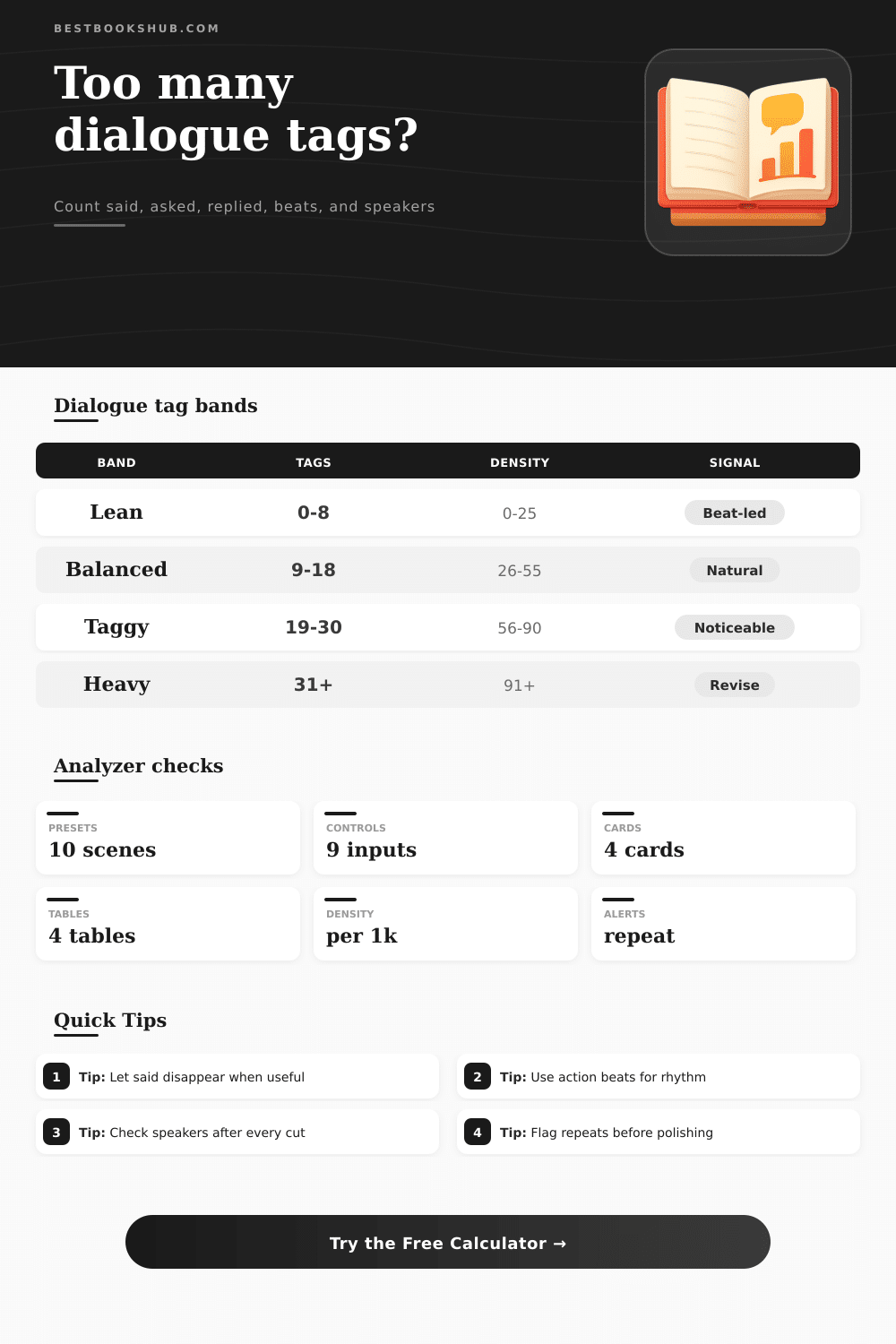
| Tags per 1,000 words | 0-25 | 26-55 | Above 90 can sound tag-heavy. |
| Tags per dialogue line | Under 35% | 35%-65% | High ratios may explain too much. |
| Action beat ratio | 15%-30% | 31%-60% | Too many beats can slow exchanges. |
| Top speaker share | Under 55% | 55%-65% | Above your limit may skew a scene. |
| Family | Examples | Best use | Common risk |
|---|---|---|---|
| Neutral attribution | said, asked, replied | Clarity without drawing attention. | Too many in short back-and-forth lines. |
| Volume or tone | whispered, shouted, murmured | When sound level truly matters. | Can duplicate what the dialogue implies. |
| Emotion-heavy | snapped, pleaded, demanded | Sharp turns or conflict beats. | Can overdirect the reader's reaction. |
| Explanation tags | explained, added, continued | Longer exposition or group scenes. | May signal dialogue doing summary work. |
| Action beat swap | turned, folded, reached | Attribution plus movement or setting. | Too many gestures can feel busy. |
Dialogue tag indicate who is speaking in dialogue. Dialogue tag become noticeable to the reader if they are used to frequent or are repetitive. When writers use dialogue tag in a repetitive manner, the reader become focused on the dialogue tags rather than the conversation.
This can be distracting for a reader. Thus, writers must have control over the dialogue tags within their work, as they serve a purpose in the conversation but should not become a distraction for the reader. Writers can use different type of dialogue tags.
How to Use Dialogue Tags and Action Beats
Some of the most common include the word “said,” but some writers may also use other words to indicate how the character is speaking. For example, some writers use words such as murmur, insist, or whisper to show the characters emotions. Many writers often use the word “said” because it is a word that most reader will not focus upon.
However, using descriptive words for dialogue tags can also convey the characters emotions. However, using too many descriptive words or using repetitive words for dialogue tags can make it seem heavily. Thus, if there are a few character in one scene, there will be fewer dialogue tags than if there are many characters in one scene.
Another alternative to dialogue tags is known as action beat. Action beats are the physical movement that the characters make. These can be used to show tension or to set the scene for the story.
They can also provide a break in the dialogue; however, using too many action beats can slow the pace of the story. Another element that writers should consider is known as speaker balance. Speaker balance refer to the number of lines that each character speak in the story.
If one of the characters has many lines of dialogue, but the other characters has few lines, this will create an lopsided scene. This can make the reader skim over the lines of the characters with few lines of dialogue. Thus, writers should check the speaker balance in their scenes to ensure that each character is given an equal opportunity to speak in their conversations.
This will help writers to spot any potential problem that may arise from this imbalance in their scene. Writers can use a calculator to determine the dialogue tag density for specific excerpt from their story. The calculator will perform calculation for the writer.
To use the dialogue tag calculator, the writer should paste the excerpt that they wish to analyze into the calculator. Additionally, the writer can adjust the settings within the calculator to determine how the calculator treats quotation marks and action words. Based off the excerpt that the writer place into the calculator, the dialogue tag calculator will reveal if there are too many dialogue tags within that excerpt.
Furthermore, there is a reference table within the calculator that depict three categories of dialogue tag density: lean, balanced, or heavy. Placing the excerpt into the calculator will reveal which category the excerpt falls into, giving the writer a signal as to the density of the dialogue tags within that excerpt. Writers often make mistake when they attempt to manage their dialogue tags.
For example, some may attempt to show variety in their dialogue tags by using too many synonyms for the same action. However, this will make the dialogue tags very noticeable to the reader. Another mistake that many writers make is the removal of all dialogue tags from their story.
While this may sound appealing to some writers, it can often leave the reader lost as to which character are speaking. Thus, the best method for most writers is to use a few dialogue tags and use action beats for the remainder of the dialogue. Additionally, writers should of check the speaker balance within their scene when they are writing it, rather than at the end of their draft when it may be more difficult to balance the characters speaking opportunities.
The goal for writers regarding dialogue tags and action beats is not to have zero dialogue tags or to have all characters have the same number of lines in their scenes. The goal for dialogue tags and action beats is simply to ensure that the readers can follow the characters voices without focusing upon the dialogue tags and action beats. Thus, if the writer uses dialogue tags and action beats correctly, the writer will succeed in their goal for the scene.